When a pope stands inside the Élysée Palace, France’s seat of executive power, and tells the president to his face that a nation cannot legislate its way past its duty to protect human life, he is not merely offering pastoral commentary. He is stepping into the oldest fault line in French public life — the line between the Republic’s insistence on secularism and the Church’s claim to speak on matters of conscience — and doing so on French soil for the first time in nearly two decades.
Key Points
- Pope Leo XIV made the first papal state visit to France in roughly 18 years, arriving September 25, 2026, and meeting President Emmanuel Macron at the Élysée Palace.
- In his address there, he delivered a forceful rebuke of France’s assisted-dying legislation, along with abortion and surrogacy, urging French leaders to defend “every human life”.
- The following day he celebrated an open-air Holy Mass at Place de la Concorde and along the Champs-Élysées, with the Vatican estimating roughly 700,000 attendees against nearly 600,000 pre-registrations.
- The trip continued to Lourdes and Metz, both major Marian pilgrimage sites, rounding out a four-day journey through the country’s Catholic heartland.
- French bishops reported the visit coincided with a documented surge in adult conversions, complicating the narrative of France as an irreversibly post-Christian nation.
A Landmark Visit to a Nation That Wrote Secularism Into Its Constitution
France’s relationship with the Vatican has always been formal, correct, and cautious. The country’s 1905 law separating church and state remains a foundational text of French civic identity, and no pope had made an official state visit since Benedict XVI in 2008 — itself the first in nearly two decades before that. Pope Leo XIV’s arrival on September 25, 2026, therefore carried weight beyond the liturgical calendar. It signaled the Vatican’s judgment that France, often cited as Exhibit A for European de-Christianization, remained a country worth a head-of-state-level visit, with a program that pointedly paired political engagement — Macron, the Élysée, European unity — with public devotion on a scale the country had not seen in a generation.
That pairing was deliberate. The itinerary, published by the Vatican months in advance, placed a visit to survivors of clerical abuse, a meeting with the Provincial Synodal Assembly, and an address to political leaders alongside two of the largest public liturgies of Leo’s papacy to date. The message embedded in the schedule itself was that the Church intended to speak to both the state and the street.
The Élysée Palace Address: Assisted Dying Named Directly
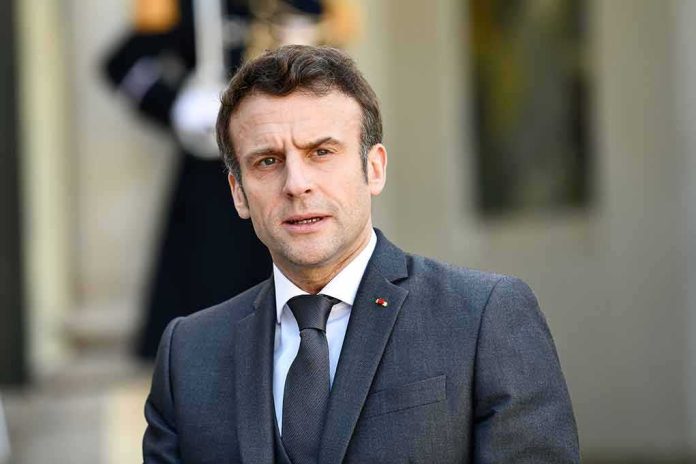
The visit’s sharpest political moment came not at the Mass but at the presidential residence itself. According to OSV News, Pope Leo XIV used his remarks at the Élysée Palace to urge French leaders “not to forget their duty to protect every human life,” delivering what the outlet described as “a forceful speech… condemning ‘assisted dying,’ abortion and surrogacy”. France has moved in recent years toward legalizing a regulated form of assisted dying, a policy trajectory that places it alongside neighbors such as Belgium and the Netherlands and that the Vatican has consistently opposed on the grounds that it redefines medicine’s obligation to the vulnerable. Delivering that objection inside the Élysée, in Macron’s presence, rather than confining it to a homily, was itself the news: it took a doctrinal disagreement out of the pulpit and put it directly in front of the officials who write the statute.
This is consistent with a pattern in Leo XIV’s public statements since his election — a willingness to press bioethical concerns in venues of secular power rather than exclusively ecclesial ones, treating end-of-life law, reproductive policy, and surrogacy as a single connected argument about human dignity rather than three separate culture-war fronts.
Place de la Concorde: A Square With Its Own History
The Mass itself took place at Place de la Concorde, the square where Louis XVI was guillotined during the Revolution and where, symbolically, the modern secular French state announced its break from throne-and-altar governance. Holding a papal Mass there, with crowds stretching the length of the Champs-Élysées, was not incidental staging; it placed a religious rite at the exact geographic point where France once executed its claim to have moved past religious authority. Archbishop Laurent Ulrich of Paris greeted the pope and presented him with a restored image of the Virgin Mary reconstructed from photographs of the original lost in the 2019 Notre-Dame fire — a gesture tying the day to the cathedral’s ongoing recovery. In his homily, delivered in French, Leo XIV drew on the Gospel image of “living water” to speak to what he called humanity’s existential thirst, invoking early French martyrs Blandina and Pothinus alongside modern figures like Vincent de Paul.
🇫🇷 I’ve been hearing for years that EUROPE is becoming post-Christian, which makes those images from PARIS this weekend especially beautiful.
Around 800,000 PEOPLE came to see Pope Leo XIV celebrate Mass at Place de la Concorde, with the turnout becoming SO LARGE that… pic.twitter.com/Toxw5q57i2
— Mario Nawfal (@MarioNawfal) September 26, 2026
How Big Was the Crowd, and Why the Numbers Move
Reported figures for the Mass ranged from the Diocese of Paris’s nearly 600,000 registrations to the Vatican’s own estimate of roughly 700,000 attendees, with Reuters citing an estimate as high as 800,000. That spread is not a red flag; it reflects how outdoor, non-ticketed religious gatherings are always measured — through aerial imagery, density modeling across sectioned zones, and organizer registration data rather than turnstile counts. Large papal Masses have historically produced similarly wide ranges, and estimates here track closely with what organizers projected in the weeks beforehand, when French authorities themselves forecast around 600,000 attendees. The consistent takeaway across every source is scale: this was among the largest public religious gatherings France has hosted in decades, regardless of which figure within that range one treats as most precise.
What the Visit Signals Going Forward
French bishops used the visit to highlight a less publicized trend: a marked rise in adult conversions and catechumen numbers, cited as part of the visit’s broader coverage. Paired with a crowd of hundreds of thousands willing to stand for hours along a secular boulevard, the visit complicates the tidy assumption that French Catholicism is in terminal decline. Politically, the Élysée remarks put assisted dying, abortion, and surrogacy squarely back into public conversation at a moment when France’s end-of-life legislation continues to move through implementation. Whatever one’s view of the Church’s position, the pope’s decision to state it inside the halls of secular government, rather than only from the altar, marks a notable recalibration in how directly the Vatican is willing to engage a state built on the premise of keeping religion out of its decisions.
Sources:
humanevents.com, apnews.com, thetablet.co.uk, vatican.va, france24.com, euronews.com, lemonde.fr, vaticannews.va, connexionfrance.com, dioceseparis.fr