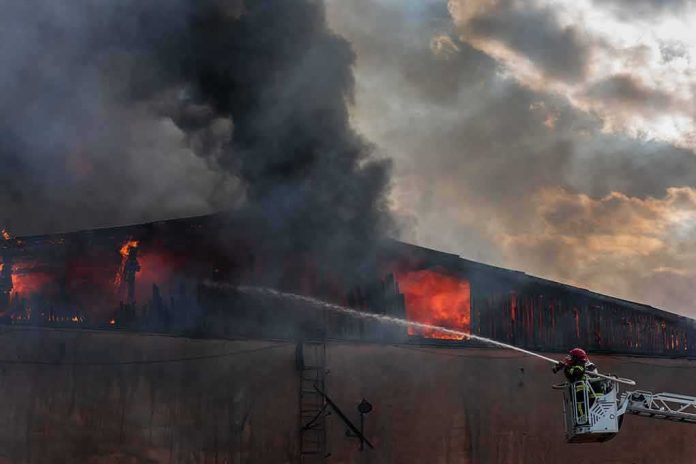
Six months into the Iran war, the center of gravity has shifted from the opening air campaign to an endurance contest that fuses military pressure, maritime risk, and economic coercion—an archetypal modern stalemate in which neither side can impose an endgame, yet both can keep raising the bill for everyone else.
The Short Version
- Reporting characterizes the conflict as a costly stalemate with no clear path to conclusion.
- U.S. and Israeli strikes that began six months ago cascaded into energy-market disruption and higher inflation risk.
- Washington’s strategy now leans hard on sanctions and financial isolation, expanding pressure on Iran’s networks.
- Official U.S. messaging touts large drops in Iranian missile and drone activity, while shipping through Hormuz remains unsettled.
How a short, decisive strike slid into a long, expensive deadlock
Reuters’ late-August reporting is unambiguous on the strategic picture: after six months, the war sits in a costly stalemate and there is no clear route to an endgame. The conflict began with U.S. and Israeli strikes aimed at blunting Iran’s offensive arsenal and deterring its nuclear ambitions, a design that drew on the grammar of modern precision campaigns—decapitate capabilities quickly, then force political concessions. What followed, however, is the pattern familiar from other limited wars: once the initial strike fails to extract a decisive settlement, the confrontation migrates into a grinding mixture of interdiction, proxy activity, and economic statecraft. That is where the Iran war now lives.
The U.S. government has kept up two lines of effort in parallel. Militarily, the early operational thesis—branded as Operation Epic Fury—targeted Iran’s missiles, drones, navy, and defense industry. Official messaging stated that ballistic missile and drone attacks from Iran fell sharply after the initial blows, by 90% and 83% respectively, pointing to a measurable tactical payoff. Politically and economically, Washington then widened the aperture to financial warfare, tightening sanctions and threatening secondary penalties against entities that sustain Tehran’s reach. That pivot signaled a recognition that even degraded military capacity can be offset by resilient financing and logistics networks, many of them transnational.
Energy and finance became the battlefield—and the world is paying for it
When a conflict surrounds the Strait of Hormuz—the chokepoint for roughly a fifth of the world’s crude—the energy market becomes the second front. Six months in, coverage documents a supply chain under stress: shipping risk premia are persistent, tanker routing is more circuitous, and insurance costs and voyage times have climbed. The result is not a singular price shock but a stickier plateau of elevated energy costs that keeps inflation pressure alive and complicates monetary policy.
Reuters’ energy analysis describes a kind of “trench warfare” in markets: no spectacular blowup, but an accumulation of frictions—intermittent shipping disruptions, refinery outages, and region-wide threat dispersion into the Red Sea and beyond—that holds oil near higher ranges than pre-war models anticipated. Some mitigating factors, especially demand-side adjustments by major importers, have tempered worst-case scenarios; but the system is operating with tighter buffers and more volatility channels than before. That matters for everyone from household budgets to central banks and heavy industry.
What Washington tried to achieve—and what it actually changed
The White House described Epic Fury as a campaign designed to crush Iran’s offensive capacity and lock in a ceasefire, articulating three discrete military objectives and claiming they were met in early April. In operational terms, U.S. briefings and Defense communications emphasized degraded Iranian naval and air assets, and the sharp decline in attack volumes cited by the Pentagon remains a central metric of effect. That said, Reuters’ portrait of late August shows a theater still contested: maritime traffic through Hormuz is disrupted, risk remains elevated, and the war persists as a live factor in global markets and regional security behavior. Both statements can be true—tactical suppression and strategic stalemate often coexist when an adversary can reconstitute enough capability to impose costs without regaining dominance.
On the non-kinetic axis, Treasury’s posture demonstrates the second act of U.S. strategy. As the war crossed the six-month mark, the department announced broadened measures against Iranian-linked financial channels—what officials framed as an onslaught against the connective tissue that keeps procurement, payrolls, and proxy support running. Secondary sanctions—the threat to punish third-country institutions that transact with designated Iranian entities—are the critical lever here. History suggests they can be potent over time, but they also redistribute risk into global finance, shipping, and compliance, which is why the escalation path is calibrated rather than maximalist from the outset.
Hormuz and the geography of leverage
The contest over Hormuz is less about who can blockade the strait absolutely and more about who can make it costly enough, long enough, to change behavior. Official U.S. statements have referenced mine clearance and maritime-security operations; meanwhile, Reuters continues to describe shipping as severely disrupted at points along the six-month timeline, underscoring that passage is possible but burdened. For Iran, the ability to keep risk premium alive—through threats, sporadic interdiction, or proxy activity—sustains bargaining power disproportionate to any single engagement. For the United States and partners, keeping lanes functionally open, even if constrained, is the minimum condition for preventing an energy shock that would ripple far beyond the region.
Why stalemate is not stasis
“Stalemate” does not mean nothing changes; it means no change is decisive. Over six months, the correlation of costs has evolved. Iran has absorbed strikes and sanctions yet continues to project risk into maritime corridors. The United States has demonstrated it can suppress attack rates and damage military infrastructure while translating the fight into finance. Each move entails adaptation by the other side and, crucially, by neutral market actors—from insurers to refiners—whose responses shape the real-world impact of each policy stroke. This is why large declarative goals (destroy capability, force compliance) tend to soften into iterative management goals (reduce attack frequency, raise the cost of evasion, stabilize shipping enough for commerce to limp through).
Six months into Trump's #OperationEpicFailure
18 Americans dead.
750+ wounded.
50,000 troops still in harm’s way.$37.5B+ spent on his war with Iran.
Tens of billions more requested.
$132B already taken out of American pockets.He promised NO NEW WARS and to make life more… https://t.co/KQyiyiSv5e
— Morgan J. Freeman (@mjfree) August 28, 2026
What to watch in the months ahead
First, sanctions implementation and enforcement. The breadth and bite of secondary sanctions—especially against nodes in the Middle East, Asia, and maritime services—will determine whether Tehran’s workarounds remain sustainable or become too expensive to scale. Second, maritime risk normalization. If convoying, minesweeping, and layered air-defense patrols can drive down insurance costs and transit delays, the energy “trench” could shallow, easing inflation pressure even without a formal settlement. Third, attack-rate dynamics. If the Pentagon’s claimed reductions in missile and drone activity persist or deepen, the space for coercive diplomacy widens; if they reverse, expect recalibration in both operational tempo and sanctions posture. Finally, political calendars on all sides will matter. Protracted costs without a narrative of progress are hard to sustain; conversely, an adversary betting on fatigue must preserve enough capability to keep pressure credible without inviting escalatory blowback.
Bottom line
Six months on, the war’s logic is no longer about dramatic breakthroughs; it is about the arithmetic of pressure, adaptation, and endurance. The evidence supports a clear judgment: Washington and Tehran both retain meaningful leverage, and neither has found a way to translate it into a definitive settlement. In that space, markets serve as the barometer—imperfect but honest—of who is actually winning the contest that matters most right now: who can raise costs for the other side faster than those costs compound at home and across the global economy.
Sources:
theamericanconservative.com, reuters.com, en.wikipedia.org, whitehouse.gov, war.gov, aljazeera.com