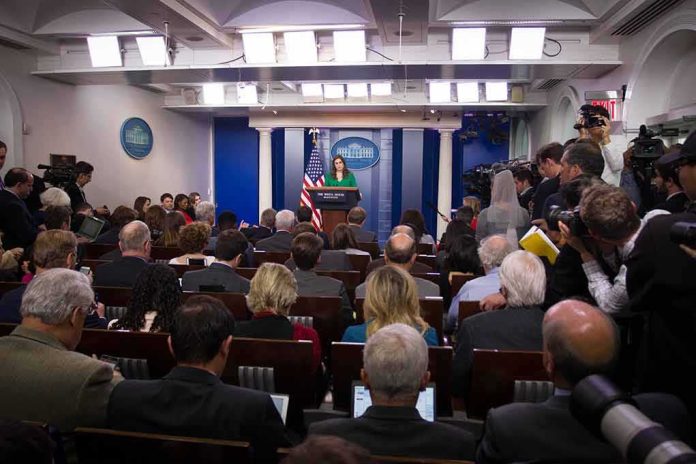
When a White House bars named outlets from its briefing rooms and press pools because of their coverage, it is not merely a spat with reporters; it is an assertion of power over the information architecture that connects the presidency to the public.
At a Glance
- President Trump announced a ban on CNN, MSNOW/MSNBC, and Politico from White House access, explicitly tying the move to their coverage as “fake news.”
- The action fits a recurring pattern of using press access as leverage against unfavorable reporting.
- Federal courts have repeatedly held that once the White House opens specific spaces to the press, viewpoint-based exclusion is constitutionally suspect.
- Recent litigation over Associated Press access underscores the conflict between executive control of venues and the First Amendment’s bar on retaliation for editorial viewpoint.
What the White House did and why it matters
President Trump said he was “banning” CNN, MSNOW/MSNBC, and Politico from the White House, effective immediately, and linked the decision to what he called persistent false or unfair coverage. The announcement came via a social media post, with the president accusing the outlets of “reporting fake news” and signaling that more bans could follow. Multiple outlets carried the statement and its rationale in real time, and none reported a competing factual account of what the president said he would do.
The stakes are not symbolic. Access to the briefing room, pooled sprays in the Oval Office, and controlled events in the East Room are the conduits through which the public sees and queries the presidency. Excluding specific organizations because of their reporting choices is not just a scheduling preference; it is a content-based gate on who gets to witness, question, and distribute primary information from the seat of executive power.
How White House press access actually works
White House access is a hybrid of discretion and law. The government controls physical spaces and sets security protocols; there is no free-floating constitutional entitlement to roam the West Wing. But the picture changes once the government opens designated venues to journalists as a class. Decades of D.C. Circuit doctrine make two points clear: the press has no special right to enter places closed to the public, and the government may not, once it has opened specific forums to reporters, deny access arbitrarily or because of a journalist’s viewpoint or content.
Court decisions analyzing White House venues treat them as “nonpublic forums,” a term of art meaning the government can impose reasonable, content-neutral rules but cannot discriminate based on viewpoint. That line has real bite: when the administration excluded the Associated Press from press pool opportunities because of editorial wording in coverage, a federal judge ordered AP’s access restored, explaining that doors opened to some journalists cannot be shut to others as retaliation for their speech.
The legal fault lines: discretion versus the First Amendment
The governing tension is straightforward. The executive branch argues that credentialing, site security, and event management are core operational prerogatives. Courts agree up to the point of neutrality. The First Amendment limit arrives when exclusion maps onto content or viewpoint—punishment because an outlet asked adversarial questions, chose a disfavored descriptor, or published critical reporting. In those circumstances, federal judges have framed the problem as unconstitutional retaliation and viewpoint discrimination under settled circuit precedent.
The AP litigation illustrates both halves of that equation. The district court’s order reinstating AP’s access relied on the “open the door to some, cannot bar others for their viewpoints” rule; later appellate maneuvering complicated the immediate remedy but left the underlying constitutional stakes unavoidable in any repeat attempt to weaponize access rules against disfavored coverage.
Historical pattern and contemporary resonance
Conflicts between presidents and the press over access are not new, but the current pattern is unusually explicit about linking punishment to perceived bias. Scholars have termed this “access retaliation”: using managed access to reward favorable coverage and penalize adversarial journalism. In practice, these fights often turn on granular questions—Is the venue a generally opened press space? Was the exclusion targeted at an outlet’s viewpoint?—but the through-line remains: once the White House has established a system of regularized access, viewpoint-based carve-outs are constitutionally vulnerable.
That is why announcements that characterize bans as a response to “fake news” trigger legal scrutiny. The rationale is not framed as a security, capacity, or process rule; it is framed as a judgment of the content and credibility of speech. Federal courts have repeatedly said the First Amendment forbids officials from imposing sanctions on speakers because of their protected expression, even in nonpublic forums where the government’s control is otherwise broad.
Practical implications for the press corps and the public
Operationally, a targeted ban can unravel the logic of pooled coverage. The press pool exists so that, in tight spaces or high-security moments, a rotating subset attends, asks questions, and shares raw material with the entire corps—conservative, liberal, legacy, digital. Selectively excluding organizations based on their reporting undermines that collective mechanism and fractures the shared evidentiary base that enables independent outlets to verify what occurred in the room.
For the public, the consequence is narrower than “media grievance” and broader than “who sits where.” The more a White House normalizes viewpoint-based access, the more the informational flow around the presidency becomes a function of favor, not rule. That dynamic amplifies polarization: audiences end up consuming filtered accounts validated by access rather than contested accounts shaped by open questioning. Constitutional doctrine guards against that slide not to privilege journalists as a guild, but to preserve an adversarial information market in which government cannot condition vantage point on deference.
What to watch next
The next steps will likely track familiar phases. First, practical implementation: whether credentials are revoked, physical entry is denied, or pool rotations are altered. Second, formal challenge: targeted outlets or press associations often seek injunctive relief, arguing retaliation and viewpoint discrimination under D.C. Circuit law. Third, judicial sorting: courts ask whether the affected venues are generally open to the press, whether the rule is neutral and reasonably applied, and whether the government’s stated rationale is operational rather than editorial. When the rationale is tied to alleged “fake news,” the constitutional defense historically weakens.
Sources:
livenowfox.com, chicagotribune.com, thegatewaypundit.com, jpost.com, kfgo.com