
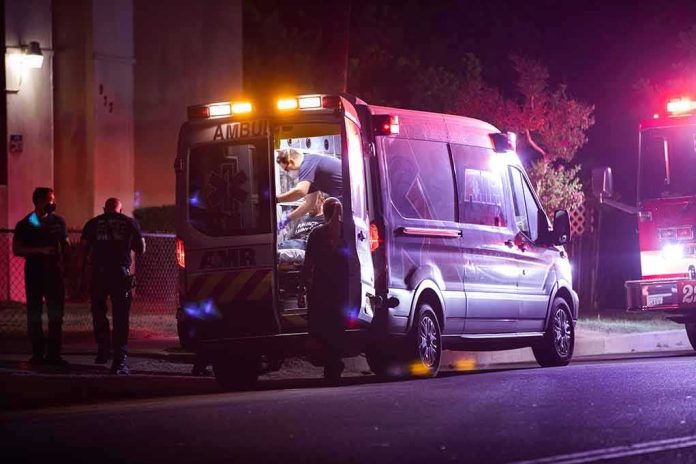
A single, brutal fact sits at the center of this incident: a vehicle-ramming at the Maccabim checkpoint on Route 443 left Neriah (Neria) Leiter — the son of Israel’s ambassador to the United States, Yechiel Leiter — critically wounded, and the assailant dead at the scene. Everything that matters flows from that.
At a Glance
- Authorities and multiple outlets report a vehicle-ramming at the Maccabim checkpoint/Beit Horon area on Route 443.
- The victim is identified as Neriah (Neria) Leiter, son of Ambassador Yechiel Leiter; he was evacuated in critical condition to Shaare Zedek Medical Center in Jerusalem.
- Israeli forces shot and killed the alleged attacker at the scene; he has been publicly named in reporting.
- Officials and media characterize the incident as a terror attack, consistent with a broader pattern of vehicle-ramming in recent years.
What Happened at the Maccabim Checkpoint
On Route 443 near the Maccabim checkpoint by Beit Horon, a vehicle-ramming attack seriously injured Neriah (Neria) Leiter, the son of Israel’s ambassador to the United States, Yechiel Leiter. Reporting is consistent on the core elements: the location, the violent mechanism — a vehicle striking personnel at or near the checkpoint — and the immediate security response that ended with the assailant shot and killed on site. Emergency responders transported Leiter to Shaare Zedek Medical Center in Jerusalem, where he arrived in severe condition. Multiple outlets identify the victim by name and family relation, aligning with contemporaneous updates from Israeli media and international broadcasters.
Israeli defense and police sources framed the event as a terror attack or suspected terror attack within minutes, language mirrored across national outlets. Magen David Adom’s emergency hotline reportedly registered the call at 4:54 p.m., marking a clear dispatch timestamp into the medical response record. While some descriptions diverge on whether the vehicle first struck a pedestrian, a guard, or a patrol vehicle, they converge on the operational facts: a vehicle drove aggressively into the checkpoint area, at least one Israeli was gravely injured, and the driver was neutralized by security forces at the scene.
The Victim, the Assailant, and the Response Timeline
The victim, identified as the ambassador’s son, is variously described in coverage as a reservist, soldier, or security/guard personnel, which often reflects the speed and sourcing of early reports rather than a substantive contradiction; in all accounts, he was on or adjacent to official duty space at Maccabim when he was struck. He was sedated and placed in intensive care following transfer to Shaare Zedek. The alleged attacker has been named in multiple reports as a 29-year-old man — identified as Muhammad (or Mahmoud) Mahmoud Suleiman — from the town of Beit Ur al-Tahta, a short drive from the checkpoint. Israeli forces shot him at the scene, with media consistently reporting his death there.
Surveillance footage reportedly captured the incident, a common feature at fortified crossing points like Maccabim, which blend anti-ram bollards, serpentine lanes, and layered observation designed to slow vehicles and create reaction time for guards. While media reference to the footage exists, the most important public-facing facts here do not depend on it: one critically injured Israeli and a dead assailant, with the act described by authorities as terrorism based on the manner, target, and context of the attack.
Why Checkpoints Are Targets for Vehicle-Ramming
Vehicle-ramming is a low-tech, high-impact tactic: a driver accelerates a common vehicle toward soft targets or installations, translating mass and speed into trauma before defenders can interpose barriers or fire. In Israel and the West Bank, the tactic surged during the mid-2010s; scholarly and policy analyses have documented that ramming moved from rare to recurrent, capitalizing on ubiquity (vehicles are everywhere), simplicity (no complex logistics), and the psychological aftershock that accompanies attacks on everyday infrastructure and security nodes. In aggregate datasets, vehicle-ramming is a recognized and durable method in the region’s threat landscape.
Checkpoints concentrate both symbolic and tactical value. They embody the conflict’s daily frictions — identity verification, movement control, weapons interdiction — and they draw predictable patterns of security staffing and temporary traffic queues, which an attacker can exploit for surprise and momentum. Physical countermeasures reduce but cannot eliminate the risk; a determined driver, particularly in a mixed-traffic environment without heavy standoff, can reach lethal speeds in seconds. The Maccabim/Route 443 geometry — a main artery linking coastal Israel with Jerusalem-area settlements and Palestinian towns — creates precisely the kind of interface where defenders must keep commerce flowing while bracing for sporadic, high-energy assaults.
How This Case Fits a Broader Pattern
The official characterization of this incident as terrorism tracks with years of incident data and doctrine. Security services classify vehicle ramming as a form of intentional assault — not a traffic event — when motive, behavior, and post-impact actions align: rapid acceleration into controlled space, steering toward personnel, and absence of evasive or corrective maneuvers. Policy literature notes the global diffusion of this tactic and its specific recurrence in Israel and the West Bank, where it has been used alongside shootings and stabbings as part of a shifting repertoire of small-unit and lone-actor violence. Analysts have quantified the trendlines and lethality, underscoring why checkpoint posture, lane hardening, and quick-react firing sectors remain central to force protection.
The seriousness of the injuries in this case — immediate ICU admission, sedation, and critical status — is consistent with blunt-force trauma typical of ramming: polytrauma involving head injury, thoracic compression, extremity fractures, and internal bleeding. The evacuation path to Shaare Zedek reflects established trauma-routing norms for Jerusalem, where rapid surgical intervention can change survivability curves in the first hour post-impact. Reporting from multiple outlets placed Leiter in serious or critical condition on arrival, aligning with that clinical picture.
🔴 BREAKING: Israel’s ambassador to the United States, Yechiel Leiter, says medical teams are fighting to save his son’s life after he was seriously injured in a car-ramming attack in the occupied West Bank. pic.twitter.com/ROcIKP8SNk
— Profesa Ochieng Odongo (@OchiengOdongoKE) September 23, 2026
Consequences and the Road Ahead
Three implications follow. First, this attack reaffirms why Israeli security planning treats roadway checkpoints as active threat environments, not administrative tollgates. Expect additional hardening — more bollards, reinforced lane geometry, increased overwatch — and operational drills emphasizing vehicle interdiction in split-second windows. Second, the diplomatic overlay is unavoidable: the victim’s family tie to Israel’s ambassador to the United States means ministries in Jerusalem and Washington will track medical updates and security posture closely, even as the case remains operationally local. Third, the information environment around such incidents can conflate details — the precise target struck, the victim’s on-duty role — but those variances do not alter the core outcome: a deliberate, high-energy attack and a life-threatening injury.
Sources:
pjmedia.com, fr.jpost.com, ua.news, jfeed.com, jewishpress.com, jpost.com, vinnews.com, x.com, israelnationalnews.com, etheses.whiterose.ac.uk, ctc.westpoint.edu