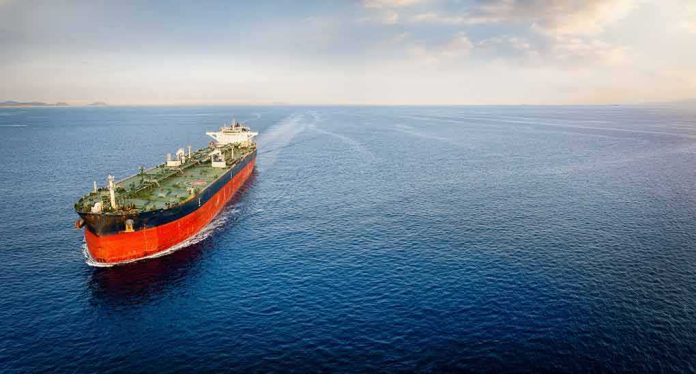
Iran is loudly claiming the Strait of Hormuz is “closed,” even as U.S. data shows oil and cargo still slipping through a fragile, high‑risk corridor.
Story Snapshot
- Iranian commanders say they have shut the Strait of Hormuz, but U.S. Central Command reports dozens of ships still transiting under American protection.
- Automatic ship-tracking data and market reports show crude oil exports continuing through an Omani-side lane, even as traffic stays far below normal levels.[4]
- A shaky U.S.–Iran ceasefire and back-channel talks have reduced open fighting but left a dangerous “gray zone” where Tehran tests how far it can control a vital global chokepoint.[1][3]
- Any renewed shutdown would fuel higher energy prices at home and hand more leverage to an anti-American regime that has long threatened U.S. allies and shipping.[7][8]
Hormuz “Closure” Claims Clash With Tankers Still Moving
U.S. Central Command says 55 merchant ships, including tankers carrying more than 17 million barrels of oil, moved safely through the Strait of Hormuz the same day Iran’s Revolutionary Guard-linked media announced the waterway was “closed.”[4] Bloomberg ship-tracking data backs this up, showing at least five loaded crude tankers using the southern lane near Oman, then briefly going dark on their tracking systems before reappearing safely in the Gulf of Oman.[4] That pattern suggests ships are still moving, but under heavy risk and military escort, not normal peacetime conditions.
Market intelligence firms also report that total crossings jumped into the dozens in the days after a U.S.–Iran interim peace deal lifted Washington’s naval blockade and signaled “free passage” on the Omani side.[4] One analytics note cited by ZeroHedge described 71 confirmed transits over a three-day window, with a single-day peak of 35 crossings, as shipowners cautiously tested the new security environment.[4] Even so, these volumes remain far below prewar norms, when roughly 100 to 135 vessels could pass daily, underscoring that Hormuz is open only in a very limited, stressed way.[19]
Reality On The Water: Open, Restricted, Or Effectively Closed?
Strategic studies groups say Hormuz today looks less like a classic, legally declared blockade and more like a “de facto” or partial closure, where fear, mines, and toll threats throttle traffic without a formal shutdown.[2] The Center for Strategic and International Studies estimates that since early March, commercial flows have been at a fraction of their old levels, with hundreds of tankers stranded and only a small group of ships from a few countries making it through under special conditions.[15] World Trade Organization data shows outbound crude, liquefied natural gas, and fertilizer cargoes down roughly 95 to 99 percent compared with normal months, which is functionally a near-stop for many key exports.[16]
Encyclopedia and United Nations reporting describe a similar pattern: legally the strait has “never been truly closed,” but in the 2026 war, credible Iranian threats, attacks, and suspected mines cut traffic by more than 95 percent and produced the largest oil supply shock ever recorded.[17] A United Nations shipping brief notes roughly 2,000 vessels and up to 20,000 seafarers trapped in the Persian Gulf at one point, unable to exit safely through the narrow strait.[7] In plain terms, a handful of ships may still move with escorts or special deals, but for most commercial players, Hormuz has become a dangerous, politicized choke point instead of a predictable global commons.
Iran’s Leverage Game And What It Means For American Families
Policy analysts warn that Tehran is trying to set a new precedent: access to key sea lanes based on political loyalty, not neutral navigation rules.[3] Reports say Iran’s new “Persian Gulf Strait Authority” is demanding permission and hefty per-transit fees from some vessels, while giving easier passage to ships from partners like China and Russia who align with its agenda.[3][15] At the same time, Western militaries report helping select commercial ships transit the southern, Oman-side corridor, which turns routine shipping into a bargaining chip in larger power politics.[3] United Nations trade experts note that such chokepoint disruptions quickly ripple into higher energy and transport costs across the world economy, including for U.S. consumers buying gas, groceries, and goods that depend on cheap freight.[20]
Fascinating data. Going "dark" (turning off AIS) in the Strait of Hormuz has essentially become the standard operating procedure for commercial shipping lines trying to mitigate transit risks.
— WorldDecoded (@BharatUncovered) June 22, 2026
Conservative energy and security analysts argue this fragile “managed gateway” is exactly what decades of globalist dependence on hostile regimes has produced.[8] Instead of secure domestic production and diverse routes, the world remains hooked on a narrow waterway where an anti-American theocracy can threaten 20 to 25 percent of seaborne oil trade.[20] For American families already squeezed by past inflation and high fuel prices, every Iranian threat or mine rumor can mean another spike at the pump. That is why many see a strong U.S. Navy presence, firm red lines on freedom of navigation, and robust American energy output as non-negotiable if we want to protect both our wallets and our constitutional ability to act independently on the world stage.
International Maritime Information Center: Shipping traffic in the Strait of Hormuz is increasing
‼️‼️‼️‼️‼️‼️‼️‼️‼️‼️‼️‼️‼️‼️‼️
— WW3 Monitor (@WW3_Monitor) June 22, 2026
Sources:
[1] Web – Ship Traffic Through Hormuz Chokepoint Continues As Normalization …
[2] Web – Hormuz traffic shows recovery : r/oil – Reddit
[3] Web – Tanker traffic resumes in Hormuz after Iran deal signed, data shows
[4] Web – eventc10000004 – IMF PortWatch – International Monetary Fund
[7] Web – Iran War Shipping Update – June 4, 2026 | UANI
[8] Web – Tracking data shows vessel traffic through the Strait of Hormuz …
[15] Web – Hormuz Live Vessel Traffic & Crude Oil Prices – ShipFinder
[16] Web – The Strait of Hormuz in 8 Charts – CSIS
[17] Web – Strait of Hormuz Trade Tracker | Data Lab
[19] Web – “This is the first time ever in the written history of the Strait of …
[20] Web – Many of the vessels that passed through the strait were so-called …