
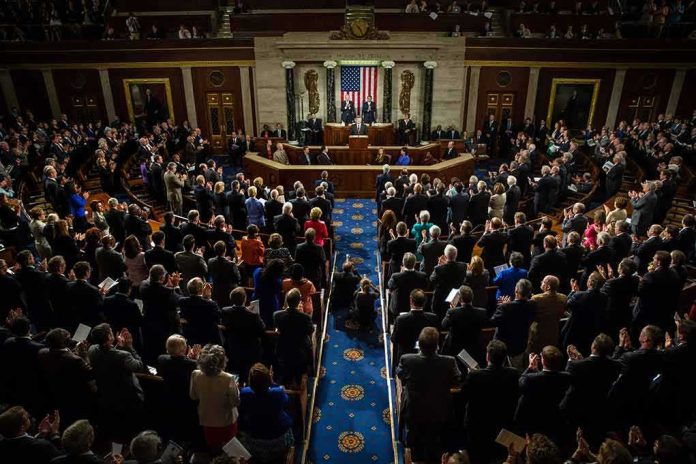
When a single party controls Congress yet still produces the longest Department of Homeland Security shutdown in U.S. history, the story is not about partisan warfare; it is about a governing coalition at war with itself.
At a Glance
- The 44‑day DHS shutdown exposed deep, public rifts inside the Republican Party, not just a clash with Democrats.
- House and Senate Republicans pursued conflicting strategies on ICE and Border Patrol funding, turning a solvable budget dispute into institutional paralysis.
- Speaker Mike Johnson’s shifting stance — rejecting a Senate bill as a “joke,” then accepting a similar framework — amplified the perception of dysfunction.
- The shutdown created real-world stress on TSA, FEMA and other DHS components, illustrating how internal party combat quickly translates into public risk.
- This episode fits a decade-long pattern in which Republican infighting repeatedly drives homeland security funding crises.
From Policy Dispute to Intra-Party Breakdown
On its face, the 2026 DHS funding fight began as a familiar policy clash over immigration enforcement. Senate Republicans, led by Majority Leader John Thune, negotiated for weeks with Democrats and ultimately produced a compromise that funded most of the department through September 30, deliberately carving out Immigration and Customs Enforcement (ICE) and Border Patrol for a separate fight. Thune’s logic was straightforward: reopen airports, pay roughly 50,000 federal workers who were missing paychecks, and postpone the most polarizing enforcement questions.
House Republicans, under Speaker Mike Johnson, rejected that sequencing outright. In televised remarks and interviews, Johnson derided the Senate bill as a “joke” because it excluded ICE and Border Patrol, insisting the House “can’t accept this ridiculousness” and “will not risk not funding the agencies that keep the American people safe.” The House GOP instead advanced its own bill, a 60‑day continuing resolution that fully funded all DHS components, including ICE and Border Patrol, at existing levels. That bill passed the House 213–203, a narrow margin that already reflected internal strain.
Why This Shutdown Became the Longest on Record
The immediate consequence of dueling Republican strategies was deadlock. The Senate moved its compromise by voice vote in the early hours of a Friday; the House passed its competing bill late that same day. With neither chamber willing to accept the other’s approach, Congress went into a two‑week recess, and the shutdown extended. By the time lawmakers returned, DHS funding had been frozen for 44 days, surpassing the previous record-holder — a 43‑day, government‑wide shutdown the prior year — and marking the longest departmental shutdown in U.S. history.
What made this stalemate distinctive was its cause. Analytic pieces across outlets converged on a central diagnosis: the core obstacle was no longer Democrat–Republican disagreement, but open warfare inside the GOP itself. Defense News, looking back to a nearly identical DHS impasse in 2015, had already warned that Republican shutdown tactics were often driven less by stated policy goals than by intra-party maneuvering and election positioning. The 2026 episode followed that script closely; once Senate Republicans cut a deal with Democrats, the center of gravity shifted to House–Senate Republican conflict rather than classic partisan opposition.
Speaker Johnson’s Strategy and its Reversal
For weeks, Johnson defined his position around full, unified DHS funding. He argued that separating ICE and Border Patrol from the rest of the department’s operations would “effectively eliminate DHS funding for this year” and leave key programs like TSA and FEMA exposed. He framed resistance to the Senate bill as a principled stand for comprehensive homeland security, backed by conservative allies who praised ICE and Border Patrol as having done a “phenomenal job” and even described the border as “closed for the first time in history.”
Yet Johnson ultimately accepted a path he had spent weeks denouncing. Under mounting pressure from rank‑and‑file Republicans furious about the political cost of an extended shutdown, and amid reports of Trump’s shifting signals on what deal was acceptable, the House allowed a partial funding package to advance that did not immediately restore full ICE and CBP funding. CNN and Fox News both reported Republicans privately blasting this arrangement as a “s— sandwich,” angry that the leadership had led them into a cul‑de‑sac and then reversed course without securing the enforcement guarantees they had demanded.
That reversal mattered for more than optics. It undermined Johnson’s earlier argument that any bill short of full, immediate ICE/CBP appropriations was an unacceptable risk to public safety. If TSA and FEMA could be funded separately after all, critics asked, why had the House refused that structure when the Senate first proposed it, and at the cost of weeks of shutdown? The inconsistency reinforced the perception that the fight was driven as much by internal ideological positioning and loyalty tests as by a coherent policy or fiscal principle.
The Human and Security Impacts Inside DHS
While Republican leaders argued over legislative strategy, DHS operations absorbed the strain. TSA agents, who cannot simply pause screening at airports, worked without pay, with some reportedly donating plasma or sleeping in their cars to cover basic expenses. Airport delays grew as staffing stress and absenteeism mounted, and media coverage increasingly framed the shutdown not as an abstract budget dispute but as a direct pressure on public safety and infrastructure.
The same dynamic played out across other DHS components. FEMA’s capacity to respond to emerging disasters and the Coast Guard’s readiness were central to arguments for restoring funding quickly, yet their needs were repeatedly used as leverage in a broader showdown over ICE and Border Patrol priorities. The Trump White House attempted to blunt the impact temporarily by directing DHS to reprogram funds to pay TSA agents and promising back pay, but those emergency measures did not resolve the underlying legislative standoff.
Trump’s Role: Signals, Silence, and Conflicting Pressure
Although Republicans controlled both chambers, the party’s de facto leader sat outside the formal negotiations. Reports from Punchbowl News and NBC indicated that Trump initially stayed largely silent on the Senate compromise, even as his staff privately signaled approval. When it became clear the House would reject the compromise, Trump shifted to side with the House Republicans, reinforcing their resistance to a partial funding deal.
That wavering stance contributed to confusion among rank‑and‑file members. Some believed the Senate had the administration’s blessing; others took Trump’s subsequent comments as a warning not to accept any deal that could be framed as soft on immigration enforcement. Combined with Trump’s broader, often unscripted political messaging — focused heavily on electoral stakes and personal vulnerability to impeachment rather than on the mechanics of DHS funding — the result was a leadership structure in which the president’s political imperatives and Congress’s institutional responsibilities pulled in different directions.
Pattern, Not Fluke: GOP Infighting and Homeland Security Funding
Viewed in isolation, the 2026 shutdown could be described as an unfortunate one‑off. Placed in historical context, it reads as the latest iteration of a recurring pattern. Since the creation of DHS, funding disputes have repeatedly centered on immigration enforcement riders and ICE/CBP priorities. Analysts at Defense News noted that in the 2015 impasse, the stated aim — blocking Democratic immigration executive actions — masked deeper conflicts inside the Republican caucus over how aggressively to wield shutdown leverage heading into elections.
The research literature on congressional gridlock reinforces this diagnosis. A Brookings analysis of enforcement‑related budget standoffs during periods of unified Republican control found that internal dissent, not cross‑party deadlock, was the dominant driver in the majority of cases. In practice, this means that the institutional fragility on display in 2026 was baked into the party’s coalition: a mix of hard‑line immigration hawks, institutional “normies,” and leadership figures trying to balance Trump’s demands with broader governing responsibilities.
Competing Narratives: Principle vs. Dysfunction
Republican leaders defended their stance as a matter of principle. Johnson and allies argued that refusing to fund TSA, FEMA, and other DHS components without simultaneous ICE/CBP funding reflected a holistic view of national security — that border enforcement could not be treated as an optional add‑on to an otherwise intact homeland security architecture. They pointed to administrative assurances that existing budget flexibility could cover ICE and CBP salaries, insisting that Democrats were the ones trying to “shut down border security” by resisting enforcement appropriations.
Opponents and many neutral observers framed the same behavior as dysfunction. Media coverage from Punchbowl News, NBC, CNN and regional outlets increasingly described the shutdown as a “political disaster for Republicans” and labeled it the “Johnson shutdown,” emphasizing the choice to prolong the impasse rather than accept a compromise that would have restarted most DHS operations. Think‑tank and legal commentary went further, arguing that these repeated funding crises signaled a deeper problem: a Congress willing to weaponize basic operational budgets as a proxy battlefield for unresolved questions about executive power, immigration, and party identity.
What This Episode Reveals About Republican Governance
For a reader trying to understand what this shutdown tells us about the modern Republican Party, two conclusions are strongest. First, the party’s internal factions can now block or derail core governing functions even when Republicans hold formal power. The House leadership’s need to manage a one‑vote majority while satisfying both Trump and the hard right created a situation in which small groups of members — moderates on one side, hardliners on the other — could credibly threaten procedural chaos.
Second, homeland security funding has become a symbolic arena for broader fights over immigration, executive authority, and the party’s electoral strategy. Decisions about whether to pay TSA agents or reopen FEMA offices are now routinely entangled with decisions about how aggressively to police the border and how to position the party in national campaigns. That entanglement makes swift, technocratic solutions to DHS funding disputes increasingly rare; even seemingly modest compromises can trigger waves of intra-party backlash.
Looking Ahead: Risks of Another “Longest Shutdown”
Absent structural changes, the conditions that produced the 44‑day DHS shutdown are still present. The incentives that reward symbolic stands over ICE and Border Patrol, the leadership dynamic that depends heavily on Trump’s fluctuating signals, and the fragmented caucus that can splinter over procedural strategy all remain embedded in Republican governance. Future appropriations cycles for DHS and other enforcement agencies will test whether the party has absorbed the costs of this episode — not just in polling, but in institutional credibility.
If the pattern holds, the next DHS funding deadline will be less a routine budgeting exercise than a stress test of intra-party discipline. The history of these fights suggests that the decisive variable is not Democratic opposition, but whether Republican leaders can align their enforcement priorities with a sustainable, coherent legislative strategy. When they cannot, shutdowns stop being tactical bargaining chips and turn into structural symptoms of a coalition at war with itself.
Sources:
feedpress.me, foxnews.com, punchbowl.news, nbcnews.com, axios.com, cnn.com, reddit.com, politico.com, debtdispatch.substack.com, facebook.com, youtube.com, defensenews.com, pbs.org