
The Girl Scouts’ cookie program keeps its cultural grip not by standing still but by folding novelty into a century-old business lesson for kids; the 2026 debut of Exploremores is the latest proof that product change, when anchored to a girl-led enterprise, strengthens the franchise rather than diluting it.
At a Glance
- Exploremores, a rocky road–inspired sandwich cookie, joins the national 2026 lineup.
- The core “cookie season” and girl-led entrepreneurship model remain the program’s backbone.
- Council-to-council differences persist due to dual commercial bakers and regional supply.
- Looking ahead, GSUSA has signaled expansion into adjacent categories, including dog and allergy-friendly cookies for 2027 online shipping.
What’s new in 2026: Exploremores goes national
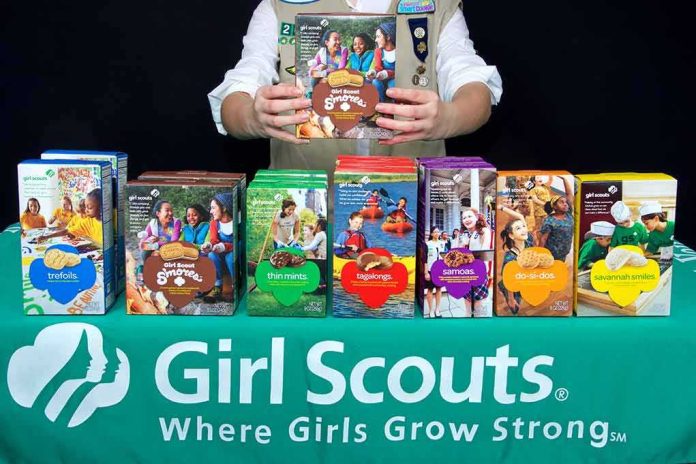
Girl Scouts of the USA announced in September 2025 that Exploremores—a sandwich cookie modeled on rocky road ice cream with chocolate, marshmallow, and toasted almond–flavored crème—would join the 2026 Girl Scout Cookie season nationwide. That commitment wasn’t a teaser; it was a formal addition to the national lineup that councils, bakers, and customers could plan around. By the time season materials rolled out, Exploremores appeared alongside stalwarts like Thin Mints, Lemonades, Peanut Butter Patties/Tagalongs, and Adventurefuls in lineup documents that councils use for volunteer training, order cards, and supply coordination. The move fits a familiar cadence for the organization: introduce one fresh flavor, retire a couple of underperformers, and let the market—thousands of neighborhood booths and millions of doorstep pitches—do the rest.
Exploremores also reflects how the program treats flavor development as brand storytelling. Thin Mints and Samoas/Caramel deLites remain anchors precisely because they are ritual items for buyers; the newcomer must feel both on-brand and momentarily irresistible. A rocky road profile is comfortable territory: nostalgic, legible, and indulgent without requiring exotic ingredients that complicate large-scale production. That is not a trivial constraint. Cookies must ship reliably through winter and early spring, hold texture over weeks, and deliver uniform quality across two authorized bakers.
How the cookie machine works: dual bakers, local councils, one national season
To understand why a single new cookie can generate outsized attention, you have to understand the machine behind it. The Girl Scout Cookie program is a national brand on a decentralized chassis. Councils—independent nonprofit entities under the GSUSA umbrella—contract with one of two authorized commercial bakers. Those bakers produce overlapping but not identical portfolios; hence the perennial name discrepancies such as Samoas versus Caramel deLites and Peanut Butter Patties versus Tagalongs. The structure traces back to the program’s evolution from home-baked sales in the 1910s and early commercial licensing in the 1930s to the modern two-baker model; regional variation is a feature of that history, not a bug. The practical result is that “the lineup” is both a national story and a set of local realities—customers in different ZIP codes may see slightly different names, shapes, or limited-run items at their booths, even as the season launches under a single nationwide banner.
That architecture shapes how new products roll out. GSUSA sets the brand standard, marketing assets, and national timing; bakers and councils translate that into production schedules and local inventory. A flavor like Exploremores, once slotted into the national season, must work operationally for both bakers and fit cleanly into councils’ planning windows—everything from troop goal-setting to warehouse logistics. Announcing the addition months ahead is not just publicity; it’s supply-chain choreography.
Why novelty matters to a century-old fundraising model
Cookie season is not merely a product drop; it is a curriculum in disguise. Troops set sales goals, budget for camp and service projects, design pitches, and learn basic unit economics—price, cost, inventory, and margin—through real customer interactions. Rotating one new flavor into the mix functions as a sales accelerant and a learning device. Scarcity and newsworthiness give scouts a conversational hook; buyers who might already have their favorites feel invited to add a box “just to try the new one.” Done well, the refresh lifts average order size while reinforcing the message that the purchase funds local programming. The organization’s long-run discipline—small, steady updates rather than wholesale overhauls—reflects that dual mandate: keep the booth conversation fresh without making the product line feel unstable.
The 2026 lineup also follows a familiar pruning cycle. GSUSA and its bakers monitor velocity and retire the stragglers to avoid SKU bloat that strains warehouses and confuses buyers. Elevated press coverage tends to fixate on which cookies are in or out in a given year, but the underlying principle is operational clarity in service of a learning program for kids. The fewer decisions a buyer must make at the table, the more time a scout has to practice the essentials: greet, ask, listen, close.
Expect local quirks—and why they persist
Every season brings renewed confusion about why a friend across town buys “Caramel deLites” while you buy “Samoas,” or why a peanut butter sandwich cookie appears as Do-si-dos in one council and as Peanut Butter Sandwich in another. The answer is contract lineage and baker-specific recipes; councils choose a baker, not a national SKU set. That is why any national announcement—including Exploremores—carries an implicit translation step to the two-baker world and the council communications that follow. For customers, the best guidance remains simple: trust the local booth or the official digital storefront for what’s truly available where you live. The brand story is national; the cart is local.
The next horizon: adjacent categories and online-only experiments
If Exploremores signals continuity, GSUSA’s forward calendar signals ambition. The organization has already previewed a pair of category expansions slated for the 2027 season: Patch Pals, its first dog cookie developed with BARK, and Girl Scout Sparkables, its first allergy-friendly cookie developed with Partake. Both are planned as online-only, shipping-exclusive products, a noteworthy distribution choice that allows the organization to test demand without overcomplicating booth assortments or troop logistics. For a program that must balance excitement with execution, online exclusivity acts as a safety valve—new audience, limited fulfillment channel, and clear separation from the core table lineup.
The dog-cookie move may look like a novelty play, but strategically it widens the circle of buyers. Families that pass the booth because “we don’t eat sweets” may still become customers when a pet treat is in the mix—especially one tied to the Girl Scout story. The allergy-friendly product speaks to a different need: inclusion. Offering a treat that better serves households managing food allergies extends the social reach of cookie season without asking troops to master complex handling protocols at the booth. Both experiments keep the business lesson intact while probing new forms of demand.
On Tuesday, the Girl Scouts of the USA announced two new varieties for the upcoming 2027 cookie season: Sparklables, a cookie designed for customers with allergies; and Patch Pals, a treat designed specifically for dogs. https://t.co/6F0eKk0pb5 pic.twitter.com/pYbavn8X2I
— WGNO-TV (ABC) New Orleans (@WGNOtv) September 8, 2026
What this means for buyers, volunteers, and the brand
For buyers, 2026 is straightforward: your classics are back, and Exploremores is the season’s conversation-starter. For volunteers, the message is operational: keep the script focused—why the purchase matters to your troop—and use the new flavor to warm up hesitant customers. For the brand, the season demonstrates a resilient formula: one or two carefully chosen changes per year, framed inside a consistent story about skills and community impact. That is how a fundraising product line survives generational turnover of both buyers and bakers. The mechanics may be unglamorous—dual suppliers, council contracts, warehouse turns—but the outcome is something most consumer brands envy: ritualized demand tied to a mission that parents and grandparents still want to fund.
Sources:
girlscouts.org, girlscouts-gssi.org