
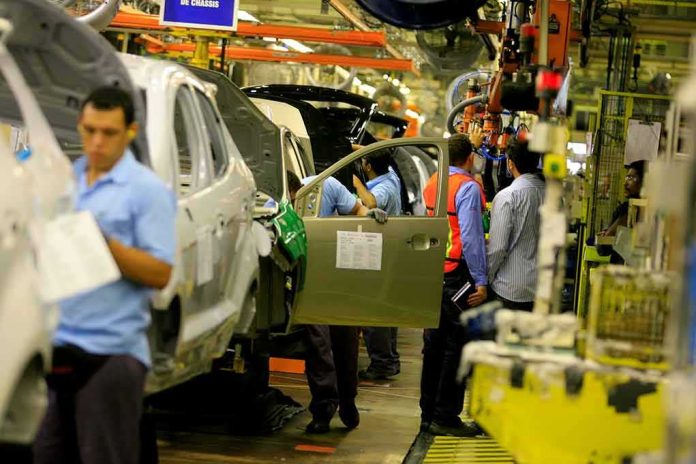
When Washington aims tariffs at North American autos, Ottawa’s pushback is not an outburst; it is a defense of an integrated production system that treats the border as a process step, not a finish line.
At a Glance
- Canada matched U.S. auto tariffs with targeted countermeasures designed to mirror U.S. structures while protecting domestic workers and market access.
- The U.S. case frames Canada’s tariff design as discriminatory and justifies additional duties—up to 50%—as necessary to level the playing field.
- The North American auto sector is a single, integrated supply chain; tariffs raise costs on both sides and risk eroding competitiveness globally.
- Policy levers—tariff formulas, side letters under CUSMA, and temporary suspensions—create room for de‑escalation but also recurring brinkmanship.
What Ottawa Actually Did—and Why
Canada’s response to the U.S. auto tariff hike has been explicit and formal: impose 25% duties on U.S. vehicles that do not qualify under the USMCA (CUSMA) rules of origin, and apply a 25% charge to the non-Canadian/non-Mexican content in vehicles that do qualify. The Department of Finance set the measures in force at 12:01 a.m. EDT on April 9, 2025, anchoring them in regulation and linking the move to protection of Canada’s auto industry and workers. Politically and technically, that structure mirrors how the United States first applied auto duties in 2025—differentiating between compliant and non-compliant content—and is framed in Ottawa as reciprocity, not escalation.
The purpose is twofold. First, to neutralize unilateral leverage by creating symmetric costs that deter continued ratcheting. Second, to preserve conditions for normal cross-border production by signaling that compliant vehicles retain preferential treatment, even if the non-preferred content is penalized. Canadian statements, from the prime minister to the finance ministry, present the package as calibrated to defend jobs and market access while staying inside the legal grammar of CUSMA preference and countermeasures.
Washington’s Case: Discrimination and “Leveling the Playing Field”
The White House’s proclamations and fact sheets present a different anchor point. They argue Canada’s tariff scheme discriminates against U.S. commerce and places American producers at a disadvantage, warranting additional duties—up to 50%—to offset the burden and restore a level playing field for critical exports, including autos, alcohol, and dairy. In this framing, Canada’s measures are not reciprocity but targeted disadvantage against U.S. firms that constrains exports and depresses revenues, investment, and jobs. The rhetoric aligns with a broader leverage doctrine set out in March 2025: use tariff threats and adjustments to minimize domestic disruption and compel trading partners to accommodate U.S. supply-chain realities.
This is not mere posturing; it is the legal and political predicate for the higher duties. The proclamations assert the factual finding of discrimination and the public interest in remedying it, which is then operationalized through additional ad valorem duties. That said, the same apparatus has also been used to pause or adjust measures when negotiations make headway, offering a mechanism for tactical de‑escalation.
The Mechanism That Actually Bites: An Integrated Supply Chain
Both governments talk about protecting workers. The bind is structural: autos in North America are built through a web, not a chain. Engines, stampings, electronics, and modules cross the U.S.-Canada border repeatedly before final assembly; an input can ping-pong seven or eight times before it ends up behind a dealership window sticker. Tariffs, even when sculpted to spare CUSMA-compliant content, raise procurement complexity, working capital needs, and variance risk. They squeeze the same firms that employ workers on both sides of the border. Analysts have warned since 2025 that the result is higher unit costs, disrupted just‑in‑time logistics, and lost global competitiveness against Europe and Asia, where scale and policy coherence now matter most.
Consider the “non-preferred content” charge. On paper, taxing only the value of non-Canadian/non-Mexican content in a CUSMA-compliant vehicle looks precise. In practice, it forces granular tracing, new customs valuations, and hedging against mid‑stream reclassification—all friction that shows up in price or in canceled purchase orders. Detroit, Windsor, and the corridor down to Ohio and up to Ontario wear those costs quickly, which is why industry and regional officials routinely warn that tariff wins and losses are often circular in autos.
How We Got Here: Legal Pathways and Political Patterns
The modern template emerged in 2025: the U.S. used national-security and trade‑remedy authorities to put 25% duties on non‑USMCA‑compliant vehicles and on the non‑U.S. content in CUSMA‑qualifying imports, then modulated measures to blunt domestic disruption. Ottawa mirrored that architecture, codifying reciprocal 25% charges under Canadian law and publishing scope lists and tariff lines, further signaling that compliant trade still benefits from CUSMA preference.
Side letters under CUSMA provide time buffers—such as minimum notice windows for certain national-security actions—and they have been invoked as both shield and bargaining chip. Temporary suspensions, like the later pause of additional U.S. duties, underscore that these tools are as much about leverage in negotiation as they are about long-run tariff policy. Canada has also rolled back selected countermeasures when the U.S. has adjusted course, reflecting a tit‑for‑tat choreography rather than a fixed tariff wall.
Canada-exposed auto supply chains have a hard repricing deadline:
Trump announced 50% tariffs on Canadian autos and parts starting January 1, 2027.
That date matters because it is not a surprise shock it is a known cliff.
Canadian vehicles already face a 25% tariff, so this… pic.twitter.com/UqlTuDaf7c
— The Zeno Report (@ZenoReport) August 25, 2026
Where the Real Disagreement Lives
The factual record is straightforward: each side enacted measures; each claims legal and moral high ground. The substantive disagreement is narrower and technical: does Canada’s mirror design “discriminate” against U.S. commerce, or does it simply replicate the United States’ own content‑based structure in reciprocal form? Washington’s proclamations answer yes to the first; Ottawa answers no, pointing to symmetry and the preservation of CUSMA preference for compliant trade. In trade politics, those are not academic distinctions—they determine whether retaliation looks like illegal targeting or legitimate balancing.
For firms, the distinction matters less than the predictability of rules and the cost curve they face next quarter. Even reduced rates or partial pauses still generate nine‑figure annual losses in a sector where margin discipline and capital cycles punish uncertainty; supply chains priced for free movement cannot be repriced overnight without consequences that outlast any single tariff proclamation.
What It Means Going Forward
Three implications deserve sobriety rather than slogans. First, the North American auto platform rises or falls together; sustained tariffs will shift investment to less encumbered jurisdictions, not re‑shore capacity neatly within one border. Second, technical pathways for de‑risking—product‑specific exclusions, temporary suspensions, and content‑tracing simplifications—are the fastest way to shave deadweight loss while leaders argue discrimination vs. reciprocity. Third, the political economy of border regions remains the decisive constraint: governors, premiers, and mayors along the Great Lakes will keep pressing both capitals toward a stable tariff truce because their tax bases and payrolls depend on it.
Canada’s vow to push back is not a promise of escalation for its own sake. It is a message about the operating system of North American manufacturing: symmetrical pressure to force symmetrical rules, ideally ending where it began—zero tariffs for genuinely integrated, rules‑compliant trade. The sooner policy returns there, the fewer factories will pay to relearn the same lesson.
Sources:
insiderpaper.com, whitehouse.gov, canada.ca, pm.gc.ca, bbc.com, theguardian.com, reuters.com, cfib-fcei.ca, search.open.canada.ca, cnbc.com, cnn.com, blakes.com, cato.org