The strategic test in the Strait of Hormuz is not whether the United States can punish Iran economically or fight its navy; it is whether policy can reliably turn a contested chokepoint back into a predictable trade artery without sliding into a wider war.
At a Glance
- Washington pairs sanctions and limited naval operations to keep commercial traffic moving while avoiding major combat.
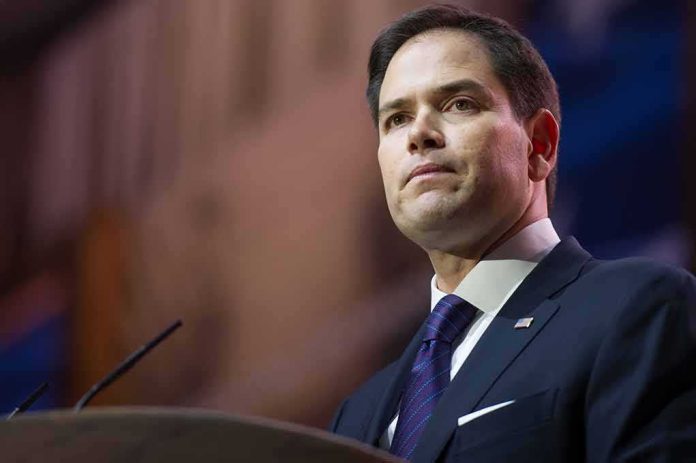
- Secretary of State Marco Rubio argues the pressure campaign is degrading Iran’s capacity and reducing the need for large-scale force.
- Attacks and mine incidents have persisted, with oil prices elevated and insurers skittish, undercutting any claim of normalcy.
- Allied hesitation leaves the burden-sharing case politically exposed even as global interests are at stake.
What Washington says is working—and what that actually means
Secretary of State Marco Rubio’s core contention is straightforward: the economic and maritime pressure campaign has so damaged Iran’s position that President Trump “doesn’t have any need to conduct major combat operations.” He frames sanctions and blockade measures as the main tools degrading Iranian capacity and deterring escalation, while U.S. forces target immediate maritime threats—mines, drones, and fire on commercial vessels—so ships can move without opening a full war. It is a coherent theory of victory for a narrow objective: protect shipping, raise costs for Tehran, and keep the fight below the threshold of major combat.
There is at least some operational evidence: in the opening phase, U.S. authorities pointed to successful guided passages by two U.S.-flag merchant ships across the Strait—a proof of concept that, in crisis management, matters more than rhetoric. It demonstrates that a coalition-sized operation is not the only way to reopen a corridor; a competent navy can carve bounded lanes under fire, if risk is concentrated and time-limited. But two ships do not constitute a shipping regime, and no professional would confuse a tactical corridor with restored freedom of navigation.
The threat picture: real hazards, contested attribution
Rubio’s description of the hazard set—naval mines, drones, missiles, and direct fire on merchant vessels—tracks with maritime reporting and what shipmasters and insurers watch most closely: indiscriminate threats that are cheap to lay, hard to attribute publicly at speed, and costly to clear. The International Maritime Organization and independent outlets counted scores of incidents in the theater, and commercial operators reported fires, damage, and delays. Those facts alone validate the risk environment and justify escorts, clearance, and hardening measures.
Attribution is where policy and proof diverge. U.S. officials lay responsibility at Tehran’s feet, including for operations staged by aligned actors, but have not publicly released incident-by-incident packages—radar tracks, debris forensics, comms intercepts—at a scale that short-circuits denial. Iran, for its part, denies key attacks, frames some mine strikes as the consequence of “unauthorized” routing, and rejects links to allied militants. In open-source terms, the balance of probability leans toward an Iranian campaign to keep leverage over the strait, but the absence of declassified, case-level evidence keeps a corridor open for counternarratives.
Economics as coercion: powerful, but not determinative
The sanctions half of the strategy has a long lineage. Decades of research and past Iran episodes show sanctions can rapidly depress oil revenue, weaken the currency, raise inflation, and cut output—sometimes dramatically in the short run. That record supports Rubio’s claim that economic pressure can “devastate” macro indicators; where his case is weaker is the leap from economic pain to strategic compliance or diminished operational tempo at sea. The scholarly literature is consistent: sanctions bite hardest early; over time, targets adapt through smuggling, substitution, and repression, even as humanitarian costs mount. Coercion is real; conversion is not guaranteed.
Markets are a blunt barometer of effectiveness. Elevated oil prices—reported at roughly 60–70 percent above prewar baselines during the crisis—signal sustained risk premia, tighter physical balances, and higher cost of capital for shipping. For an energy-importing world, that translates directly into fuel, freight, and consumer price pressures. If the objective is to protect global trade, a strategy whose visible outcome is durable price elevation must either deliver a path back to normal flows or own the economic drag as the price of containment.
Burden-sharing and legitimacy: the missing coalition
Rubio’s ask to partners is analytically clean: the United States does not import significant oil from the Gulf; others do, so others should help secure the artery. In practice, the coalition piece has faltered. France publicly ruled out participation in “opening” the strait amid active hostilities, conditioning any escort role on a calmer environment. Several other U.S. partners distanced themselves from minesweeping or escort deployments. Rubio acknowledged he received no affirmative G7 responses when he raised the appeal. The result is a credibility gap between the universality of the interest and the particularity of the effort; it also hands Tehran a narrative that Washington is isolated in enforcing its policy.
That gap matters operationally. Sustained convoying and mine clearance are manpower, sortie, and maintenance-intensive; without reliable partner lift—surface combatants, MCM hulls or drones, rotary-wing overwatch—the U.S. Navy bears tempo risk and opportunity cost elsewhere. Politically, a thin coalition complicates legal framing around blockade-like measures and increases the premium on transparent evidence to keep insurers, flag registries, and wary capitals onside.
Where the evidence is strong—and where the case needs proof
Three propositions withstand scrutiny. First, the maritime threat is concrete and ongoing; the mix of mines, drones, and missiles is precisely the cheap, scalable toolkit a mid-tier power uses to weaponize a chokepoint. Second, limited naval action can pry open lanes episodically, proving that traffic can move under pressure. Third, sanctions can and do inflict macroeconomic damage quickly in Iran’s case; this is not speculative. These points support a narrow claim: pressure can manage risk in the strait without a general war.
Three other propositions remain unproven in the public record. One, that economic “devastation” has durably reduced Iran’s capacity or appetite to menace shipping; incident trends do not yet show decisive de-escalation. Two, that restored freedom of navigation exists beyond isolated passages; the denominator—total attempted versus completed commercial transits—is largely missing. Three, that this is a genuinely international operation; the diplomatic ledger shows hesitancy, not buy-in. A strategy that leans on these claims would benefit from releasing transit statistics, incident-level attribution files, and quantified sanctions impacts to move the debate from assertion to audit.
What works next: managing a chokepoint for the long haul
Chokepoint security is a systems problem. The mechanics are familiar: persistent MCM coverage with unmanned assets to lower attrition; predictable convoy windows that let shippers and insurers price risk; layered air and missile defense for the corridor; and a disclosure policy that, within classification limits, publishes enough evidence to underwrite political and insurance confidence. On the economic flank, calibrate sanctions to keep pressure on procurement and foreign exchange while minimizing incentives for dangerous horizontal escalation. Finally, align the diplomatic narrative with the operational one: if the goal is global trade protection, bring energy importers, littoral states, and registry nations into a formalized role they can defend at home.
Sources:
youtube.com, state.gov, 2news.com, bostonglobe.com, cbsnews.com, amp.dw.com, iranwire.com