Presidential protection succeeds or fails long before a shot is fired; what matters is how quickly professionals detect, assess, and interrupt armed intent moving toward the seat of power.
At a Glance
- Secret Service officers arrested a Venezuelan national parked on Constitution Avenue near the White House after he allegedly said voices told him to kill President Trump; three firearms and dozens of rounds of ammunition were recovered.
- DHS described a stolen vehicle and specified multiple local weapons and property charges; major outlets independently reported the same core facts attributed to federal authorities.
- Agency leadership framed the event as representative of today’s heightened threat environment around the White House complex.
- History shows armed approaches to presidents are not rare outliers—protection is built to neutralize exactly this pattern of proximity plus means.
What Happened Near the White House
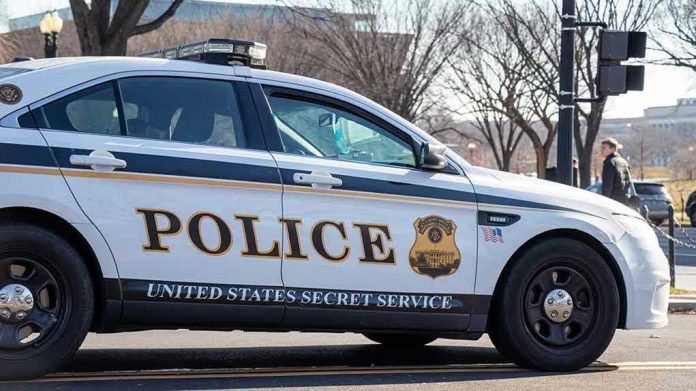
According to the Department of Homeland Security, U.S. Secret Service officers approached a man parked on Constitution Avenue on November 5 and took him into custody after he allegedly stated he had come to Washington to kill President Trump. A subsequent search recovered three firearms—including a rifle—and dozens of rounds of ammunition from a vehicle DHS described as stolen. The department identified the suspect as a Venezuelan national unlawfully present in the United States and released a photograph of the seized weapons and ammunition. Multiple outlets, citing DHS and the Secret Service, reported the same key details of location, date, alleged statement, and the weapons recovered. One brief caveat: the threat language is presently described in agency accounts rather than a publicly released recording or transcript.
The arrest did not end as a nebulous inquiry. Reported charges include counts for unlawful transportation of a firearm, carrying unregistered firearms and ammunition, possession of a prohibited weapon, an unlicensed pistol, and stolen-property offenses linked to the vehicle. The specificity of these charges—especially the discrete weapons counts—signals a case anchored in physical evidence, not merely an asserted threat.
How Presidential Protection Interdicts Risk
Modern protective doctrine is designed for moments exactly like this: an armed individual in public space who edges into the White House security envelope. The work is not theatrical; it is procedural. Uniformed Division officers and agents use concentric layers—fixed posts, patrols, cameras and analytics, intelligence leads, and behavioral cues—to identify risk early, isolate it, and convert uncertainty into custody and evidence. When a subject volunteers motive or intent, as DHS says occurred here, that statement informs the protective threat assessment, but the decisive elements remain proximity, means, and legal violations that justify detention and seizure. The Secret Service Director’s own characterization—pointing to the continued number of armed individuals drawn to the White House—tracks with that doctrine: the environment is saturated with signal; the job is rapid triage and removal.
The weapons themselves matter for both charge architecture and threat modeling. A rifle combined with handguns and ammunition changes the envelope of potential harm, the effective range, and the time-to-intervention calculus for officers on the ground. The release of a photo and itemization of recovered arms, referenced by national outlets, aligns with how protection bureaus substantiate probable cause and reassure the public that the tools of violence have been removed from circulation pending adjudication.
Where This Fits in the Historical Pattern
Armed approaches to presidents have happened often enough to be a category, not a novelty. Congressional research and Secret Service materials document at least 10 to 11 direct attacks on presidents since the 19th century—four fatal—while the broader universe of incidents includes thwarted plots, perimeter breaches, and sidewalk gunfire at the Executive Mansion. These data points are the tip of a much larger threat-management iceberg: for every attack, protection professionals process large volumes of threats, suspicious persons, and weapons violations near protected venues. The goal is to keep events like a parked car with guns and declared intent from turning into a footrace at the fence line.
Proximity is the red flag that converts possibility into urgency. Historic cases such as the 1994 shooting at the White House from Pennsylvania Avenue remind us how quickly a firearm at curbside becomes a live ballistic problem for protective agents and bystanders. That history informs today’s posture: what might sound to a layperson like an arrest for weapons possession near a landmark is, to protection veterans, an operational success at the last prudent decision point.
Charges, Evidence, and the Path Through Court
Weapons cases in the District often rise or fall on four pillars: possession, registration status, transport or carry behavior, and the firearm’s functional condition. Prosecutors typically pair those with any property or vehicle charges that place the subject behind the wheel and inside constructive possession of contraband. The charge list reported here—unregistered firearms and ammunition, a prohibited weapon, an unlicensed pistol, unlawful transport, and stolen-property counts—maps exactly to that playbook. Independent of motive, those statutes allow the system to incapacitate risk while courts sort intent, sanity, and immigration issues under separate processes.
Intent still matters, especially where protective threats intersect with mental health. Statements about hearing voices, if substantiated, can trigger competency reviews, shape charging decisions, and influence conditions of confinement. Protective professionals do not have the luxury of diagnosing at the curb; their mandate is to stop the risk and preserve evidence. From there, prosecutors, defense counsel, and clinicians determine the credibility of any claimed delusions and whether the subject is fit to stand trial. The Secret Service’s emphasis on a heightened environment underscores why posture and procedure must assume capability until a court record proves otherwise.
Why Immigration Status Appears in the Narrative
DHS’s statement identified the suspect as unlawfully present. In practice, that information enters a protective incident record because it shapes custody options, detainers, and potential transfer to federal immigration proceedings after local prosecution. Public reporting often highlights the status as part of the subject’s identity; in the operational file, it is one variable among many—alongside criminal history, weapons trace results, and behavioral indicators—that determines where the person is housed and which agencies have concurrent interests. Here, it neither expands nor contracts the weapons evidence that animates the case; it does clarify why DHS, not just local police, is speaking to the arrest.
🚨#BreakingNews U.S. Secret Service arrest illegal alien from Venezuela with multiple guns in his vehicle near the White House in an alleged assassination attempt against President Donald J Trump.
On Thursday evening, November 5, Secret Service officers approached the suspect… pic.twitter.com/A7V4XVE1H4
— Lynnwood Times (@LynnwoodTimes) November 6, 2026
What This Incident Tells Us Going Forward
Two takeaways endure. First, deterrence is built from visible competence. When an armed person parks within sight of the White House and leaves in handcuffs, the signal to imitators is unambiguous: rapid interdiction is the norm, not the exception. Second, transparent, charge-driven cases strengthen public trust more than abstract warnings about a “threat environment.” A photographed inventory of guns, a stolen car, and a docket with specific counts is exactly how you communicate that protective security is doing the quiet, unglamorous work that keeps the symbolic core of government safe. That is the point of a protection system: convert dangerous possibility into orderly process before it becomes history’s next tragedy.
Sources:
thegatewaypundit.com, edition.cnn.com, dhs.gov, cbsnews.com, nbcpalmsprings.com, winnipegfreepress.com, wvlt.tv