
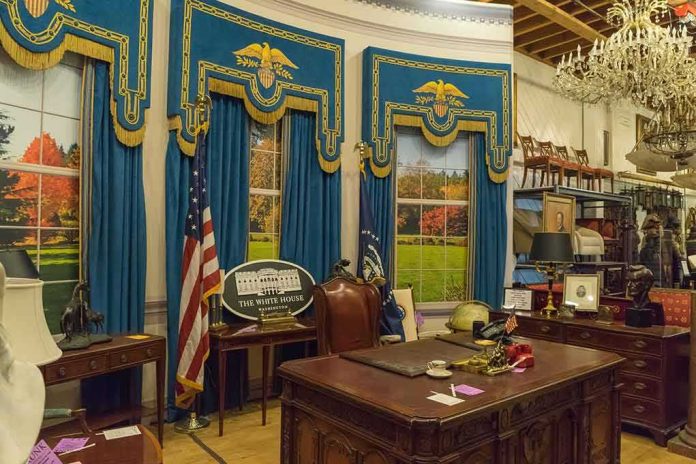
A presidential proclamation has used the Antiquities Act to draw legal lines around the heart of American executive power—the Oval Office and adjoining rooms—shifting those spaces from tradition-bound stewardship to a formal national monument regime with procedures that make major alterations significantly harder to carry out.
The Short Version
- A signed proclamation established the Oval Office National Monument under the Antiquities Act.
- The designation covers the Oval Office, the Outer Oval Office, and the Cabinet Room with defined boundaries.
- Management is assigned to Interior and the National Park Service, prioritizing historic character and architectural integrity.
- Substantial changes now face documentation, review, and alternatives analysis; President Trump has described the effect in absolute terms.
What the proclamation does, precisely
The legal instrument is a presidential proclamation invoking 54 U.S.C. § 320301, the Antiquities Act. It creates the Oval Office National Monument and specifies what, exactly, the monument includes: the Oval Office itself (Room 110), the Outer Oval Office (Rooms 106 and 108), and the Cabinet Room (Room 105). Those are not rhetorical labels; they are administrative room numbers that define the protected footprint. The proclamation directs the Secretary of the Interior, acting through the National Park Service, to manage the monument to protect its historic character, architectural integrity, and association with the presidency. That assignment imports the federal preservation toolkit—standards, documentation practices, and review procedures—into the daily life of the West Wing.
Crucially, the proclamation builds a process barrier around change. Before any action that would substantially alter or demolish the monument or its essential architectural elements, it requires documentation, review, and consideration of alternatives. That is the recognizable structure of preservation law: not an immutable freeze, but a high-friction system that forces decision-makers to justify interventions, explore less-intrusive options, and keep the through-line of historical significance intact. The White House’s fact sheet framed the move in those terms—preservation, proper care, management—rather than as an aesthetic veto.
How this fits with the Antiquities Act and White House preservation
Using the Antiquities Act for places of historic import is well-worn ground. Courts have consistently afforded presidents broad latitude to identify “objects of historic or scientific interest” and set aside the smallest area compatible with protection—language that, applied to rooms at the symbolic core of American governance, is straightforward to satisfy. Congress’s research arm has chronicled that courts have uniformly rejected challenges to monument proclamations, and that while presidents have reduced monument sizes, no president has formally revoked a national monument; the law around diminishment and elimination remains debated because it has not been squarely tested to final judgment.
What’s novel is less the legal authority than the venue. The White House complex already lives under a preservation regime, including the Committee for the Preservation of the White House and longstanding reliance on the Secretary of the Interior’s Standards for the Treatment of Historic Properties. The proclamation overlays that practice with a formal monument designation and federal land-management processes, effectively giving the National Park Service an explicit mandate to police change in the Oval Office suite consistent with the Antiquities Act’s protective purpose.
Trump’s absolutist framing versus the legal text
President Trump has described the effect in sweeping terms—“it will not be allowed to be touched by anybody,” and “impossible for anybody ever to destroy this incredible space”—positioning the monument as a kind of constitutional glass case for the Oval Office. The proclamation itself is more lawyerly: it mandates review, alternatives analysis, and management for historic integrity before substantial alteration or demolition, but it does not declare that no change of any kind can ever occur. In other words, the legal instrument builds a procedural gate with preservation criteria; it does not proclaim a total ban on all future modifications.
This distinction matters in practice. Historic interiors evolve under carefully managed standards—lighting, security, communications, and accessibility all drive periodic interventions that preservation professionals accommodate through reversible methods, material conservation, and design consistency. By formalizing the monument status, the proclamation raises the threshold for such work, demands a paper trail, and centers the historic character test. That is a meaningful constraint. It is not, by the text alone, an absolute prohibition on every change.
Boundaries, management, and the mechanics of enforcement
Because the proclamation is explicit about the rooms included, disputes over scope will focus on what counts as an “essential architectural element” and what qualifies as “substantial.” In preservation practice, those terms typically point to architectural fabric—walls, millwork, flooring, ceilings, fixtures—and designed ensembles, rather than strictly to movable furnishings, though the line can blur when a room’s historic significance is tied to particular built-ins or custom elements. The Secretary of the Interior’s Standards and NPS guidance provide the interpretive framework; expect the National Park Service, in consultation with the White House preservation apparatus, to codify a management plan that classifies permissible, reversible, and prohibited interventions consistent with the room’s period of significance and cumulative history.
Enforcement inside the Executive Residence is necessarily institutional rather than police-like. The proclamation assigns responsibility to Interior and NPS, backed by the President’s Article II authority to direct executive departments. That structure makes process and paper the primary levers: no major work proceeds without documented review, alternatives analysis, and a finding of consistency with historic character. In the world of high-stakes, high-visibility interiors, those levers are powerful—not because they handcuff a future administration, but because they create accountability and a record that can be scrutinized by Congress, historians, and, if necessary, courts.
Durability: how binding is one president’s monument on the next?
Two threads shape expectations about longevity. First, the case law and practice under the Antiquities Act have consistently sustained presidential proclamations and their protective aims; as noted, there is no precedent for outright presidential revocation, and episodes of reduction have been politically and legally contested, underscoring that change is possible but not frictionless. Second, Congress retains plenary authority over federal property management and could legislate with respect to any monument, including this one; that background power is a feature, not a bug, of the system’s checks and balances.
Against that legal backdrop, the proclamation’s practical durability stems from institutional norms as much as doctrine. Rooms like the Oval Office already command deference to continuity. A monument designation amplifies that norm, making any attempt at radical alteration conspicuous, process-heavy, and politically costly. That is a real form of protection in Washington: when the paperwork is long, the alternatives must be documented, and the findings must live on the record, the path of least resistance typically runs through preservation, not reinvention.
Trump has designated the White House's Oval Office as a national landmark https://t.co/yh2BOm8lIV
— dpa news agency (@dpa_intl) November 6, 2026
Why this matters beyond symbolism
Designating the Oval Office and Cabinet Room as a national monument is not mere pageantry. It embeds federal preservation standards into the functioning center of the presidency, regularizes how upgrades and repairs get done, and clarifies that the space’s historic identity is itself a governmental interest. For future administrations, the message is clear: continuity has legal teeth. For historians and the public, the designation provides a governance architecture to keep the room’s evolution legible and proportionate to its significance. And for the federal preservation enterprise, it is an assertion that symbolic interiors can warrant the same procedural respect as red-rock canyons and ancestral sites—different on the ground, but congruent in the law’s core idea: protect what defines us.
Sources:
townhall.com, cnn.com, whitehouse.gov, usatoday.com, en.wikipedia.org, home.nps.gov