A fatal shooting outside a Pilsen encampment has become a referendum less on what happened on South Union Avenue than on who gets to narrate it — and the record, as it stands, belongs almost entirely to the institution whose employee pulled the trigger.
Key Points
- An off-duty FBI agent killed Oscar Corrales, 27, on West 18th Street near South Union Avenue in Chicago’s Pilsen neighborhood after the FBI said Corrales fired into “a group of innocent people.”
- The Cook County Medical Examiner’s Office ruled Corrales’s death a homicide by multiple gunshot wounds — a classification describing cause and manner of death, not a legal verdict on the agent’s conduct.
- Reports differ on whether Corrales fired directly into a nearby homeless encampment or into a broader group; the FBI’s language did not specify the encampment itself.
- DHS identified Corrales as a Venezuelan national released after a 2023 border apprehension, with a subsequent ICE detainer and a prior criminal record — details that have dominated coverage without resolving whether the shooting was lawful.
- A Chicago alderman has called for an independent investigation, underscoring that the only publicly detailed account so far comes from the FBI itself.
What Happened on South Union Avenue
On the evening of Monday, October 27, an off-duty FBI agent driving through Pilsen encountered a man firing a weapon into a group of people on South Union Avenue, between 17th Place and 18th Street. According to the FBI, the agent exited his vehicle and shot the gunman “in an effort to stop the ongoing threat” after witnessing him “discharging a firearm into a group of innocent people”. Witnesses told responding outlets they heard between five and ten shots. Chicago police established a perimeter within minutes, and the gunman — later identified by the Cook County Medical Examiner’s Office as 27-year-old Oscar Corrales — was pronounced dead at the scene.
A firearm was recovered near Corrales’s e-bike, which investigators say he had been riding immediately before the confrontation. The medical examiner ruled the cause of death multiple gunshot wounds and classified the manner of death a homicide — a technical designation that describes what killed Corrales, not whether the agent who fired was legally justified in doing so.
The Encampment Question, and Why It Matters
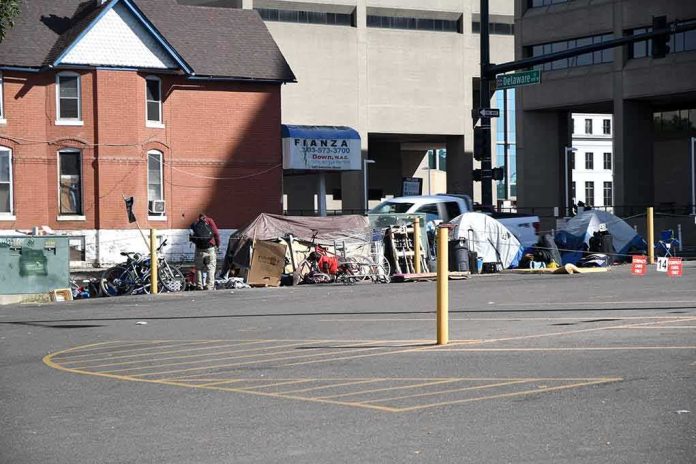
Much of the public framing has centered on a homeless encampment located near the shooting scene, with some reporting stating plainly that Corrales was firing into it. Other accounts are more cautious: the FBI’s official language referred only to “a group of innocent people,” and at least one outlet explicitly noted that it remained unclear whether the encampment itself was the target of Corrales’s gunfire. That distinction is not pedantic. If Corrales was firing indiscriminately into an occupied homeless camp, the agent’s intervention looks like a protective act against an active threat to one of the city’s most physically exposed populations. If the target was a different cluster of bystanders, the encampment’s proximity is incidental rather than central to understanding what the agent confronted.
Records suggest Corrales may himself have been unhoused — a prior arrest report from a May retail-theft case listed a shelter address — which complicates any narrative that casts the shooting as a clean story of a victimized homeless population defended by federal law enforcement. The people nearest the gunfire, the encampment’s residents, have not yet been identified or quoted in available reporting, which means the account of what the shots were aimed at currently rests on secondhand characterization rather than on-scene testimony.
Who Was Oscar Corrales
The Department of Homeland Security identified Corrales as a Venezuelan national who entered the country illegally, was apprehended at the southern border in October 2023, and was released during the prior administration. Reporting also cites an ICE detainer issued against him in December 2025 and prior arrests in Illinois and California, including a May retail-theft case at a Nordstrom store that left an outstanding warrant after he failed to appear in court. These facts are documented and uncontested in the available record. What they do not do, as a matter of law or logic, is settle the separate question of whether the agent’s decision to fire was necessary and proportionate. Immigration status and criminal history describe who Corrales was; they do not describe what he was doing with a gun on South Union Avenue or what the agent reasonably perceived in the seconds before firing.
An Investigation Still Resting on One Institution’s Account
Every detail about the threat the agent faced — that Corrales was armed, that he fired first, that the agent acted to stop an “ongoing threat” — originates with the FBI, the agency that employs the shooter. No publicly released body-camera footage, surveillance video, named eyewitness, or completed ballistics analysis has yet corroborated the sequence independently. That is not evidence of wrongdoing; it is simply the normal early posture of an agent-involved shooting, in which the involved agency necessarily speaks first because it possesses the only information available. Chicago Alderman Byron Sigcho-Lopez has called for an independent investigation by the Illinois Attorney General and Cook County State’s Attorney’s Office, a standard and appropriate check whenever the account of a fatal shooting and the identity of the shooter’s employer are the same entity. That call does not imply misconduct; it reflects the ordinary expectation that lethal force by any officer, federal or local, be reviewed by a party without an institutional stake in the outcome.
Resident Videos Raise New Questions About Canalport Encampment Before FBI Shooting
Neighborhood Witness Reports Armed Homeless Occupants, Drug Activity and Claims Shooting Victim Had Been Visiting Encampment for Two Weekshttps://t.co/o4P6hsbHLb® Crime Report | October 28, 2026… https://t.co/ucUIcNHpOQ pic.twitter.com/Gj9OHgEWm6
— SubX.News® (@SubxNews) October 28, 2026
The Larger Pattern: Policing as Homelessness Policy
This shooting lands inside a decades-old argument about what role law enforcement should play around encampments at all. A Department of Justice evaluation of Los Angeles’s Safer Cities Initiative found that targeted policing of Skid Row reduced violent, property, and nuisance crime without measurably displacing it elsewhere — evidence that visible enforcement can suppress disorder near encampments. The same evaluation concluded, however, that policing did not touch the underlying causes of homelessness or most of its consequences for the people living unsheltered. That tension — enforcement can make an encampment safer in the moment without making anyone housed — explains why incidents like this one get read through two entirely different lenses: as proof that encampments need more protection, or as proof that protection by force is not protection at all.
What Remains to Be Established
The shooting is confirmed; Corrales’s identity, immigration history, and cause of death are confirmed; the medical examiner’s homicide ruling is confirmed. What is not yet publicly resolved is the independent forensic and video record that would let anyone outside the FBI verify the precise sequence of gunfire, and no named progressive official or outlet has, as of this writing, offered a competing account of the encampment’s role or the shooting’s justification. Until an independent review — the kind Alderman Sigcho-Lopez has requested — produces ballistics, recovered footage, or witness statements from the encampment itself, the public record will continue to rest on the account of the one party already certain it acted correctly.
Sources:
pjmedia.com, yahoo.com, cbsnews.com, nbcchicago.com, chicago.suntimes.com, fox32chicago.com, patch.com