When a wildfire jumps from a backyard spark to more than a thousand scorched acres of national forest, the line between careless moment and federal felony becomes painfully clear—because the law treats ignition on federal land, whatever the spark, as a federal crime with real teeth.
The Short Version
- Federal prosecutors filed a criminal complaint charging a Santa Clarita man with arson tied to the Bouquet Fire.
- The complaint alleges he admitted tossing a cigarette onto fireworks on his property, triggering the blaze.
- Investigators identified an ignition point and concluded fireworks were the probable cause after excluding other sources.
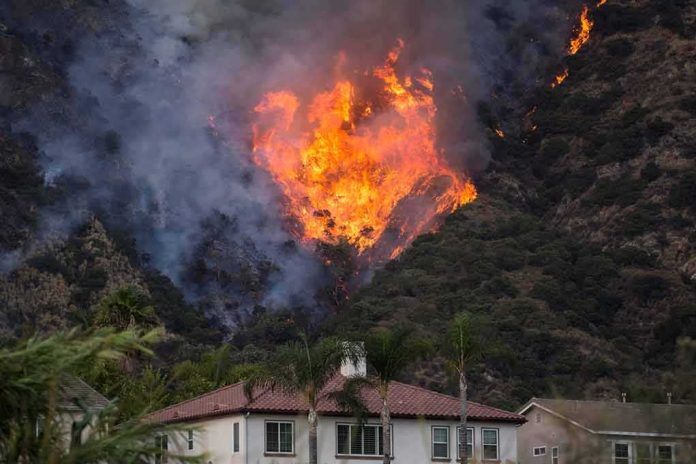
- The Bouquet Fire burned about 1,048 acres in the Angeles National Forest and prompted evacuations.
What prosecutors say happened: the ignition, the admission, and the acreage
Federal authorities charged 70-year-old Rodney Ameile Saba in connection with the Bouquet Fire, filing a criminal complaint that ties the blaze to activity behind his residence along Bouquet Canyon Road. According to the reported complaint, investigators placed the initial ignition at approximately 2:13 p.m. on October 3 and attributed the start to fireworks—an assessment they reached after ruling out lightning, campfires, debris burning, and other common sources. The prosecution further alleges Saba admitted he tossed a cigarette from his porch onto fireworks, which then detonated and set nearby fuels ablaze. The resulting fire burned an estimated 1,048 acres of federally managed land in the Angeles National Forest and drove evacuations as crews fought to corral its spread.
The federal posture matters. When fire damages federal property—here, national forest land—prosecutors can proceed under federal arson statutes and related offenses, which hinge on origin-and-cause determinations and whether the government can show a legally sufficient mental state. Early operational reporting from the fire zone documented the blaze’s rapid growth and public-safety consequences; the charging announcement connects those outcomes to a discrete ignition mechanism and place, forming the backbone of the case.
How origin-and-cause investigations build a case
Wildland fire origin-and-cause work proceeds methodically: investigators narrow the fire’s area of origin by reading burn patterns and indicators—V-shaped char, grass stem bending, soot deposition—then test hypotheses about ignition sources against physical evidence and elimination logic. When investigators say they excluded lightning, campfires, and debris burning, they are signaling a standard process: rule out the plausible, document why each is inconsistent with the scene, and converge on what remains as the most probable cause. In this instance, authorities reported that fireworks best fit the facts after that elimination sequence, and prosecutors linked that conclusion to a specific alleged act and admission.
In a federal setting, those technical findings feed into a probable-cause narrative supporting charges. The ignition time stamp, the location behind a residence, and the alleged statement from the defendant operate as interlocking elements: time-place-mechanism. Each piece reduces ambiguity; taken together, they provide the theory of the case that the government will press in court. While an arrest or complaint is not a conviction, the contour of the government’s case is clear from the public account.
The legal hinge: ignition on federal lands and the question of intent
Arson in wildland contexts occupies a narrow legal lane within the broader world of human-caused fires. Human activity is responsible for the large majority of U.S. wildfires, but that bucket includes abandoned campfires, equipment sparks, powerline faults, and negligent disposal of smoking materials, among others; arson is the intentional-crime subset, not the whole. In a prosecution like this one, two questions typically drive charging and adjudication: what physically ignited the fire, and what was the defendant’s mental state at the time. The government’s reported narrative answers the first—fireworks activated by a tossed cigarette—and sets the stage for litigating the second under federal law’s intent standards.
This distinction matters for more than semantics. To prove an arson offense, prosecutors must connect an ignition mechanism to a defendant and satisfy the statute’s mens rea requirement; the cause classification alone does not resolve intent. Still, fireworks are a recognized human ignition source in wildland investigation taxonomies, and when a blaze escapes into federal land, federal charges follow the footprint of burned acres and jurisdictional lines, not neighborhood boundaries.
Why fireworks and dry fuels are a volatile combination in canyon country
Fireworks are engineered to ignite and combust; in the wrong conditions, they throw sparks and hot fragments far beyond their launch site. In canyon topography under seasonal heat and low humidity, cured grasses and chaparral can carry flame quickly upslope, aided by local winds that align with drainages. An ignition on the leeward side of a structure, where embers can accumulate in dry litter, can transition from a small flame front to head fire in minutes. Once established, a fire can spot across roads and breaks, rendering initial attack more difficult and expanding the fire’s footprint deep into adjacent wildland—here, the Angeles National Forest.
That coupling between human ignition and receptive fuel bed is why investigators and prosecutors pay sharp attention to fireworks in wildland-urban interface zones. The physical pathway from a single ember to a thousand-acre incident is well understood in fire behavior science; the legal consequences flow from that foreseeability when ignition occurs adjacent to federal property.
The Bouquet Fire reportedly burned 1,048 acres of California’s Angeles National Forest. Federal prosecutors have charged a 70-year-old Santa Clarita man with arson, alleging that he ignited fireworks with a cigarette, sparking the blaze. If convicted, he faces up to 20 years in…
— Master Thought (@MasterThousmg) October 10, 2026
How this case fits the national pattern of human-caused wildfire
The Bouquet Fire charge aligns with a national reality: most recorded wildfires are started by people. Across multiple datasets and analyses, researchers have documented that roughly 80–85% of U.S. wildfires have human causes, with categories spanning equipment use, debris burning, smoking, recreation, and fireworks; arson sits inside that larger human-caused universe, not apart from it. The practical implication is straightforward. Reducing catastrophic fire losses in the wildland-urban interface requires managing both structure and vegetation risk and the ignition behaviors—some intentional, many careless—that light the first flame.
What to watch as the case moves forward
The case will turn on the strength and admissibility of the origin-and-cause work and any statements attributed to the defendant, alongside the government’s articulation of the required mental state under federal arson law. Expect the prosecution to emphasize the mapped origin point, the elimination of alternative causes, and the reported admission tying cigarette and fireworks; expect the defense to probe gaps in the chain between an ignition act and the mental state the statute demands. One caveat remains standard in criminal matters: a complaint contains allegations, and the defendant is presumed innocent unless and until proven guilty in court.
Sources:
nypost.com, abc7.com, ground.news