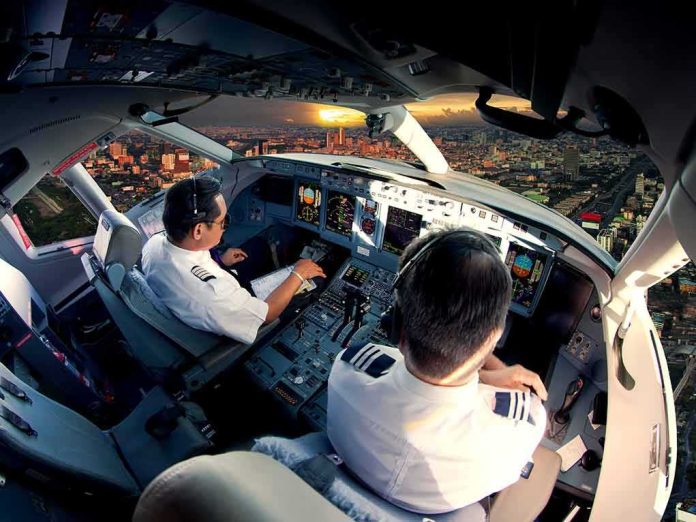
A cockpit built to keep intruders out could not prevent a threat from within—yet disciplined airmanship, swift crew coordination, and help from aboard saved 174 people when a FlyDubai flight diverted safely to Tabuk after a violent struggle between its pilots.
The Short Version
- FlyDubai FZ1073 from Dubai to Tel Aviv diverted to Tabuk, Saudi Arabia, after a co-pilot stabbed the captain during flight; the aircraft landed safely.
- Passengers and crew entered the cockpit after the wounded captain opened the door; an additional FlyDubai pilot pair on board assisted in securing control.
- The flight transmitted emergency squawks associated with general emergency and unlawful interference.
- Israel’s prime minister said the attacker “apparently tried to crash” the plane; the airline suspended Israel routes pending investigation.
What happened inside the cockpit—and how the crew broke the chain
On a routine Dubai–Tel Aviv sector, FlyDubai FZ1073 experienced a cockpit assault that turned a secure flight deck into a fight for aircraft control. Multiple outlets reported that the first officer stabbed the captain, identified in later coverage as Capt. Smit Machchhar, during the cruise phase. Despite his wounds, the captain managed to open the reinforced cockpit door, enabling passengers and cabin crew to enter and help overpower the attacker—a pivotal move because modern cockpit doors are designed to resist entry from the cabin side, not to manage a threat already seated at the controls. Reports indicate that two additional FlyDubai pilots traveling as passengers moved to the flight deck and assisted in stabilizing the aircraft for diversion and landing at Tabuk, Saudi Arabia. Israel’s prime minister publicly stated that one pilot stabbed the other and “apparently tried to crash” the aircraft, a characterization echoed across major coverage.
The aircraft signaled distress using transponder emergency codes—first 7700 (general emergency) and also 7500, which flags unlawful interference—consistent with a sudden, serious in-flight security event. After control was secured, the crew diverted to Tabuk and landed safely, with the captain and the alleged attacker hospitalized and questioned by authorities, according to contemporaneous reporting. FlyDubai confirmed an “altercation” occurred, emphasized that the jet was diverted as a safety measure, and suspended operations to and from Israel while investigators worked to establish the motive.
The insider-threat problem aviation never fully solved
Commercial aviation hardened against external hijacking after 9/11: armored doors, sterile cockpit procedures, reinforced security screening, and recurrent crew defense training. But those measures target intruders; they are far less effective when the antagonist already has a seat on the flight deck. This is the “insider threat” scenario—vanishingly rare, yet uniquely dangerous because it bypasses perimeter defenses. The FlyDubai incident fits that pattern: the barrier designed to keep passengers out was, in this case, opened from within by a wounded captain to allow help in, an inversion of the post-9/11 logic that illustrates the trade-offs embedded in cockpit security doctrine.
Line operations depend on trust, redundancy, and procedure. Standard operating procedures require two qualified pilots to cross-check each other’s actions; aircraft systems add layers—autopilot modes, envelope protections, and alerting—to dampen errors or signal anomalies. None of these, however, is designed to physically restrain a determined crew member. Mitigations shift to human factors: hiring and recurrent medical checks, peer observation, and a just-culture environment where concerns can be surfaced early. As experts have argued across prior incidents, those are necessary but imperfect filters; intent is hard to predict, and episodic violence can erupt without a long runway of detectable warning signs.
How FZ1073 was recovered: airmanship, access, and redundancy
Three features of the recovery mattered. First, cockpit access at the decisive moment: the captain’s action to open the door made intervention possible. Without that, a barricaded cockpit could have isolated the struggle on the flight deck. Second, onboard redundancy in human capital: reports indicate a second pair of FlyDubai pilots were traveling on the flight and were able to take seats and help stabilize the jet, a fortunate alignment that turned training and type familiarity into immediate control authority. Third, procedural clarity once the immediate threat abated: declare emergencies, aviate-navigate-communicate in that order, coordinate with ATC for the nearest suitable field, and land. The safe diversion to Tabuk conforms to that playbook and demonstrates that, even after an acute security shock, established crew-resource-management (CRM) principles can reassert order quickly.
Passengers’ and cabin crew’s roles were also consequential. Accounts consistently describe a rapid move to restrain the attacker and clear the flight controls, while simultaneously tending to the injured captain. That division of labor—physical restraint, medical triage, and cockpit reinforcement—aligns with security training widely adopted in the industry since the early 2000s: contain, communicate, and support flight deck control until the aircraft is on the ground.
Numbers, signals, and the decision to divert
The reported headcount—174 people—appears consistently across major coverage and situates the stakes: a full narrow-body load at cruise altitude in busy Middle East airspace. The coded transponder signals provide a clear technical through-line for the flight’s changing status: a general emergency paired with an unlawful-interference indicator justifies priority handling, vectoring, and immediate clearance for the nearest runway meeting aircraft performance requirements. Tabuk, a Saudi field with adequate runway length and emergency response capability, was a logical choice under those constraints. The coordinated response—priority descent, medical staging, and security handover—demonstrates how international ATC and airport emergency services interlock under Annex 17 and related state procedures when a security event unfolds in the air.
Post-landing, the basic contours are uncontested in reporting: the captain and the co-pilot received medical attention, authorities took statements, and FlyDubai paused its Israel service while the airline and state investigators proceeded. Netanyahu’s explicit public statement—that the attacker had stabbed his colleague and apparently tried to crash the plane—set the investigatory frame that subsequent coverage used as shorthand for intent; the airline, by contrast, limited itself to facts of diversion and injury while noting the investigation was ongoing.
Flydubai, bound for Israel, forced down in Saudi Arabia after a cockpit stabbing. Normalization was the route. Smit Machchhar kept it from becoming a crash. #TerrorWillNotWin pic.twitter.com/ECXZmkD1zX
— Subham Singhal (@Subh567__) October 2, 2026
What this means for passengers, carriers, and regulators
The FlyDubai incident is a stark reminder that aviation safety is not just metallurgy and software; it is also psychology, culture, and trust. For carriers, the to-do list is familiar but urgent: examine fit-for-duty evaluations and pathways for colleagues to escalate behavioral concerns; refresh crew training on intra-cockpit threat scenarios; and review how, when, and by whom a reinforced cockpit door might be opened if help is needed inside. For regulators and airport authorities, the signal is to recheck the seams between security and medical certification regimes—where privacy, stigma, and operational pressure can discourage early intervention—while preserving a just culture that keeps self-reporting viable.
For passengers, the takeaway is twofold. First, the system’s redundancy works: even a grave breach on the flight deck can be contained by training, additional qualified crew, and ground coordination. Second, vigilance remains part of safety; the swift action by passengers and cabin crew on FZ1073 was not incidental to the outcome—it was integral to it. The aircraft landed safely, 174 people walked away, and a set of lessons moved from theory and procedure into lived practice.
Sources:
youtube.com, bbc.com, nytimes.com, theguardian.com, apnews.com, foxnews.com, pbs.org