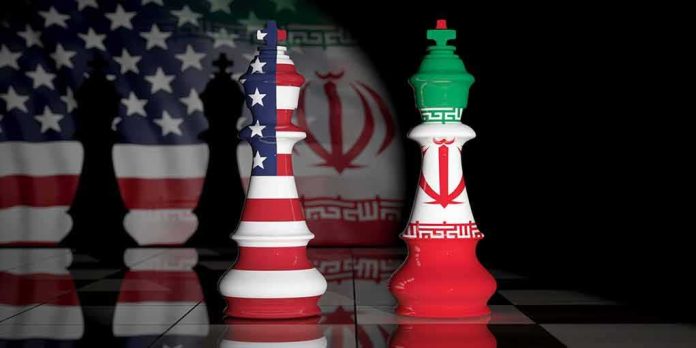
Deterrence works only when capability, credibility, and clarity align; in the U.S.–Iran contest under President Trump, Washington projected formidable capability and unambiguous red lines, but the public record shows a wobble on credibility and mixed evidence on outcomes—powerful pressure, yes, but not a verified compellence success.
At a Glance
- Trump fused explicit military threats with visible force deployments to block an Iranian dash to a bomb and force talks.
- The administration framed carrier groups and air/missile assets as defensive deterrence; the rhetoric cast them as leverage.
- Iran signaled defiance and threatened harsh retaliation, not capitulation; no public, durable rollback of enrichment emerged.
- Analysts faulted the effort for inconsistent escalation and limited evidence of compellence; coercion risks spiraling without steady credibility.
What coercive diplomacy aimed to achieve—and how it was built
Coercive diplomacy marries threats (and sometimes limited strikes) to conditional off-ramps: do X and pressure eases; refuse and costs mount. The Trump approach toward Tehran put the nuclear prohibition—“Iran cannot have a nuclear weapon”—at the center, and tied it to blunt warnings of severe punishment. This was not oblique signaling. Trump publicly set short deadlines, warned of “really bad things,” and later said the United States would resume bombing if Iran did not “behave,” explicitly linking military pressure to halting nuclear advance. The message architecture leaned on visible force as well as words: a prominent carrier deployment led by the USS Abraham Lincoln, destroyers, fighter squadrons, and layered missile defenses moved into the theater; coverage described the posture as defensive, designed to shield U.S. forces and partners even as the President framed it as leverage for a deal.
The administration also claimed prior operational success against nuclear infrastructure as proof of resolve and efficacy—asserting that U.S. strikes had “completely and fully obliterated” Iranian nuclear capabilities and warning that rebuilding would be met with renewed attacks. In coercion theory, such demonstrations are meant to raise doubt in the target’s mind about the survivability of forbidden programs while making the cost of defiance immediate rather than hypothetical. Israeli-aligned commentary reinforced this interpretation: former ambassador Danny Ayalon argued Iran would only gain legitimacy by abandoning nuclear and regional ambitions, praising Trump’s posture as showing Tehran he “means business”.
Where the evidence is strong—and where it thins out
Two pillars are well supported. First, the threats were explicit, repeated, and tightly tied to the nuclear file—this is not an inferential reading but the President’s own words, backed by compressed timelines for a deal. Second, the military presence near Iranian waters was real and publicly messaged as a deterrent shield for U.S. forces and allies even as it served diplomatic leverage. These are concrete facts of posture and policy communication.
The record is significantly thinner on two consequential claims. One is the scope and durability of strike effects on nuclear capacity. The assertion that earlier operations “obliterated” the program lacks publicly available corroboration—no IAEA post-strike safeguards reporting, no declassified U.S. battle-damage assessment, no independent forensic analysis of complex sites that would persuade a skeptical reader that enrichment and associated infrastructure were comprehensively neutralized for any meaningful span of time. The other is outcome: threats and deadlines generated negotiations and counter-threats, but there is no publicly documented Iranian concession—no verified abandonment of enrichment, no durable rollback of stockpiles, no codified renunciation of regional proxy activity traceable to this pressure window.
The credibility problem: deterrence versus compellence in practice
Deterrence asks an adversary to refrain; compellence asks it to reverse course. The latter is harder and generally demands sustained, predictable pressure. Here the evidence shows episodic surges and pauses. Trump’s escalation rhetoric was punctuated by reversals—threatened strikes then delayed or called off—which adversaries can read as time-buying opportunities rather than as a metronomic ratchet of costs. Analysts across outlets converged on the risk: a strategy that showcases U.S. capacity but sends mixed signals on follow-through can produce stalemate, not compliance. Reuters’ syntheses were blunt—coercive diplomacy had “hit a wall,” with little reason to expect larger attacks to be more effective than earlier ones. A broader policy critique, echoed by think-tank analysis, argued that Washington demonstrated it could inflict damage but not the steady commitment and strategic clarity required to compel Tehran to change core programs.
Iran’s public line, moreover, never moved toward capitulation in this period. Officials warned that aggression would be met “harshly,” defended a right to peaceful nuclear technology, and paired defiance with their own time pressure—counter-messaging that sustains domestic legitimacy and blunts the coercer’s narrative of inevitable compliance. That is familiar terrain in U.S.–Iran history: sanctions and threats often constrain and signal resolve but do not, on their own, unlock rapid policy reversals—consistent with Congressional research and the longer arc of maximum pressure politics since 1979.
This war has real costs. Fuel is up. Bases have been hit. Billions spent. Americans killed and wounded. Those facts don’t disappear because Trump is president.
But “this is expensive” is not the same as “this is pointless.” Iran has been a U.S.-designated state sponsor of terror…
— Cindy K (@MAGAMAHACindy) September 19, 2026
What would count as success—and how it could be demonstrated
For a deterrence narrative to mature into verifiable compellence success, three things need to be public or at least credibly attested: neutral technical confirmation of degraded capability, sustained behavior change by the target, and a traceable link between the pressure and that change. In the Iran nuclear file that means IAEA reporting that enrichment lines, centrifuge cascades, and stockpiles have been dismantled or reduced to defined limits; satellite forensics showing lasting damage at subterranean complexes and no rapid reconstitution; and a negotiated instrument—interim or final—that codifies constraints and inspections. None of that is in the public record for the period in question. Absent those anchors, a deterrence claim can rest on demonstrated U.S. capacity and declared red lines, but a compellence claim cannot.
Strategic consequences: leverage gained, risks accumulated
The pressure campaign delivered near-term leverage: it forced the nuclear issue to the top of Tehran’s and the region’s agenda, reassured hawkish partners, and created plausible near-term military options if Iran crossed explicit thresholds. But leverage was purchased with risk. Each deployment and deadline increased the chance of miscalculation in a theater threaded by proxies and vital shipping lanes. And the credibility penalty from public reversals accumulates; over time, adversaries test and probe between surges. That is why some assessments warn that simply adding more attacks rarely shifts the target’s calculus if the broader signaling is inconsistent—and why skeptics judged that further escalation would not extract concessions that earlier phases did not.
The durable lesson for policymakers and readers
Deterrence against Iran’s bomb is a floor of U.S. policy; compellence to reshape Iran’s broader behavior is the ceiling, and it is much higher. The Trump-era approach put muscle behind the floor and spoke loudly to raise the ceiling, but the publicly available evidence supports a narrower conclusion: credible capability and vivid threats generated pressure and deadlines; they did not, in the open record, produce the kind of verified rollback that turns coercion into an enduring settlement. If Washington seeks that outcome, it must align capability with steadier credibility and inspection-backed clarity. In this file, the physics of coercion have not changed: show you can strike, convince you will, and prove—through neutral verification—what changed as a result.
Sources:
youtube.com, english.ahram.org.eg, yahoo.com, reuters.com, israelnationalnews.com, apnews.com, aljazeera.com, pbs.org, cebri.org