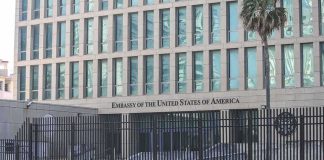

The fight over whether children born on U.S. soil to certain foreign-government employees are citizens at birth turns on a single legal hinge—what “subject to the jurisdiction” means in the Fourteenth Amendment—and whether a narrow, century-old diplomatic carveout can be stretched by executive action to cover a far broader class of government personnel.
At a Glance
- Executive Order 14418 directs agencies not to recognize birthright citizenship for U.S.-born children when neither parent is a U.S. citizen and a parent is a “foreign government employee.”
- Historically, the sole well-settled exception to birthright citizenship has been children of accredited foreign diplomatic officers—nothing broader.
- DHS implementation materials and reporting indicate categories extending beyond ambassadors to some embassy/consulate staff and international-organization personnel with immunity.
- Litigation is centered on whether the executive can expand the diplomatic exception without Congress or the Supreme Court reinterpreting the Fourteenth Amendment.
What the new policy attempts to do
Executive Order 14418 states that no federal department or agency should issue or accept documents recognizing U.S. citizenship where neither parent is a citizen and a parent is a foreign government employee, among other specified categories. The directive is framed as an enforcement of the Fourteenth Amendment’s “subject to the jurisdiction” language, not a repudiation of birthright citizenship writ large. It instructs agencies to withhold recognition rather than to rewrite the Constitution—a legal posture designed to survive administrative review by arguing it merely implements a historically recognized exception.
Contemporaneous reporting on the Department of Homeland Security’s implementation clarifies the practical reach: cases involving foreign-government employees, embassy and consulate personnel, and some individuals with international-organization immunities would encounter nonrecognition at the documentation stage, with pathways offered to lawful permanent residence rather than citizenship at birth. That administrative stance changes outcomes for affected families at hospitals, vital records offices, and passport counters; the change is operational, not theoretical.
The constitutional baseline: a broad rule with a narrow exception
American birthright citizenship rests on a simple rule refined in 1898: persons born on U.S. soil are citizens if they are “subject to the jurisdiction” of the United States. The controlling understanding—followed in agency practice, treatises, and federal regulation—recognizes a few narrow exceptions. The canonical one covers children of accredited foreign diplomatic officers, who, as a matter of international law, are not subject to the receiving state’s jurisdiction in the ordinary sense and therefore fall outside the Citizenship Clause. The State’s duty to recognize diplomatic immunity and the Fourteenth Amendment’s jurisdictional qualifier converge here; this exception is settled and long implemented in regulation.
What is not settled—because it has not been the rule—is any broader category beyond those accredited diplomatic officers. For more than a century, the line has been clear: accredited diplomats’ children are excluded; nearly everyone else born on U.S. soil is in. Attempts to extend the exception from accredited diplomats to a wider class of “foreign government employees” test the boundary between a precise immunity-based carveout and a more policy-driven category that sweeps in people who, in daily life, are fully subject to U.S. law.
How the new approach departs from the historical line
The order’s language—“foreign government employee”—is capacious. Unlike the existing regulation, which keys off accreditation and the legal status of “foreign diplomatic officer,” the new policy asserts that employment by a foreign sovereign in official capacity can suffice to defeat birthright recognition. That shift blurs an important legal distinction: diplomatic immunity is a status grounded in the Vienna Conventions and accreditation; mere government employment, even at an embassy or consulate, often does not carry comparable immunity. Several independent reports describe the contemplated reach as including embassy and consulate staff and some personnel with international-organization immunity—categories that include many individuals who are plainly subject to U.S. criminal and civil jurisdiction.
In practice, this means two neighbors working at the same consulate could face different outcomes for their U.S.-born children based on titles and immunities that are not always transparent to civil registrars. That administrative opacity invites error. It also invites litigation, because the further the policy strays from the immunity-based exception, the harder it is to square with the long-settled reading of the Citizenship Clause.
The implementation question: from constitutional theory to paperwork reality
Executive orders become real at counters and case files. The nonrecognition directive forces documentary gatekeepers—state vital records offices, the State Department’s consular affairs unit, and DHS benefit adjudicators—to ask new questions about parents’ employment and legal status. Reporting indicates DHS anticipated requiring parental information and proof of status in some documentation processes. That introduces a verification burden and potential delays for families who, under the traditional rule, would clear these steps without friction. Accuracy matters: a misclassified parent could deny a child a passport or delay a Social Security number—decisions with cascading consequences for healthcare, taxation, and schooling.
The administration’s workaround for those it deems outside the Citizenship Clause is to steer them toward lawful permanent residence from birth, echoing the long-standing green-card path available to children of accredited diplomats. That is a meaningful legal status, but it is not citizenship, and its acquisition and maintenance require a different set of filings, fees, and risks—again raising stakes for line-level accuracy.
JUST IN: DHS Creates Rule Denying Birthright Citizenship To Children Of Foreign Government Employees.
DHS just dropped an interim final rule: a child born on U.S. soil to a foreign government employee is not a birthright citizen unless at least one parent is a U.S. citizen.… pic.twitter.com/oSlK8JniOR
— Benny Johnson (@bennyjohnson) September 4, 2026
Where courts are likely to focus
The litigation roadmap is straightforward. Plaintiffs will argue that the Fourteenth Amendment’s text, as historically construed, grants citizenship to nearly everyone born on U.S. soil except the tightly defined class of accredited diplomatic officers; therefore, an executive cannot enlarge the exception to a broader, employment-based category without congressional action or a new constitutional ruling. They will anchor that position in the regulatory definition that ties the exception to accreditation and diplomatic status, not job description.
The government will respond that the order is an implementation of the “jurisdiction” qualifier and that some roles—foreign-government employees performing official functions or those holding international-organization immunities—are not meaningfully under U.S. jurisdiction at birth, placing them within the same constitutional logic as accredited diplomats. The success of that defense turns on whether courts accept an expanded equivalence between immunity, official capacity, and “not subject to the jurisdiction” for Fourteenth Amendment purposes. That is the crux.
Implications for families, agencies, and foreign relations
For affected families, the chief risk is administrative misclassification and the downstream harm of delayed documents. For agencies, the risk is error and inconsistency across 50 state vital records systems and federal adjudicators tasked with parsing unfamiliar immunity categories on tight timelines. For foreign relations, the shift invites reciprocity: countries hosting U.S. personnel may revisit how they treat the children of American government employees born abroad—usually a settled matter under jus sanguinis (citizenship by blood), but still sensitive in bilateral practice. The more the United States treats ordinary foreign-government staff as outside its jurisdiction for citizenship at birth, the easier it is for other states to analogize in ways Americans may not welcome.
How to read the road ahead
Two propositions remain durable guideposts. First, birthright citizenship in the United States is expansive by design, with a historically narrow and administratively precise exception tied to accredited diplomatic immunity. Second, executive policy can shape how that rule is administered, but it cannot refashion the constitutional boundary on its own. The order’s outcome will turn on whether courts view “foreign government employee” as a faithful proxy for the jurisdictional exception—or an overbroad surrogate that departs from the immunity-based line the law has recognized for generations. Until that question is settled, expect uneven implementation, targeted injunctions, and a premium on accurate, case-by-case determinations.
Sources:
aila.org, reuters.com, apnews.com