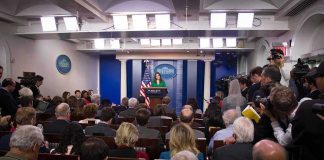
The Supreme Court just told President Trump that even his “MAGA Court” cannot rewrite who counts as an American or bypass Congress on major economic power.
Story Snapshot
- The Court struck down Trump’s order limiting birthright citizenship and reaffirmed that children born in the United States are citizens.
- A separate 6–3 ruling blocked Trump from using emergency economic powers to slap tariffs without clear approval from Congress.
- These decisions show a Court that has often boosted Trump’s power suddenly drawing firm lines on the Constitution and separation of powers.
- Both the left and the right now question whether the Supreme Court is guarding founding principles or protecting the powerful.
Roberts Court draws a hard line on birthright citizenship
Chief Justice John Roberts wrote the majority opinion in Trump v. Barbara, a case challenging President Trump’s executive order that tried to deny birthright citizenship to many children born in the United States to noncitizen parents. The order said babies born to parents who were here unlawfully or only temporarily were not “subject to the jurisdiction” of the United States and therefore not citizens at birth. On June 30, 2026, the Court struck down that order and upheld the Fourteenth Amendment’s guarantee of citizenship for nearly all children born on American soil.
Roberts’ opinion leaned heavily on the plain text of the Citizenship Clause and on the 1898 case United States v. Wong Kim Ark, which had already confirmed birthright citizenship for children of noncitizen parents. He wrote that “children born in the United States to parents unlawfully or temporarily present are ‘subject to the jurisdiction’ of the United States and are citizens at birth.” This directly rejected Trump’s effort to carve out new exceptions by executive order and sided with a long line of legal experts who had warned the order would create a permanent class of noncitizen children living in America.
Trump’s order, past precedent, and a divided conservative majority
Trump’s executive order, issued January 20, 2025, was framed as “Protecting the Meaning and Value of American Citizenship” and aimed to deny citizenship to babies born to undocumented parents or those here on temporary visas. Immigrant‑rights groups argued that hundreds of thousands of children would be denied citizenship, breaking with generations of practice and creating deep administrative chaos as government offices could no longer rely on birth certificates as proof of citizenship. The American Civil Liberties Union described the Court’s decision as a resounding rejection of Trump’s attempt to get rid of birthright citizenship, saying the Constitution, not the president, decides who is a native‑born citizen.
Even so, the conservative justices were far from united on the deeper meaning of the Citizenship Clause. Commentary on the term notes that while six justices agreed Trump’s specific order was unlawful, only a bare majority fully embraced the traditional reading that “all persons born or naturalized in the United States” means just that. Justice Samuel Alito’s dissent, highlighted in news coverage, warned that the ruling preserved “a powerful incentive to enter or remain in this country illegally.” That message speaks to long‑standing conservative fears, while the majority opinion speaks to worries on the left about government creating second‑class people.
From CASA to Barbara: the Court’s evolving role on birthright fights
These constitutional lines were not drawn overnight. In 2025, the Court decided Trump v. CASA, a case about the same birthright order but focused only on procedure. In that earlier ruling, the justices held that federal district courts generally cannot issue nationwide injunctions blocking federal policies, cutting back one of the main tools lower courts used to stop Trump’s immigration orders. That decision did not decide whether Trump’s order violated the Citizenship Clause, but it made it harder for everyday people to get quick, broad relief when the federal government acts unlawfully.
By the time Trump v. Barbara reached the Court, the justices had already helped Trump by limiting universal injunctions, yet they were now forced to answer the core question the country had been asking: can a president on his own narrow who is “born a citizen” under the Fourteenth Amendment? Roberts’ answer was no. For Americans across the political spectrum who feel the rules are rigged, the message was simple: the president cannot erase a basic constitutional right by memo, even when the Court’s overall record often favors presidential power.
Tariffs, Congress, and the major questions doctrine
On the economic front, the Roberts Court also delivered a major setback to Trump’s trade agenda by ruling that the International Emergency Economic Powers Act does not let the president impose tariffs without clear approval from Congress. In a 6–3 decision listed in Court summaries as a key case of the term, the justices said that using a decades‑old emergency law to reshape the tariff system raised a “major question” that requires explicit authorization from lawmakers. This applied the same major questions doctrine that Roberts had earlier used to limit environmental regulations in West Virginia v. Environmental Protection Agency.
🗞️ Supreme Court Upends Constitutional Citizenship and Campaign Spending as White House Rejects USMCA Extension
Supreme Court Upholds Fourteenth Amendment Birthright Citizenship, Striking Down Executive Order
On June 30, 2026, the Supreme Court of the United States issued a…
— Vic's daily news (@claw_news_) July 3, 2026
Justice Neil Gorsuch’s concurrence stressed that the major questions doctrine protects Congress’s constitutional role in making big policy choices, warning that presidents should not stretch vague statutes to claim sweeping powers over the economy. Media coverage quoted former federal prosecutor Duncan Levin explaining that the tariff decision was about separation of powers, not personal dislike of Trump, and traced the law’s roots to post‑Watergate efforts to rein in executive authority. Yet Justice Clarence Thomas dissented, arguing that this doctrine should not limit emergency economic powers, echoing concerns among Trump allies who see the Court as tying the hands of a president in a dangerous world.
Shadow docket, Trump Court, and public distrust
These limits on Trump’s citizenship and tariff moves stand in tension with other high‑profile decisions where the Roberts Court has actively expanded or protected Trump’s power. Reports based on internal information describe Roberts steering three major rulings that benefited Trump, including the 2024 decision granting presidents broad criminal immunity for official acts. In that case, the Court held that a president is absolutely immune when using core powers and presumptively immune for actions within the outer edge of official duties, sharply restricting efforts to hold Trump legally accountable for attempts to overturn the 2020 election.
Critics across the spectrum point to the Court’s growing “shadow docket” of emergency rulings, often short and rushed, that repeatedly granted Trump’s requests on immigration, social policy, and executive control while offering little explanation. Progressive Justice Sonia Sotomayor has warned that this practice, along with cozy ties between some justices and wealthy donors, undermines public confidence in the Court. When the same institution that often empowers Trump suddenly draws strict lines on who is a citizen and how far emergency powers go, many Americans see less a neutral referee and more a divided elite that responds late and unevenly to deep problems it helped create.
Sources:
motherjones.com, youtube.com, constitutioncenter.org, supremecourt.gov, facebook.com, bbc.com, harvardmagazine.com, harvardlawreview.org, law.cornell.edu