
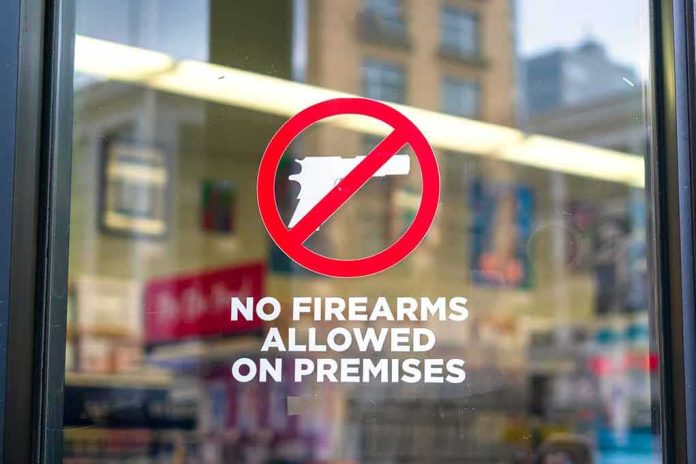
Hawaii’s default-rule gun law matters because it shows how, after Bruen, states have tried to regulate public carry indirectly rather than by banning it outright—and the Supreme Court has become increasingly hostile to that maneuver. The constitutional fight is not about whether private owners may exclude guns; it is about whether the government may flip the usual default and make silence equal a crime.
Intro Header
- The core dispute is over who sets the baseline on public-facing private property: the state or the owner.
- The challengers say Hawaii’s rule turns an ordinary concealed-carry license into a fragile privilege that vanishes in everyday places.
- Hawaii argues the law simply protects the property owner’s right to exclude armed entrants.
- The Court’s review has been narrowly framed, but the issue has broader significance for similar laws in other states.
What Hawaii’s Rule Actually Did
Hawaii’s law required licensed concealed-carry holders to obtain express authorization before carrying handguns onto private property open to the public unless the owner posted clear permission or gave written or verbal consent. That sounds modest until one examines how modern life works: daily errands routinely move through gas stations, stores, restaurants, and other privately owned spaces that function as the state’s public square. The challengers argued that because most owners do not post gun policies at all, the default rule effectively converted broad swaths of ordinary life into no-carry zones. Their petition described the law as a near-total ban on public carry in practical effect.[7]
The plaintiffs’ point was not that private businesses lose their prerogative to exclude firearms. It was that Hawaii transferred that prerogative from owners to the state by criminalizing carry when the owner is silent. In other words, the law did not merely enforce a business’s explicit decision; it made the absence of an affirmative invitation into a legal barrier. That distinction is the whole case. Under the challengers’ theory, the Second Amendment right to bear arms in public cannot survive if the government may presume prohibition everywhere unless a private person takes the extra step of granting permission.[1][6]
Why This Became a Bruen Test Case
The case sits squarely inside the post-Bruen landscape. In 2022, the Supreme Court rejected means-end balancing for public-carry restrictions and replaced it with a text-and-history inquiry: if the Second Amendment’s plain text covers the conduct, the government must show a historical tradition of comparable regulation.[19][25] Hawaii’s defenders tried to meet that test by recasting the law as a property-rights measure rather than a carry restriction. The state’s basic position was that the right to bear arms does not include a right to override the implied license that ordinarily allows the public to enter private premises.[3]
That framing is legally shrewd, but it is also the vulnerability. The challengers’ brief argued that there is “no comparable historical—or even modern-day—tradition” of a government-imposed no-carry default for private property open to the public.[1] The federal amicus brief supporting the challengers said the Hawaii statute “flips the tradition” by making public carry illegal unless private owners affirmatively override the state’s preference.[6] That is the jurisprudential pressure point: Bruen tolerates historically grounded regulation, but it does not give states a blank check to redesign the baseline rules of lawful carry by administrative default.[19][25]
Where Hawaii’s Defense Is Strong—and Where It Runs Thin
Hawaii’s strongest argument is conceptual rather than historical. Private property owners plainly have the right to exclude firearms from their own premises, and the state can plausibly say it is helping enforce that right. The 9th Circuit accepted that logic in 2024, which gave the state a judicial foothold before Supreme Court review.[3][8] The state also leaned on a broader tradition of owners controlling who may enter and on the idea that the Second Amendment does not create a right to carry firearms into another person’s space by default.[3][9]
But the weakness in that defense is that it collapses two distinct things: a private owner’s right to say no, and a government’s power to presume no unless the owner says yes. Bruen requires more than a general appeal to property rights; it requires a relevant historical analogue for the specific regulatory mechanism at issue. The materials in the record do not show Hawaii producing a concrete 18th- or 19th-century tradition of government-imposed no-carry defaults on public-facing private property.[2][7] That omission matters because it leaves the state arguing from first principles while the challengers argue from the actual legal test the Court now applies.[2][19]
The other practical weakness is evidentiary. Hawaii and its supporters could say the rule merely regulates a category of locations, but the challengers responded with a functional claim: for ordinary people moving through daily life, the rule reaches so many places that it becomes prohibitive in practice.[5][7] That kind of argument can be overstated if not supported with hard compliance data, yet the Court’s skepticism at argument suggests the justices were not persuaded that the rule preserved a meaningful public-carry right.[2][9] In the post-Bruen era, practical burden and historical pedigree travel together; a law that looks like a workaround is unlikely to fare well.
The Narrow Legal Issue That Carries Broad Consequences
The Court’s review focused on the private-property default rule rather than every part of Hawaii’s broader sensitive-places framework, which means the case is narrower than the rhetoric around it.[5][8] That narrowness is important. It prevents overreading the decision as a blanket rejection of every place-based gun restriction, and it leaves room for states to regulate truly sensitive places if they can tie those restrictions to history. But narrow does not mean trivial. A ruling that the government may not impose a presumption of no-carry on public-facing private property would limit one of the most sophisticated end runs around Bruen.[1][4]
That is why the case resonated far beyond Hawaii. Similar laws in other jurisdictions attempted to preserve public gun restrictions by shifting the burden onto permit holders to secure permission everywhere they go. If that structure fails constitutional scrutiny, states will need to return to more traditional forms of regulation—specific sensitive-place restrictions, explicit trespass enforcement by owners, or historically grounded disarmament rules tied to recognized categories of danger.[5][23] The larger lesson is institutional as much as doctrinal: after Bruen, the Court is increasingly unwilling to let states do indirectly what they cannot do directly.[19][25]
SCOTUS struck down the law that Hawaii had that blanket prohibited firearms in private businesses held open to the public without specific permission (signage or verbal) that welcomed firearms.
By striking down this law, by default, Hawaiians can enter a private business with…
— Ryan Knoll (@ryknoll3) June 25, 2026
What the Record Shows About the Court’s Direction
The available coverage and argument summaries point in the same direction. Reporters described a skeptical Court, and the challengers’ position was reinforced by the federal government’s amicus support, which adopted the view that Hawaii’s law nullifies the general right to publicly carry arms recognized in Bruen.[2][6] The 9th Circuit’s earlier approval of the law mattered, but not enough to supply the kind of historical grounding the Supreme Court now demands.[3][8] When the state’s best argument is that its law is a clever way to preserve property rights, the doctrine itself becomes the obstacle.
The deeper significance is that this case is less about firearms than about constitutional evasion. Modern legislatures often discover that direct bans are vulnerable, so they build layered restrictions that preserve the same practical result through defaults, permissions, and procedural friction. Wolford v. Lopez is a test of whether that strategy can survive when the right at issue is framed, as Bruen framed it, as a right to carry arms in public for self-defense. The evidence in the record indicates the Court answered no.
Sources:
[1] Web – SCOTUS Overturns Hawaii’s Default Rule Against Guns on Private …
[2] Web – Supreme Court skeptical of Hawaii’s ‘vampire rule’ for gun owners
[3] Web – [PDF] brief – In the Supreme Court of the United States
[4] Web – [PDF] IN THE SUPREME COURT OF THE STATE OF HAWAI’I —o0o
[5] Web – Hawaiʻi AG To Supreme Court: Gun Control Is Hawaiian Tradition
[6] Web – What’s at Stake in Wolford? Supreme Court Grants Cert to Review …
[7] Web – LISTEN: Supreme Court hears case on law banning guns … – PBS
[8] Web – Hawaii’s strict gun law faces Supreme Court scrutiny in landmark case
[9] YouTube – Can businesses ban guns? U.S. Supreme Court weighing case in …
[19] YouTube – Supreme Court to Decide Private Property Gun Ban Case — Hawaii Law …
[23] Web – [PDF] The Standardless Second Amendment – American Constitution …
[25] Web – [PDF] Second Amendment Federalism – Stanford Law Review