
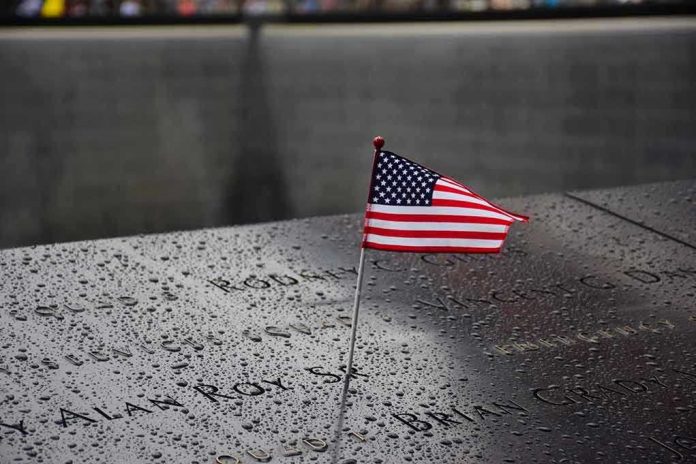
Twenty-five years on, 9/11 remains a living reference point in American civic memory: most adults still see it as a defining rupture that changed the country’s trajectory and believe it should be actively remembered.
At a Glance
- Majorities describe 9/11 as a defining event that fundamentally changed the nation and should be remembered.
- The 25th‑anniversary CBS News/YouGov survey continues a durable pattern seen at the 10th and 20th anniversaries.
- Remembrance consensus persists even as Americans detect less social unity today than immediately after the attacks.
- Anniversary polls reward clarity over nuance; understanding what these surveys measure—and don’t—matters.
What the 25th‑anniversary polling actually shows
The headline finding is straightforward: a CBS News/YouGov survey fielded ahead of the 25th anniversary reports that Americans continue to view the September 11 attacks as a central, identity‑shaping event and say it should be remembered. CBS describes a nationally representative sample—fielded September 1–4, with several thousand adults—designed and weighted to reflect the U.S. population. The topline sits comfortably within a long series of similar results from CBS at earlier milestones, including the 20‑year mark, when “forever changed” was also the modal judgment and personal recall of the day remained acute.
Two complementary themes recur. First, the normative one: “remembering” 9/11 is not a contested proposition in these data; large pluralities to majorities deem it important. Second, the sociological one: respondents commonly report that the country feels less unified now than it did in the immediate aftermath, while believing that, if confronted with a comparably grave threat, Americans would again rally. That combination—firm remembrance, nostalgia for post‑attack unity, skepticism about present cohesion—has characterized anniversary polling for more than a decade.
Why these results are durable across years and firms
Anniversary surveys are, by design, memory instruments. They cue collective recollection, ask respondents to situate the attacks within their personal and national narratives, and surface judgments about consequence rather than detailed policy views. As a result, the core items tend to be sticky across time and vendors. YouGov’s recent 25‑year check finds a majority favoring some formalized commemoration—half support making September 11 a national holiday—and pluralities who think public attention to 9/11 is about right or too low. CBS’s 20‑year survey echoed the same arc of durable memory, perceived national transformation, and lasting sadness. These are not fragile findings likely to flip with a week’s headlines; they are slow‑moving indicators of civic memory.
Methodologically, both the CBS/YouGov and stand‑alone YouGov instruments rely on large national samples and standard weighting to correct for demographics and participation patterns. While the exact sample sizes, margins of error, and question wording vary by survey, the convergent pattern—broad remembrance, “changed country,” and qualified concern about national unity—has been consistent enough across cycles to treat as a genuine public sentiment rather than an artifact of a single questionnaire.
How to read the unity and “changed country” findings without overreading them
“Changed country” is a capacious phrase. It captures policy shifts—the creation of the Department of Homeland Security, changes to surveillance authorities, and two decades of counterterrorism posture—but it also captures culture: airport rituals, media frames, and how generations talk about risk. Poll questions do not adjudicate which dimension respondents have in mind; they register the judgment that the attacks reorganized American life. That is why the measure stays high even as specific threat perceptions wax and wane over time in other polls. A 2013 YouGov/Economist instrument, for example, found Americans drifting toward prioritizing domestic concerns over confronting enemies abroad; that did not diminish the sense that 9/11 had reordered national priorities.
The unity item requires similar discipline. Respondents routinely say Americans feel less unified today than in the months after 9/11—an unsurprising result given the unique, short‑lived solidarity forged by a national trauma—and simultaneously predict that the country would cohere again under comparable stress. These are not contradictions so much as a recognition that the extraordinary cannot be the baseline. When CBS’s 20‑year poll recorded deep emotional memory alongside an acknowledgment of frayed social fabric, it was tracking this same intuition.
Continuity with past CBS polling—and what’s new at 25 years
At the 10th anniversary, CBS reported high levels of worry about another attack; by the 20th, worry had moderated even as the “forever changed” frame held. The 25th‑anniversary profile maintains the memory and “changed country” consensus while layering in generational distance: more adults now came of age after 2001, yet the expectation of remembrance persists. When YouGov asked whether September 11 should be a national holiday, a narrow majority agreed—evidence that the commemorative impulse has institutional, not just emotional, support.
If there is a tonal shift at 25 years, it lies less in threat perception than in the maturity of memory. The responses suggest that Americans have integrated 9/11 into the nation’s long arc of formative trials—wars, assassinations, economic convulsions—while resisting the flattening that time sometimes imposes. The memory has stabilized without being trivialized; people still report sadness and a sense of irrevocable change, but they are also rating remembrance as a civic duty rather than a live policy debate.
Mamdani should respect the wishes of the families that lost their loved ones….@NYCMayor
Petition from 9/11 families asks NYC Mayor Zohran Mamdani not to attend remembrance ceremony – CBS New York https://t.co/sPbH1Hf2lK
— Bill (@BillMcCaul71441) September 8, 2026
What anniversary polls measure—and what they don’t
Several caveats help keep the findings in proportion. First, anniversary polling is a snapshot of civic memory, not a referendum on discrete counterterrorism policies or intelligence tradeoffs. It tells us that the event remains salient and normatively central; it does not specify which lessons respondents would apply to present‑day security choices. Second, the incentives around anniversaries favor clear, emotionally legible frames. Newsrooms and polling partners know these stories draw engagement; consequently, the most resonant themes—changed country, unity, remembrance—are rightly featured but can overshadow methodological nuance about question wording or subgroup variation. The answer is not cynicism but careful reading: treat these surveys as valid measures of memory and meaning, not as granular program evaluations.
Implications for institutions charged with remembrance
For schools, museums, veterans’ and first‑responder organizations, and elected officials, the through‑line is practical: there remains broad public support for intentional remembrance. Institutions that steward commemorations—curricula that teach the facts without sensationalism, museum programming that honors victims and explains context, civic ceremonies that invite service rather than spectacle—are operating with a mandate, not pushing against it. The CBS and YouGov findings suggest that Americans will back efforts that keep the memory accessible to those without lived recall, including the youngest adults who learned about 9/11 as history rather than experience.
The bottom line
Across a quarter‑century, the public’s core judgment has scarcely budged: 9/11 changed the country, and remembering it matters. That consistency across multiple surveys and milestones is the story. Disagreements over policy legacies or the state of current unity are real, but they sit atop a stable foundation of shared memory. For a nation often described as polarized, the endurance of that foundation is itself a civic asset—one institutions can build on with confidence.