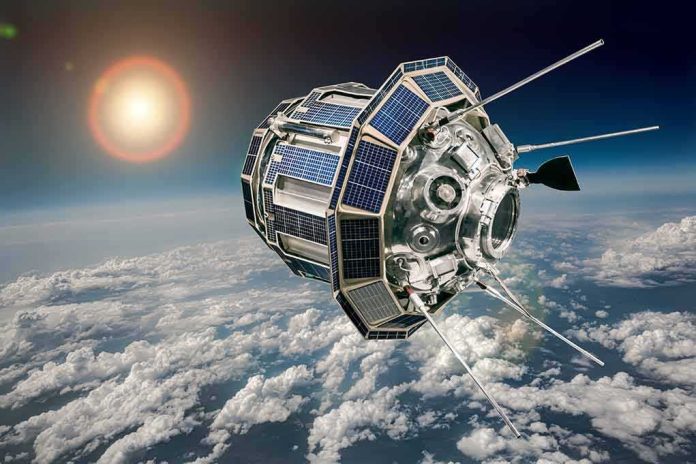
America just put a two‑armed robot spacecraft into orbit that can grab satellites—and even Northrop Grumman’s own CEO now refuses to rule out using it as a weapon.
Story Snapshot
- Northrop’s Mission Robotic Vehicle (MRV) is built to rendezvous with, grapple, and physically modify satellites in orbit.
- The same robotic arms that attach “jetpack” propulsion pods could, in theory, push, twist, or damage another country’s spacecraft.
- Northrop’s CEO said whether there is an “offensive version” of MRV is up to the U.S. government, feeding fears of weaponized space robots.
- The project grew out of a Defense Advanced Research Projects Agency (DARPA) program and is openly tied to national security goals.
A Space Robot That Can Grab Other Satellites
Northrop Grumman’s Mission Robotic Vehicle is a new spacecraft now in geosynchronous orbit, tens of thousands of miles above Earth. It carries two long robotic arms and a toolkit designed to let it approach other satellites, lock on to them, and install small propulsion “jetpacks” called Mission Extension Pods. These pods can give aging communication satellites up to six or eight more years of life, saving companies and governments from buying new hardware.
Northrop describes the MRV as the first commercial robot spacecraft able to repair, relocate, and upgrade satellites in that high orbit. It can inspect strange behavior, adjust orbits, fix some mechanical problems, and install new payloads. To do that, it must perform very close‑in maneuvers around billion‑dollar spacecraft and then use its arms to grapple them by key structures such as engine nozzles. That same close‑in access is exactly what worries military planners and everyday citizens alike.
Servicing Mission On Paper, Dual‑Use Tool In Reality
On paper, the MRV is a servicing vehicle, not a weapon. Company fact sheets and launch coverage talk about inspection, life extension, repairs, debris removal, and repositioning in orbit, all framed as “space sustainability.” The technology payload comes from the Robotic Servicing of Geosynchronous Satellites program run by the Defense Advanced Research Projects Agency, which was sold to the public as a way to keep U.S. satellites healthy and reduce space junk. None of these documents openly say the MRV will attack anything.
Yet the same sources confirm the key point that critics focus on: MRV can rendezvous, dock, and physically manipulate other satellites. Its robotic arms are strong and dexterous enough to grab, steer, and bolt hardware onto client spacecraft. It has ports for future tools, meaning engineers can design new end‑effectors for different tasks later on. In simple terms, this is a space robot built to touch other satellites and do real mechanical work on them, which is exactly what you would need to either help a satellite—or harm it.
Northrop’s CEO Leaves Weaponization To The Government
The debate spiked when Northrop Grumman CEO Kathy Warden spoke on a 2026 earnings call. An analyst asked if there was a market for an “offensive version” of MRV that could disable other satellites. Warden did not deny the idea or say such use would be off limits. Instead, she replied, “I will leave it up to the U.S. government to decide how that capability might fulfill mission objectives.” She added that providing “technical options” is the company’s goal.
That answer matters because it confirms the company sees MRV as a flexible platform the government can use as it chooses. Russian and Chinese outlets quickly highlighted the quote, warning that the robot arms could be used to drag enemy satellites off orbit or snap vital solar panels and antennas. Their coverage may be propaganda, but the basic physics is simple enough for anyone to grasp: if a robot can safely grab and move a friendly satellite, it can also grab and move—or twist or shove—a hostile one.
Why Both Left And Right See A Deep‑State Problem Here
For many Americans, the MRV story taps into a deeper worry that the federal government and defense contractors now build tools that serve them first and the public last. Conservatives already distrust “globalist” elites and huge military‑industrial firms that profit from endless security projects. Liberals worry about secret weapons programs and growing gaps between ordinary people and well‑connected defense companies. A multibillion‑dollar space robot, born in a defense lab and marketed as “strategic advantage,” fits both nightmares.
Northrop Grumman’s novel Mission Robotic Vehicle (MRV) and three “jetpack” pods were lifted into orbit Tuesday night, kicking off the company’s next batch of efforts designed to extend the life of aging satellites. https://t.co/YAaA59AdfH pic.twitter.com/GhWYJh3IbK
— DefenseScoop – @defensescoop.bsky.social (@DefenseScoop) July 23, 2026
Northrop openly says this technology will help provide a strategic edge against adversaries. Yet the same public material never spells out hard limits on what the robot may or may not do to another nation’s satellites. There is no released contract clause banning non‑cooperative seizures or attacks in orbit. That silence feeds the sense that the real decisions are happening inside a “deep state” world of classified documents and quiet understandings, far from any meaningful voter control.
What We Know, What We Do Not, And Why It Matters
There is still no proof that MRV is currently loaded with weapons or being flown on attack missions. All confirmed operations so far are about attaching jetpacks to aging satellites and extending their lives. But experts across the world agree that servicing technology and counter‑space technology now overlap almost completely. Once you have robots, sensors, and software good enough to approach and handle a satellite, turning that into an anti‑satellite system is more a policy choice than a technical leap.
That is why many call for real oversight: full release of program requirements, sworn testimony from engineers, and clear rules that ban turning MRV into an orbital battering ram. Without that, Americans on both the left and right are left to wonder whether yet another powerful tool was built with their tax dollars, sold as “helping,” but ready to serve undisclosed missions in a future crisis. At a time when many feel shut out from the American Dream, watching space robots quietly edge toward weapon status only deepens the trust gap.
Sources:
realcleardefense.com, news.northropgrumman.com, northropgrumman.com, satellitetoday.com, spacenews.com, apnews.com, youtube.com