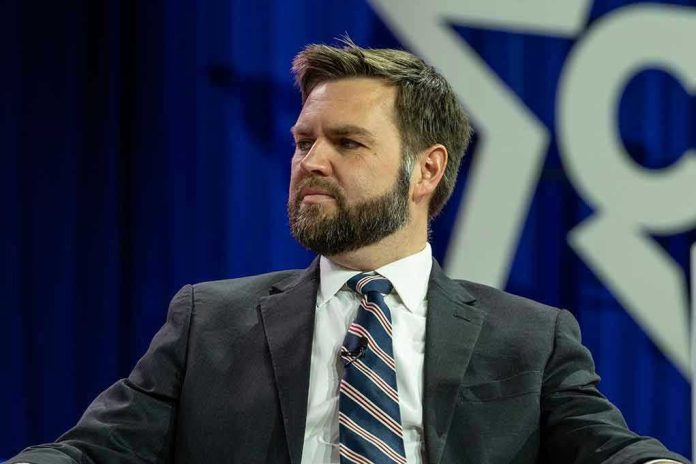
As Vice President J.D. Vance tears into what he calls the “fake news media,” millions of conservatives see a long-overdue reckoning with a press corps they believe has lied about them for years.
Story Snapshot
- Vance is turning the Trump-era “fake news media” charge into a central theme of the new administration’s communications strategy.
- His rhetoric reflects years of conservative frustration with media bias, coastal elitism, and attacks on traditional American values.
- Mainstream outlets respond with fact-checks and denunciations, which many on the right see as proving Vance’s point.
- Experts warn the clash will shape how Americans get information, trust institutions, and judge future elections.
Vance’s Viral Clash With The “Fake News Media”
The headline “MUST WATCH: Vice President Vance RIPS the fake news media” fits a growing pattern: short, hard-hitting clips packaged for conservative audiences who are tired of being lectured and smeared. In these moments, Vance channels years of anger at networks and newspapers that framed border security as “racist,” painted parents as extremists, and treated Trump voters as problems to be managed, not citizens to be heard. For many viewers, Vance is finally saying directly what they have thought for a decade.
According to reporting on his public remarks, Vance leans heavily on the word “fake,” using it not only for media but also for polls, political narratives, and what he calls a “fake economy” built by elites who profit while working families fall behind. He argues that legacy outlets often ignore real wages, crime, and border chaos to protect a globalist agenda. When those outlets turn around and “fact-check” him, conservative audiences see more spin than scrutiny, reinforcing the belief that the referees are players on the other team.
From Trump’s “Fake News” To Vance’s “Fake System”
Donald Trump first weaponized the label “fake news” when major outlets pushed narratives that later collapsed, from Russia collusion storylines to repeated predictions that his movement was finished. Vance has picked up that banner and broadened it, portraying a “fake system” run by media, bureaucrats, and corporate interests who profit from porous borders and endless culture wars. For voters burned by inflation, COVID mandates, and open-border chaos under Biden, that story sounds far closer to lived experience than cable-panel lectures ever did.
Critics in left-leaning commentary insist that branding journalists “fake” is an ad hominem attack on the press itself, not a serious critique of coverage. They accuse Vance and Trump of undermining democratic norms by questioning the media’s role as neutral watchdogs. Yet conservative viewers remember years when those same outlets downplayed riots, cheered censorship of dissenting views, and labeled concerns about election integrity as dangerous “disinformation.” That history makes it hard to accept lectures about “protecting democracy” from the very institutions many blame for misleading them.
A Media War With Real-World Consequences
The back-and-forth between Vance and the press is not just rhetorical theater; it shapes how Americans process every major issue. When mainstream anchors quickly frame new Trump immigration policies as “cruel” or “anti-immigrant,” many conservatives hear opinion masquerading as fact. When reporters highlight every misstep in the administration but gloss over failures in blue states and big-city crime, trust erodes further. Vance’s jabs at “fake news media” resonate because people already feel gaslit about the border, inflation, and attacks on religious and family life.
Researchers who track conspiracy theories warn that a low-trust environment lets bad information spread faster. But many conservatives argue that trust collapsed not because of Vance’s rhetoric, but because institutions earned that distrust by getting big stories wrong and never truly owning it. From censored laptop stories to shifting narratives on COVID, Americans watched powerful outlets close ranks to protect preferred candidates and causes. Against that backdrop, Vance’s sharp pushback looks less like reckless norm-breaking and more like overdue accountability for a media class that never admits its own role in fueling division.
What This Means For Conservatives Going Forward
For Trump supporters and traditional conservatives, the fight over “fake news media” is about far more than personality clashes. It is about who gets to define reality on core questions: whether the southern border is an “invasion” or a “challenge,” whether parents are “domestic threats” or the backbone of the country, whether defending the Constitution and the Second Amendment is “extreme” or simply American. As long as major outlets frame these debates through a progressive lens, leaders like Vance will find a willing audience for their charges of bias and fakery.
Looking ahead, conservatives will have to navigate a media environment where trust is fractured and every big story arrives preloaded with spin. Vance’s confrontational stance gives many on the right a voice that finally hits back, but it also raises the stakes: when no shared referees exist, citizens must do more homework themselves. For readers who cherish faith, family, the Constitution, and secure borders, that means being vigilant, asking hard questions of every outlet, and refusing to let any “fake” narrative drown out the country they know firsthand.
Sources:
The real reason J.D. Vance calls everything fake – Politico
Expert on conspiracy theories explains latest national hoax – University of Cincinnati
JD Vance’s fifty shades of lies – Baptist News Global
Vance at Turning Point – WBUR / NPR
Morning Joe fact-checks J.D. Vance’s false statements – MSNBC