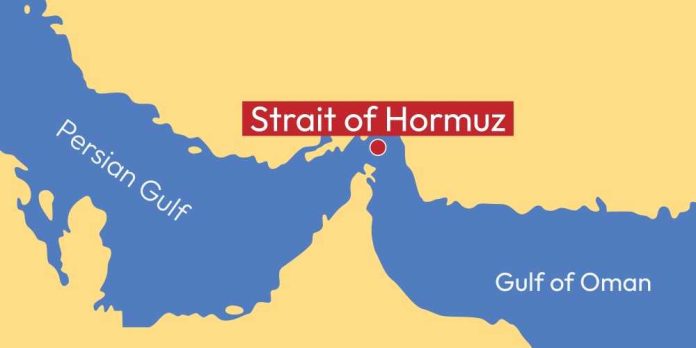
A peace deal that President Trump says has “reopened” the Strait of Hormuz is now colliding with live ship trackers that still show a near-standstill in tanker traffic.
Story Snapshot
- President Trump says a U.S.–Iran peace deal is “complete” and the Strait of Hormuz is reopening toll free.
- Independent vessel dashboards still show shipping traffic at a fraction of normal levels, with many ships stranded.[2]
- Reports suggest parts of the agreement may be a framework still waiting for signatures and on-the-ground steps.[2]
- Energy markets and American families are watching to see if this deal really lowers prices or stalls out.[6]
Trump Declares Iran Deal Complete And Blockade Ending
President Donald Trump has told the American people that the peace deal with Iran “is now complete” and that the Strait of Hormuz will reopen, toll free, with the United States naval blockade lifted.[3] In his public remarks and social media posts, he framed the agreement as a finished deal that will end the war, let oil flow, and calm world markets.[1] Major networks repeated that language, treating the accord as a landmark moment after months of rising tension.[5]
Television clips and breaking news banners showed Trump announcing that ships will again move through the strait without U.S. warships stopping them, stressing that the goal is peace through strength and relief for consumers hit by high energy costs.[4] Supporters quickly cast this as a victory for American resolve after years of weak Iran policy under past leaders.[6] Allies like Pakistan and Qatar were cited as helping broker the understanding between Washington and Tehran, signaling wider regional support.[7]
Live Ship Trackers Tell A Slower, Messier Story On The Water
While the White House calls the deal complete, independent vessel monitors still show a strait that is far from normal. One real-time dashboard that has tracked the crisis reports that traffic remains near zero compared with an average of about sixty ships per day in normal times, with more than one hundred fifty commercial vessels stranded.[2] Throughput is listed at under two percent of usual daily cargo weight, a sign that the bottleneck has not yet cleared in practice.[2]
Another live monitoring site described an “unprecedented and alarming operational freeze” in outbound commercial traffic, highlighting days with no verified departures at all.[1] That same source warned that the freeze has severe economic implications as oil and goods remain stuck on both sides of the choke point.[1] Public vessel maps that everyday users can view still show clusters of tankers loitering near the Persian Gulf and Gulf of Oman, waiting for clear and safe passage before they risk moving.[5]
Is This A Finished Peace Or Just A Framework On Paper?
Some coverage of the talks has raised doubts about how “complete” the deal really is, even as cameras captured Trump’s confident tone.[2] One report said the agreement is best understood as a framework, with a more formal memorandum to be signed in Switzerland, meaning important terms and timelines may still need to be locked in.[2] At earlier stages, officials also spoke of suspending military operations in the strait due to “progress in the negotiations,” which suggested a step-by-step process rather than a single final moment.
Commentary on recent U.S.–Iran diplomacy notes a pattern where leaders announce historic breakthroughs before technical teams finish the hard work of enforcing them on the ground.[2] That pattern seems relevant now, as the public hears of an open, toll-free Strait of Hormuz while independent trackers still show a closed or barely moving waterway.[2] Until Iranian authorities, ship owners, and insurers all see and trust a signed document and clear security rules, many will likely move slowly and test the new reality in small stages.
What This Means For American Energy Costs And Security
Energy watchers say that a true reopening of the Strait of Hormuz matters because a large share of the world’s oil moves through that narrow channel every single day.[6] Earlier fighting and the U.S. naval blockade sent prices higher and rattled markets, straining family budgets already hit by years of inflation and heavy federal spending.[6] Some investors have already reacted to Trump’s announcement with sharp moves in oil and stock prices, betting that peace will last and shipments will resume.[6]
Dow futures jumped 380 points and crude fell more than 4% after Trump announced a framework peace deal with Iran, including plans to reopen the Strait of Hormuz.
— Fidget (@Fidget_Finance) June 15, 2026
Conservative Americans will be watching two things in the days ahead. First, whether live vessel trackers finally show daily traffic returning toward normal, proving that the deal is more than words.[2] Second, whether Iran respects its commitments or uses any pause to regroup and threaten shipping again, as it has done in the past. For now, the deal looks like a serious step toward easing the crisis—but the real test will be on the water and in your wallet.
Sources:
[1] YouTube – LIVE: Strait of Hormuz vessel traffic as Trump says deal with Iran is …
[2] YouTube – Trump confirms deal with Iran and opening of Strait …
[3] YouTube – Trump Announces Iran Agreement and Reopening of Strait …
[4] YouTube – ‘Let the oil flow!’: Trump says US makes deal with Iran to …
[5] YouTube – Trump announces U.S.-Iran deal, says blockade on Strait …
[6] Web – Trump says U.S.-Iran deal “is now complete,” U.S. ending …
[7] YouTube – Trump Watches UFC as US-Iran Announce End of War …