
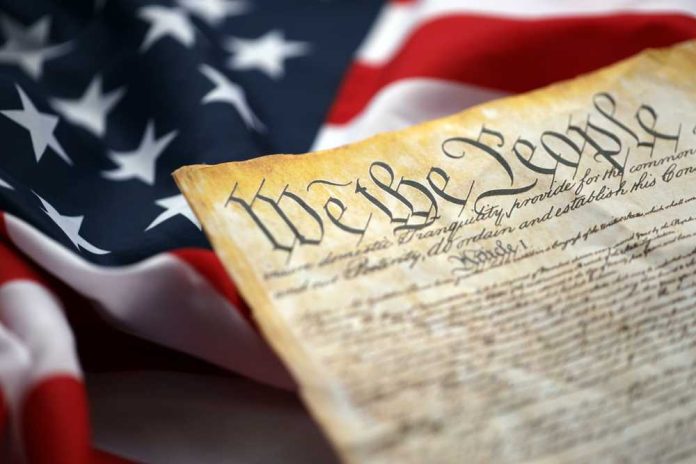
The real story is not simply that Americans like the founding; it is that the civic core of the republic still commands broad assent, even as the meaning of “teaching America” has become more contested in schools and politics. The evidence supports confidence about public reverence for the Declaration, the Constitution, and the Bill of Rights, but it does not show that Americans specifically want schools to “teach capitalism” in any direct or measured way.
Intro Header
- Most Americans still identify the founding ideals as central to American identity, not ancestry or religion.
- Public favorability toward the Constitution remains extraordinarily high, and large majorities still see the founding as a force for good.
- The available research supports a strong appetite for civic instruction about founding principles, but not a clean, direct measure of support for capitalism instruction.
- Generational differences matter: younger Americans are more likely to frame national values in terms of tolerance, dignity, and institutional reform.
What the polling actually shows about the founding
The strongest evidence in this package points in one direction: Americans continue to treat the founding documents as a legitimate civic canon. In the Discovery Institute survey, 62.1% said a true American should agree with the ideas in the Declaration of Independence, 64.3% said the same of the Constitution’s form of government, and 71.3% said the same of the freedoms protected by the Bill of Rights.[1] That is not a fringe preference. It is a broad statement that American identity is still, in the public mind, tied to a shared political creed rather than bloodline or creed.
The Cato/YouGov polling reinforces that picture with a more neutral measure of document-level esteem. Eighty-five percent of Americans view the Constitution favorably, 94% say it is at least somewhat important for protecting liberty, and 90% believe the founding has been primarily a force for good.[2] Those are not small-margin findings. They suggest that whatever the country’s arguments over interpretation, the founding remains a durable source of civic legitimacy. Americans may fight over how to apply it, but they have not lost the habit of revering it.[2]
Why the “true American” language matters more than it first appears
The Discovery Institute survey is doing something more specific than asking whether respondents like the country’s founding. It asks what attributes someone should have to be “truly” American.[1] That wording matters because it probes the boundary between civic nationalism and ethnic or religious nationalism. On that question, the answers are strikingly inclusive: only 3.2% said descent from Britain or Europe is required, and only 16.8% said agreement with Christianity is required.[1] In other words, Americans are far more willing to define national belonging by assent to founding ideals than by ancestry or religious conformity.
That finding helps explain why appeals to the founding remain politically potent across classes and regions. The public is not necessarily endorsing a nostalgic version of history; it is endorsing a rule of civic membership. The state, in this view, is not an ethnic inheritance but a constitutional project. The Library of Congress description of the nation’s founding underlines that the republic was built around a set of beliefs—equality, liberty, free speech, religious freedom, due process, and assembly—not merely around geography or lineage.[7] The polling suggests many Americans still understand themselves that way.[1][7]
The weak link in the claim about schools and capitalism
This is where the headline overreaches. The available research does not directly measure whether Americans want schools to teach capitalism, nor does it ask whether they want those ideas taught “more clearly.” The strongest education-related evidence in the package concerns civic education and founding principles, not market economics.[1][2][18] That distinction is not a technicality. Teaching the Declaration and Constitution is a civic-identity question; teaching capitalism is partly a civic question but also an economic-ideological one, and public opinion can diverge sharply on the two.
That divergence is visible in separate polling on capitalism itself. Gallup has found that Americans are more positive toward capitalism than socialism overall, but that capitalism’s favorability has fallen to 54%, while Democrats, in particular, have become far more skeptical.[1][4] Pew likewise found a majority view of capitalism favorably, but with notable partisan disagreement and a long-term decline from earlier years.[3] So the public does not reject capitalism as a system; it simply does not show the same universal reverence for capitalism that it shows for the founding documents. Those are different objects of trust, and the data keep them separate.[3][4]
Where the generational divide really lies
The counter-evidence is not that younger Americans have abandoned civic values altogether. It is that they often translate those values into a different language. In the Sine Institute poll, young adults most often chose “treating all people with respect, dignity & tolerance” as a core value, followed by equality of opportunity, individual freedom, and freedom of speech.[10] That is not anti-American sentiment; it is a different ordering of civic priorities. Younger respondents were also dissatisfied with the state of democracy and open to structural reform, which means they are not passive inheritors of the system but critical participants in it.[10]
Other youth-oriented research points in the same direction. A Close Up survey found that younger Americans still believe in the American Dream, but define it less through marriage, homeownership, and children than through happiness, fulfillment, and personal freedom.[11] The Harvard Youth Poll similarly shows weak institutional trust and widespread economic anxiety among Americans under 30.[15] Put together, these findings suggest that the youngest cohorts are not rejecting the republic’s ideals so much as re-sorting them around autonomy, inclusion, and practicality. That matters for curriculum debates because schools rarely teach to a single national mood; they teach into a fractured one.[10][11][15]
What civic-education polling does support
If one strips away the rhetoric and asks the narrower question—do Americans want schools to teach the nation’s founding ideas?—the answer is yes, very substantially. A Jack Miller Center poll found that 89% of parents said civic education about the founding is very important, and more than 70% said K-12 civic education should prioritize the principles behind the Declaration of Independence and the Constitution.[18] Education Next’s review of K-12 opinion adds that Americans want schools to produce citizens as well as workers and decent human beings, although Republicans and Democrats disagree on how selective schools should be about that mission.[19]
That is the most defensible reading of the evidence: public support for civic instruction is broad, while support for any one ideological framing of that instruction is much less settled. Schools occupy a fraught space here. They are expected to transmit shared civic knowledge without becoming vehicles for partisan theology, and public trust depends on that distinction being preserved. Brookings notes that Americans sharply disagree about whether schools are politically neutral, with Republicans much more likely than Democrats to see liberal bias.[17] That disagreement is the practical obstacle beneath the curriculum debate: not whether civic education matters, but who gets to define it.[17][19]
What the evidence can and cannot prove
The central evidentiary strength of this package is clear: Americans remain attached to the founding, and they want schools to teach some version of it. The central evidentiary weakness is just as clear: no cited survey here directly demonstrates that Americans want capitalism taught in schools, much less that they want it taught more clearly. The most honest conclusion is therefore narrower than the headline suggests. Public opinion still grants the founding a special status in American life; capitalism, by contrast, is more contested, more ideologically loaded, and less directly measured by the available polling.[1][2][3][4][18]
That narrower conclusion is still consequential. It implies that civic education remains one of the few areas where a shared national vocabulary still exists. But it also shows why this terrain is unstable: the closer schools move from constitutional common ground into economic doctrine, the more the consensus thins. The republic still has a civic center. It does not have an equally settled economic catechism.
Sources:
[1] Web – Americans Still Believe in the Founding—and Want Schools To Teach …
[2] Web – New Survey: Americans Defined by Belief in America’s Founding …
[3] Web – 70% Say Founders Would Disagree with How We Currently Follow …
[4] Web – America at 250: Surveying Change and Continuity on Civic Values
[7] Web – As America approaches its 250th anniversary, a new survey from the …
[10] Web – New Survey: Americans Defined by Belief in America’s Founding …
[11] Web – Young Americans Cite Respect, Dignity, Tolerance as Core Values …
[17] Web – Perceptions of US public schools’ political leanings and the federal …
[18] Web – Nationwide Parents’ Poll on Civic Education – Jack Miller Center
[19] Web – The Year in Public Opinion on U.S. K–12 Education Policy