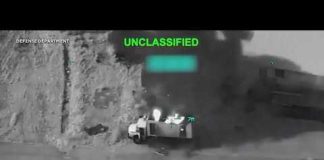
Commercial satellites are now exposing Middle East battle damage in near-real time—leaving Iran less able to hide the cost of hitting Americans and U.S. allies.
Story Snapshot
- New Planet Labs and Vantor satellite imagery shows widespread damage across Iranian military sites after U.S.-Israeli strikes that reportedly killed Iran’s Supreme Leader Ayatollah Ali Khamenei.
- Iran responded with missile and drone attacks on U.S. positions and regional infrastructure across the Gulf, with damage visible at multiple locations.
- Images indicate the conflict spans hundreds of miles inside Iran, while retaliation has also spilled into key Gulf hubs tied to U.S. basing and commerce.
- Reports differ on some claims—such as the exact number of Iranian vessels sunk—highlighting what is confirmed by imagery versus what remains disputed.
Satellite imagery makes the battlefield harder to spin
Satellite photographs published in early March offer a rare, high-altitude record of how far the war has spread and how quickly it escalated after strikes that began February 28. Commercial providers, including Planet Labs and Vantor, captured visible smoke and impact patterns in and around Tehran and at multiple Iranian military locations separated by roughly 800–900 miles. That distance matters: it suggests coordinated targeting across widely dispersed facilities rather than a single, localized hit.
For Americans watching from home, the significance isn’t just the destruction; it’s the transparency. These images are not a government press release and not a regime propaganda clip. They function as a check on misinformation from any side, showing what can be confirmed: fires, damaged structures, and strike footprints. The reporting emphasizes how commercial satellites are now documenting major military operations quickly enough to influence public understanding while events are still unfolding.
Strikes inside Iran: leadership shock and military infrastructure hits
Reporting describes U.S.-Israeli strikes that hit Iranian military infrastructure—naval bases, air bases, and drone-related sites—alongside attacks in Tehran that reportedly killed Khamenei and other top figures. If accurate, that is an unprecedented leadership decapitation for Iran’s modern regime and would help explain the internal political scramble that followed. Iranian officials declared a period of mourning, and Mojtaba Khamenei was identified as the chosen successor in subsequent coverage.
Independent imagery analysis highlighted by CNN also points to the war’s widening footprint, including strikes near sensitive civilian areas such as hospitals and a school. That reporting frames at least one incident as “likely” attributable to U.S. strikes, but it stops short of a definitive conclusion. The distinction matters: satellite evidence can show damage, craters, and burn patterns, yet attribution can still depend on additional intelligence that the public may not see.
Iran’s retaliation: U.S. bases and Gulf infrastructure take hits
Satellite images and visual verification cited by ABC News indicate damage at multiple U.S.-linked sites in the Gulf following Iran’s missile and drone retaliation. The timeline described includes visible impacts by March 1 at locations associated with U.S. forces, including Bahrain and Kuwait. Gulf partners also reported significant interception activity, underscoring both the scale of the barrages and the strain such attacks place on regional air defense when volleys arrive in waves.
Other imagery cited in reporting showed secondary effects in the United Arab Emirates, including fires and debris impacts consistent with shrapnel, as well as damage tied to major infrastructure. Strikes near high-value commercial and logistics areas raise the stakes for global shipping and regional stability, even when the initial military objective is to pressure U.S. assets. In practical terms, this is how conflicts expand: one side targets bases, the other side’s neighbors absorb spillover.
What is confirmed, what is disputed, and what it means under Trump
Some details remain contested in public reporting even as imagery confirms broad damage. One example is the claim that U.S. Central Command actions sank multiple Iranian vessels; President Trump was briefed on a figure of nine, while available public confirmation is described as partial. The same theme applies to contested strike attribution in crowded areas: images can corroborate destruction, but they do not automatically settle who launched which munition in every case.
Strategically, the larger takeaway is that the conflict is being documented in a way that limits denial and forces accountability. For a conservative audience wary of open-ended foreign entanglements and also wary of weakness that invites attacks on Americans, these reports present a hard reality: Iran chose to retaliate against U.S. positions and regional partners, and the region’s basing network becomes a magnet for escalation. The best available public evidence right now is visual—satellite proof that the damage is real and widespread.
Sources:
https://www.wunc.org/2026-03-01/satellite-images-provide-view-inside-iran-at-war