
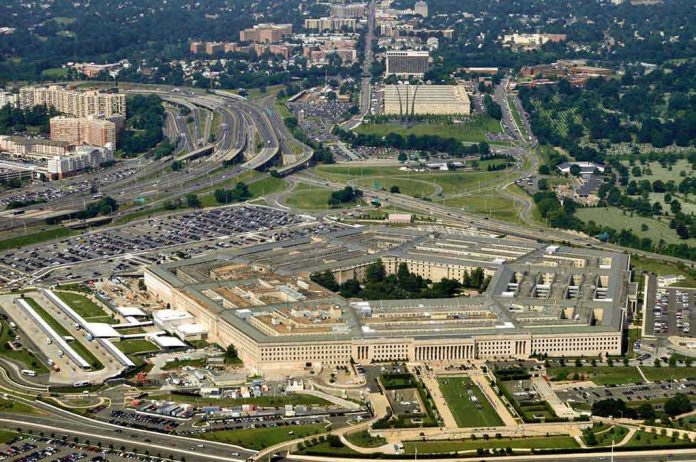
Trump’s $1.5 trillion defense budget proposal sends a bold message, challenging defense contractors and promising a dream military funded through tariffs.
Story Highlights
- Record $1.5 trillion defense budget proposed by Trump for fiscal year 2027.
- Proposal includes strict measures on defense contractor practices.
- Significant increase funded through tariff revenue.
- Emphasizes modernization and great-power competition, particularly with China.
Trump’s Ambitious Defense Spending Proposal
On January 7-8, 2026, President Donald Trump announced his intention to propose a $1.5 trillion defense budget for fiscal year 2027 through his Truth Social platform. This budget marks a 50% increase over anticipated 2026 spending levels and a 66% rise from the $900 billion Congress recently authorized for 2026. President Trump cited the necessity of a “Dream Military” and pledged to fund this increase through tariff revenue.
Trump’s proposal includes several significant measures targeting defense contractors, including prohibitions on stock buybacks and executive compensation limits for underperformance. Raytheon, a business unit of RTX Corporation, was singled out for its alleged failure to meet the needs of the U.S. military. These accountability measures aim to ensure defense contractors prioritize national security over shareholder profits.
Congressional and Industry Reactions
The proposal has garnered support from key Republican figures, including House Armed Services Committee Chairman Mike Rogers, who praised it as essential for rebuilding the military. Meanwhile, OMB Director Russell Vought suggested the administration might leverage reconciliation procedures to pass the proposed budget, splitting it between a party-line bill and regular processes. However, the proposal’s success hinges on congressional approval, with Democrats’ positions currently unclear.
The immediate market reaction was significant, with defense stocks experiencing a downturn following Trump’s criticism of contractor practices. This response underscores the potential impact of the proposed restrictions on corporate policies, including stock buybacks and executive compensation.
Long-Term Implications and Strategic Goals
If enacted, the budget would fund modernization initiatives such as the “Golden Dome for America” space defense system and the “Golden Fleet” naval expansion. These projects, along with others, are designed to counter peer adversaries like China, reflecting a strategic pivot toward great-power competition. However, the proposal also raises fiscal concerns, with the Committee for a Responsible Federal Budget estimating an addition of $5.8 trillion to the federal debt over a decade.
The proposal’s broader implications include potential restructuring of the defense industrial base, with executive compensation and capital allocation restrictions potentially reshaping business models. The initiative sends a clear signal of U.S. military commitment, aiming to reassure allies and deter adversaries.
Sources:
Trump Announces Record $1.5 Trillion Defense Budget
Trump’s $1.5T Defense Budget Protects Warfighters
Trump Calls for Record Defense Budget
CFP: Trump’s $1.5 Trillion Defense Budget Should Not Come as a Surprise
CRFB Analysis: $1.5 Trillion Military Budget & Debt Impact
House Armed Services Committee Statement