
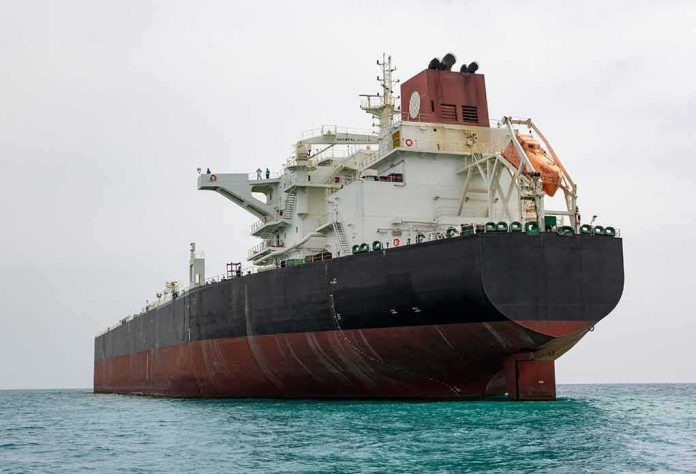
A dramatic new U.S. Navy video of American forces storming the Iranian-linked supertanker MT Davina shows both Washington’s resolve to choke off Tehran’s oil cash and the quiet risks of opaque, globalist-style sanctions power.
Story Snapshot
- U.S. Indo-Pacific Command released video of a nighttime “right-of-visit” boarding of the sanctioned, stateless tanker MT Davina in the Indian Ocean.[1]
- The vessel has been under U.S. sanctions since 2024 for allegedly hauling Iranian crude to markets like China, feeding Tehran’s terror-sponsoring regime.[2]
- Officials label Davina “stateless,” but public ship registries still show past Singapore registration, raising questions global bureaucrats have not yet answered.
- The Pentagon shared few details on cargo, crew, or legal memo, spotlighting how powerful sanctions and military tools often operate behind a wall of secrecy.[1]
U.S. Navy Boards Sanctioned “Shadow Fleet” Tanker
U.S. Indo-Pacific Command says American forces carried out a “maritime interdiction and right-of-visit boarding” of the sanctioned, stateless tanker **MT Davina** in the Indian Ocean on June 4, releasing striking nighttime footage of the operation.[1] The command describes Davina as part of a network of vessels moving oil to support Iran and vows to keep targeting ships that help fund Tehran’s destabilizing activities across the Middle East and beyond.[1] Reuters reporting similarly labels Davina a “sanctioned stateless oil tanker.”[2]
Marine and defense outlets report that the boarding occurred overnight within Indo-Pacific Command’s area of responsibility, with U.S. forces approaching by small boats and helicopter before securing the massive vessel’s deck.[1] The Pentagon frames the action as part of a broader effort to disrupt “illicit networks” and enforce existing sanctions, especially as Iran relies on covert shipments to keep oil revenues flowing despite long-standing U.S. pressure.[1] Officials did not announce any injuries or resistance during the boarding.[1]
Why Davina Matters: Iran’s Oil Cash and America’s Leverage
Davina is no small player; multiple maritime sources describe it as a crude oil supertanker capable of carrying around two million barrels of oil, meaning a single successful voyage can represent a major cash infusion for Iran’s regime. The United States Treasury first sanctioned Davina in October 2024, identifying it as a Marshall Islands–registered vessel tied to Iranian oil shipments and treating the ship itself as sanctioned property. Indian media report Treasury previously said Davina delivered Iranian oil to China, underscoring the global scale of these routes.[2]
For conservatives who have watched Iran arm proxies from Gaza to Yemen, cutting off this revenue stream aligns with long-standing calls to stop financing terror and aggression through lax enforcement. Indo-Pacific Command’s message is that there will be no safe ocean corridor for what many call Iran’s “shadow fleet” of deceptive tankers operating under shifting flags and opaque ownership structures. The operation fits a pattern of recent U.S. interdictions targeting similar vessels linked to sanctioned Iranian oil trades in the region.
Stateless Ship or Paper Trail Problem? Questions on Flag and Law
U.S. officials repeatedly describe Davina as a “sanctioned stateless vessel,” language that gives the United States greater authority under maritime law to board and inspect.[1] A stateless ship is one that sails without the protection or legal cover of any recognized national flag, often a sign of deliberate evasion or fraud. Yet public ship-tracking platforms still list the vessel DAVINA, with the same International Maritime Organization number 9746499, as an oil products tanker sailing under Singapore’s flag, at least historically.
That discrepancy highlights a familiar trouble spot for citizens trying to understand these complex operations: the government says “stateless,” but the public database shows a national flag, and officials have not yet released the registry documents that would explain exactly when, how, and why the vessel lost or falsified its status.[1] Coverage of the operation so far relies heavily on Indo-Pacific Command’s announcement, without independent publication of cargo manifests, registry records, or legal memos justifying the right-of-visit determination.[1][2] For Americans skeptical of unaccountable global bureaucracies, that missing paperwork matters.
Sanctions Power, Transparency Gaps, and What Comes Next
Most reporting on Davina’s interdiction simply echoes the official narrative that the tanker is sanctioned, stateless, and tied to Iran’s oil trade, but it does not yet provide the full evidentiary package—voyage data, crew testimony, or cargo inspection results—that would allow the public to independently verify every claim.[1][2] That imbalance is common in sanctions enforcement: agencies and commands move fast, while the documentation that shows exactly how they reached their conclusions often remains classified, redacted, or buried in slow-moving bureaucracies.
🇺🇸🛥️ The United States Indo-Pacific Command announced that U.S. forces conducted a maritime interdiction and right-of-visit boarding of the sanctioned tanker MT Davina in the Indian Ocean.
👥 According to officials, the vessel was operating without recognized nationality and has… pic.twitter.com/eyaOpZi5uQ
— THE INFORMANT (@TheInformantUSA) June 6, 2026
For constitutional conservatives, Davina’s case cuts both ways. On one hand, it demonstrates real American strength on the high seas—projecting power, backing allies, and squeezing a hostile regime’s wallet instead of sending our sons and daughters into another ground war.[1] On the other hand, it reminds us why oversight and transparency are non-negotiable when Washington wields global financial blacklists and military interdictions. Demanding the release of the underlying sanctions rationale, flag-status records, and legal basis does not weaken the mission; it keeps it grounded in the rule of law that protects both our security and our liberty.
Sources:
[1] Web – Newly released video by U.S. Indo-Pacific Command shows American …
[2] Web – US forces board sanctioned tanker MT Davina in Indian Ocean