
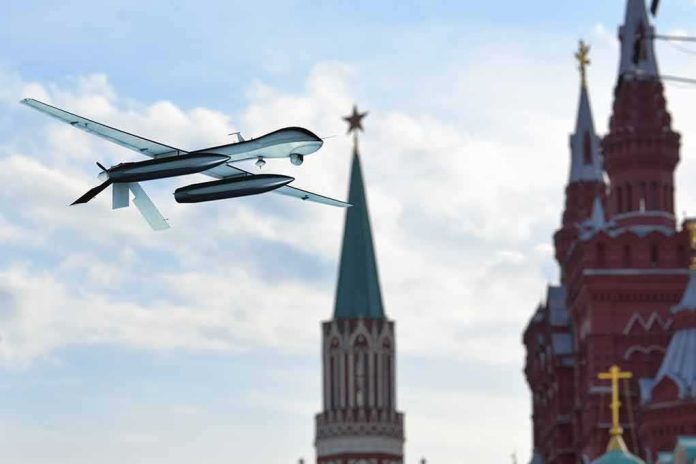
Ukraine’s long‑range drone campaign has transformed Russia from a distant battlefield into a sprawling front line, with the Moscow region now routinely absorbing strikes that expose the limits of Russian air defenses and the vulnerability of its own civilian and economic infrastructure.
At a Glance
- Ukraine has escalated from sporadic drone raids to near‑daily, mass attacks reaching the Moscow region, often involving hundreds of drones in a single night.
- Russian authorities acknowledge repeated damage to oil refineries, logistics hubs, warehouses, and residential buildings around Moscow, as well as casualties and large fires.
- Moscow’s air defenses intercept many drones, but not enough to prevent recurring disruption, including airport closures, black smoke over the city, and “black rain” from refinery hits.
- The campaign is designed to stretch Russian air defense, raise domestic costs of the war, and shift the psychological burden of vulnerability onto Russian citizens.
From Symbolic Raids to Systemic Pressure on Moscow
The most important shift in Ukraine’s use of drones against Russia is not a single spectacular strike, but the transition from occasional symbolic flights over Moscow to sustained, large‑scale raids that now form a regular part of the war. Early attacks in 2023 and 2024 were treated in Moscow as one‑off incidents — alarming, but manageable. By 2025 and especially 2026, that pattern had changed: Russian officials were reporting dozens or hundreds of drones aimed at the capital in a single night, sometimes for nine days in a row. This is the hallmark of a campaign, not a series of stunts.
Russian data and international reporting converge on the same picture. In March 2025, Moscow’s mayor described the “largest drone strike from Ukraine on the city” after at least three workers were killed and 17 injured, with four major airports briefly closed while defenses intercepted more than 90 drones over the region. By mid‑2026, that scale had been normalized: Sobyanin and the Defense Ministry were citing figures like 400, 427, or even over 452 drones intercepted across Russia in single overnight attacks, with dozens shot down as they approached the capital. In July 2026, officials said more than 400 “enemy drones” were launched toward the Moscow region in one night. The numbers vary by account, but the pattern is unmistakable — mass raids have become routine.
What the Drones Are Hitting: Oil, Logistics, and Everyday Life
Ukraine’s campaign is not random harassment; it concentrates on targets that matter both militarily and economically. Oil refineries around Moscow have been struck repeatedly; in one of the largest attacks described as “one of the most substantial assaults on the Russian capital,” Ukrainian drones hit the city’s primary oil refinery twice in a week, forcing at least temporary disruption. Black smoke and flames over Moscow have become a recurring motif in eyewitness videos and news footage, underlining the visibility of these hits for residents far beyond the immediate blast zone.
Beyond fuel infrastructure, Ukraine has increasingly focused on logistics centers and warehouses that underpin Russia’s wartime economy. Strikes on major e‑commerce hubs such as Wildberries’ logistics centers have caused enormous fires and significant casualties, with Russian military bloggers warning of “significant” economic consequences as online marketplaces become central to daily life and supply chains. This choice of targets is deliberate. Ukrainian officials and analysts have framed long‑range strikes as “long‑range sanctions” intended to raise the cost of aggression by degrading Russia’s ability to move goods, maintain military supply lines, and insulate its domestic population from the war’s impact.
Civilian exposure is now inherent in the geography of the campaign. Several attacks have damaged or struck residential buildings and warehouses near densely populated areas, killing or injuring workers and residents. In one widely reported incident, a drone hit an apartment building while another damaged facilities at the Moscow Refinery, prompting flight restrictions at all four of the city’s international airports. Another raid produced “black rain” — oil droplets falling over parts of Moscow after a refinery hit — a vivid sign of how industrial targets can quickly bleed into everyday urban life.
Russia’s Air Defenses: Interceptions, Gaps, and Strain
Russian officials emphasize interception tallies to reassure the public and signal control, frequently claiming to have downed the overwhelming majority of incoming drones. Figures in the hundreds are now commonplace: 343 drones intercepted across the country in one attack, 437 by midnight in another, 452 in yet another, and “more than 550” in a 14‑region strike that hit Moscow and Belgorod. Moscow itself often reports dozens of drones shot down in the immediate approach to the city, with regional governors adding counts for the wider oblast.
Those numbers are not meaningless. Intercepting hundreds of small, low‑flying, often commercially derived drones is technically and logistically demanding; Russia has deployed layered defenses combining traditional surface‑to‑air systems with electronic warfare and jamming to force some drones off course. Yet the very need to publicize interception statistics reveals a structural vulnerability. The question is no longer whether air defenses work — they clearly do, much of the time — but whether they can keep up with a campaign designed to saturate them across multiple regions, night after night.
Evidence of strain shows up in the gaps that remain. Despite high interception rates, drones regularly reach sensitive facilities: refineries, satellite communication centers, logistics depots, and residential areas in the Moscow region have all been hit. Temporary flight restrictions and airport closures, reported repeatedly over 2025–2026, are another indicator of how even a partially intercepted raid can disrupt a major metropolis. Each night that defenses must respond to another wave ties up radar operators, missile batteries, and electronic warfare units that cannot be used elsewhere — including on the Ukrainian front lines.
Strategy Behind “Turning Russia Into One Big Target”
Ukraine’s leadership and military thinkers describe these operations as part of an intermediate‑range strike campaign aimed at shifting the war’s center of gravity. The logic runs on several levels. First, by hitting deep into Russian territory, particularly the capital, Ukraine undermines the Kremlin’s narrative that the war is something happening “over there,” safely cordoned off from everyday Russian life. When oil depots burn, warehouse workers die, and airports close, the sense of distance erodes.
Second, the campaign forces Russia to redistribute air defense assets across a much larger area. Protecting Moscow, St. Petersburg, refineries, power substations, and major logistics centers requires systems that could otherwise reinforce the front. Analysts have compared this to a classic strategic bombing logic adapted to the drone age: inexpensive, attritable drones compel the defender to invest in more expensive, scarce interceptors and radars, steadily increasing the defender’s marginal cost relative to the attacker. Reports from Russian military bloggers and regional officials complaining about coverage gaps and the difficulty of protecting every site suggest this pressure is being felt.
Third, the targets chosen — from oil refineries to e‑commerce distribution centers — are designed to hit dual‑use infrastructure that supports both military operations and civilian comfort. Striking Wildberries or other logistics hubs is not only about interrupting the flow of goods to soldiers; it is also about sending a signal to urban consumers that the war has economic consequences inside Russia’s own borders. Ukrainian rhetoric around “long‑range sanctions” and statements like “if Ukraine burns, then your Moscow will burn as well” capture that intent.
Risks, Civilian Harm, and the Escalation Spiral
No serious assessment of this campaign can ignore its human cost. Russian authorities have reported fatalities and injuries among civilians and civilian workers in multiple raids: three killed and 17 wounded at a meat warehouse; several dead and wounded near Moscow in one of Ukraine’s largest‑ever attacks; at least 17 injuries in a major refinery strike; and other casualties at warehouses and residential buildings. Video evidence confirms drones hitting apartment blocks and causing substantial fires.
Russia characterizes these raids as “terrorist drone attacks” targeting civilian infrastructure, while Ukraine’s General Staff and security services insist they aim at military or military‑linked facilities, including oil depots, pumping stations, satellite communication centers, and logistics hubs that supply Russia’s armed forces. The reality of modern war is that dual‑use sites blur the line: refineries fuel tanks as well as cars, logistics platforms ship uniforms and weapons alongside consumer goods, and workers at these sites are civilians even when the sites support military operations. That ambiguity is intrinsic to the strategy and one of its moral hazards.
The escalation dynamic is also clear. Major drone raids on Moscow often follow or coincide with devastating Russian missile and drone strikes on Ukrainian cities, including Kyiv, where dozens of ballistic missiles and attack drones have killed civilians and damaged residential and industrial infrastructure. Each side presents its long‑range strikes as retaliation, creating a cycle in which both capitals experience disruption and civilian risk. Russia has publicly threatened “massive group strikes” in response to the largest raids on Moscow, and has carried them out against Ukrainian targets. The drone campaign, in other words, is both symptom and driver of a broader escalation in long‑range warfare.
Ukrainian drone attacks in the region around Moscow killed five people, local officials said Tuesday, while authorities in Ukraine said Russian aerial strikes there also caused at least five civilian deaths.https://t.co/OyPgDyKXRb
— WNCT (@wnct9) August 4, 2026
Moscow as a Test Case for the Drone Age
Beyond the immediate Russia‑Ukraine conflict, Moscow’s experience offers a preview of how drone warfare reshapes the geography of vulnerability. A capital city of more than 20 million people, long portrayed as insulated by layered air defenses and distance from the front, now lives with the possibility of nightly raids that may not level neighborhoods, but can still kill, injure, and disrupt. For residents, the practical impact ranges from delayed flights and strange oil‑tinged rain to the sight of black smoke over familiar skylines. For planners and militaries worldwide, the lesson is stark: in the drone age, distance from the front no longer guarantees safety.
Ukraine’s expanding drone campaign has not, as of this writing, crippled Moscow’s economy or forced Russia to change course. It has, however, demonstrated that even a heavily defended capital can be repeatedly penetrated by relatively cheap systems, and that defending a vast country against swarms is a resource‑intensive, imperfect endeavor. In that sense, Ukraine has succeeded in turning Russia into one big target — not in the sense that every point can be struck at will, but in the more profound sense that no part of the country, including its core political and economic centers, can now assume it lies beyond the reach of war.
Sources:
19fortyfive.com, reuters.com, cnn.com, youtube.com, abcnews.com, cnbc.com, en.wikipedia.org, foxnews.com, apnews.com, bbc.com, facebook.com, npr.org, pbs.org, rferl.org