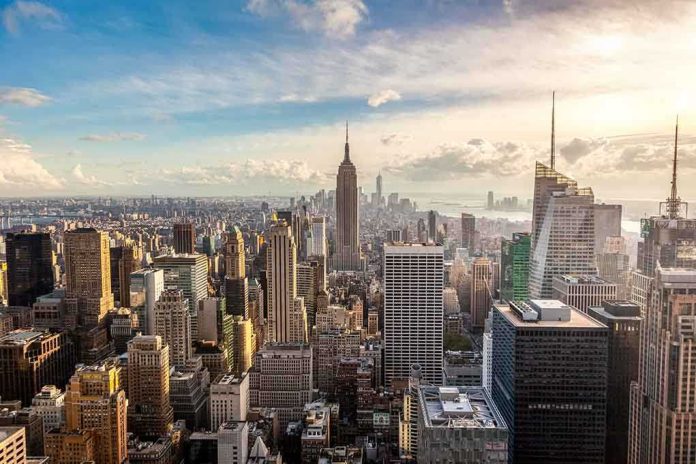
Two masked climbers turning the Empire State Building into their own 1,454‑foot wedding stage just exposed how fragile our “secure” landmarks really are.
Story Snapshot
- Two well-known daredevils free-climbed the Empire State Building’s antenna, unfurled a giant “power of love” banner, and got engaged before arrest.
- Police shut down streets, sent specialized officers up the spire, and later confirmed felony charges including reckless endangerment.
- No one was hurt, but officials admit they still do not fully know how the pair beat security to reach a supposedly protected area.
- Media and fans cast the stunt as romantic and inspiring, raising questions about whether “elite” rule-breakers get soft treatment while ordinary people face harsh justice.
A stunt at the top of New York raises hard questions about security
On July 1, two masked climbers scaled the Empire State Building’s antenna, nearly a quarter-mile above Manhattan, and unfurled a huge banner about “the power of love.” News helicopters showed them in black clothing, without visible safety tethers, kissing and posing for photos on a narrow ledge at 1,454 feet. After descending, they embraced again on lower levels and were taken into custody by New York City Police Department officers shortly after 1 p.m.
The pair later claimed their identities online as Russian climbers Angela Nikolau and Ivan Beerkus, already famous from a 2024 Netflix documentary titled “Skywalkers: A Love Story.” Local coverage and ABC7 New York reports matched this claim and noted the couple’s history of high-rise climbs around the world. Police on the scene initially did not confirm names or charges, a common gap that fuels public suspicion that authorities hide details when systems fail.
Police response: streets closed, officers on the spire, felony charges
New York City Police Department officials say they mobilized quickly once the climb was spotted. Streets around Fifth Avenue and 34th Street were shut down, pulling officers and resources from other calls in the nation’s largest city. Emergency officers climbed the building structure themselves to reach the pair and coordinate their descent, underscoring how seriously law enforcement viewed the breach of such a symbolic site.
While early reports said charges were still being decided, later television commentary and local coverage indicate the couple now faces felony counts that include reckless endangerment, along with criminal trespass and related offenses. Police also say that, despite the danger, no tenants, tourists, police, or other civilians were hurt during the incident. That “no harm done” outcome may help the climbers in court, but it does not erase the clear risk that a fall or dropped gear could have turned the stunt into a mass-casualty event.
How did they get up there—and why are consequences so uneven?
One of the most troubling parts of the story is what officials cannot explain. Building management calls the climb “unauthorized” and insists there was “no danger” to people inside, yet neither management nor police have clearly laid out how the pair reached an area that ordinary visitors are never allowed to enter. Reports mention broken fencing and gated areas, but much of that detail comes from media sources, not a full public security report, leaving many wondering who really dropped the ball.
This is not New York City’s first run-in with “urban climbers.” Years ago, city leaders proposed an “anti-Spidey” law to make climbing any structure over 25 feet a separate crime, after other stunt climbers walked free with only minor disorderly conduct charges and short sentences. Even today, experts note that most unauthorized building climbs end with light penalties, while police still must lock down blocks of traffic and risk officer safety to respond. For many Americans on both the right and left, that pattern looks like a system that protects spectacle and tourism more than everyday security.
Romantic framing vs. real-world risk in a country tired of double standards
Major outlets and social media users quickly framed this event as a “love story in the sky,” focusing on the proposal and the peace quote on the banner—“When the power of love beats the love of power the world knows peace.” People shared clips and posts praising the courage and romance, even as police processed the pair on felony counts. This “daredevil couple” label softens the image of what was, at its core, an illegal and dangerous breach of a critical landmark.
Two climbers who scaled the Empire State Building to unfurl a marriage proposal banner have been arrested. Police processed the pair at the Midtown South Precinct before transferring them to face formal charges.
Arrested:
Ivan Kuznetsov, 32, NJ
Angelina Nikolau, 33, NJCharges… https://t.co/GiuxbT60PD pic.twitter.com/eIr65fxQE5
— Veritas (@veritayr) July 2, 2026
For many Americans, the mixed reaction hits a nerve. Ordinary citizens feel hounded by rules, fines, and surveillance, while famous risk-takers seem to turn crimes into brand-building events and streaming deals. Conservatives frustrated with rising crime and weak enforcement see yet another example of the state failing to deter high-risk behavior. Liberals worried about unequal justice see a system that often throws the book at poor, unknown offenders but shrugs when global “influencers” bend the law for clicks. Both sides share a deeper fear: if elites can turn the nation’s most famous buildings into personal stages, maybe the people in charge are not really in control at all.
Sources:
facebook.com, fox5ny.com, youtube.com, instagram.com, abc7ny.com, nytimes.com, yahoo.com, nbcnews.com