
A man almost lost his head on a Belfast street, and now one ugly question hangs over the whole United Kingdom: did a quiet border deal turn into a back door for danger?
Story Snapshot
- A Sudanese ex-policeman from a well-connected family is charged with an attempted beheading in Belfast.
- Police say he came into Northern Ireland from Dublin in 2023 and was later granted leave to remain.
- Outrage is now focused on the “Irish route” and the Common Travel Area as a de facto asylum loophole.
- Officials insist it is not terrorism, but the case exposes how vague border rules collide with public safety.
A shocking street attack that turned into a border fight
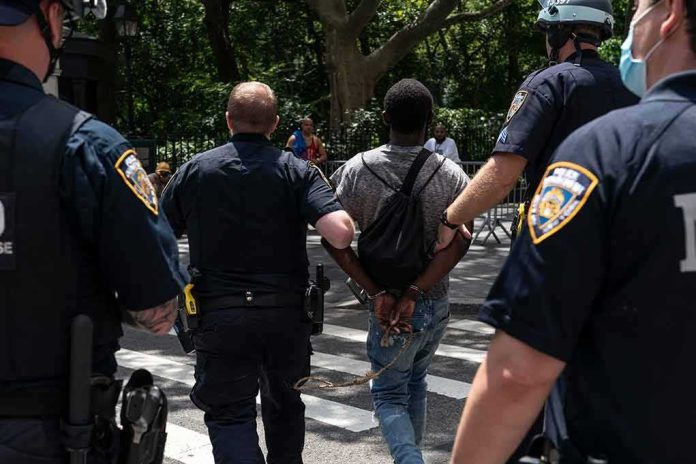
Video from North Belfast shows a man on a city street, a struggle, and then something far worse than a normal knife fight. Witnesses say a Sudanese immigrant tried to behead another man in his 40s, leaving him with severe injuries to his face, neck, and back before police rushed in and made the arrest at the scene.[3][1] The Police Service of Northern Ireland says they are not treating the case as terrorism right now, but the violence alone has lit a fire under the border debate.[3]
Police first told reporters the suspect was Somali, then corrected themselves and said their updated understanding is that he is Sudanese.[3] That early mix-up matters. If the police can misstate something as basic as nationality in the rush, it reminds everyone that first headlines and political hot takes often outrun hard facts. Yet in the court of public opinion, “African migrant tries to behead man in Belfast” is already set in stone, no matter how the exact country label shifted.[1]
From Paris to Dublin to Belfast: the “Irish route” under the microscope
Senior officers now say their understanding is that the man came into Northern Ireland from Dublin, moving up the island before getting leave to remain.[3] Broadcast coverage goes further, claiming he flew into Dublin from Paris, then took a bus to Belfast and later applied for asylum.[2] The Home Office has reportedly stated that he entered the United Kingdom in 2023, was granted refugee status that same year, and now has leave to remain until 2028.[1] That is not rumor; that is a legal grant of status.
British and Irish citizens share a Common Travel Area that allows movement without normal passport checks on the land border. Commentators now argue that this arrangement, meant for close neighbors, has turned into an asylum side door for people who first land in the European Union and then ride a bus north.[1][2] One Conservative voice said leave to remain has been “handed out like Smarties,” claiming that this case proves a porous border and a broken asylum system. That lines up with long-standing conservative concerns: protect borders, vet newcomers, and do not trade public safety for feel-good migration policy.
Who the suspect is, and why his background fuels anger
Reporting names the suspect as Hadi Alodi, a Sudanese man in his 30s now charged with attempted murder over the Belfast knife attack.[2] The Telegraph says friends described him as a former police officer in Khartoum, from a prominent Sudanese family.[2] Social media chatter goes further, claiming his brother lives with him in Belfast and that the family is well connected back home. Those claims about status and training cut against the image of a desperate refugee with nowhere else to go.
If a trained ex-officer from a strong family network can fly into Paris, move through Dublin, cross the land border, and secure refugee status in the same year he arrives, many ordinary voters will ask what sort of checks, if any, actually took place.[1] To a common-sense conservative, this looks less like sheltering the truly persecuted and more like importing risk. That does not excuse mob anger or riots, but it does explain why this single case has become a symbol for a deeper fear that the system now protects the newcomer first and the citizen second.
Loophole or lazy label? What we really know so far
Telegraph coverage framed the entry path as an “asylum loophole” and “Irish route,” language now echoed across television, Instagram clips, and talk shows.[1][3] Police, however, chose more cautious words. The assistant chief constable called it his “understanding” that the man came from Dublin and was later granted leave to remain, and he stressed that the Home Office would need to confirm the exact immigration details. That is an important line. It means the immigration picture is still based on working information, not a finished case file.
There is, so far, no public evidence that he slipped across a field at night or dodged every check. The record shows a route through the Republic of Ireland, onward movement to Northern Ireland, and then a successful asylum or refugee claim that produced legal status.[1][4] Critics use “loophole” to describe the mix of the Common Travel Area and fast refugee grants. Defenders reply that one brutal crime does not by itself prove the legal framework is broken. From a conservative standpoint, the core issue is simpler: did the government use its full powers to screen, and did it still wave a clear risk through?
What this case exposes about borders, elites, and trust
Every part of this story highlights a gap between what ordinary citizens expect and how the system actually works. People assume that if someone can almost behead a man in public, something must have gone wrong earlier: at the airport, on the bus, in the asylum interview, or at the point where “refugee” status was handed out.[1] Yet police insist the attack is not terrorism, officials drip out partial facts, and legal labels shift from “asylum seeker” to “refugee” to “leave to remain” depending on who is talking.
That mix of elite caution and legal fog breeds suspicion. When a former cop from a prominent family secures refugee protection on the back of a cross-border route that voters barely understand, common-sense conservatives see a pattern: a ruling class more eager to advertise compassion than to guard the front door. Until the full immigration file and travel records are laid bare, the Belfast attack will remain more than one shocking crime. It will stand as a warning about what happens when border promises outpace border reality.
Sources:
[1] Web – Sudanese man charged in attempted beheading of Belfast man entered …
[2] Web – ‘Beheading’ suspect used asylum loophole to enter UK
[3] Web – Sudanese migrant arrested for attempted murder in Belfast crossed …
[4] Web – A Sudanese man accused of attempting to behead a … – Facebook