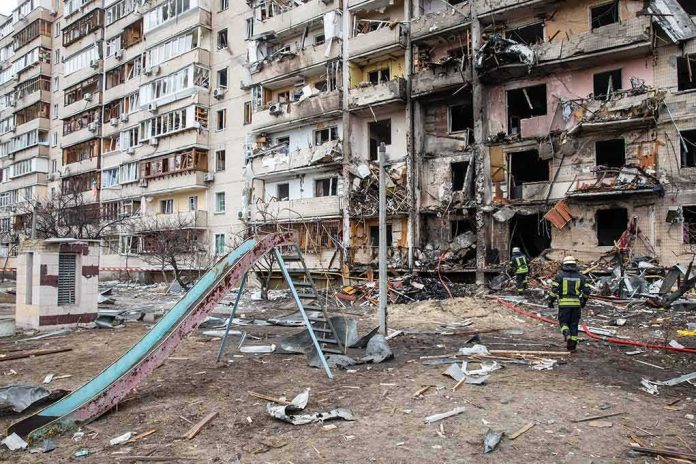
Russian strikes on Kyiv and its surrounding region have repeatedly produced mass-casualty scenes because the attack profile—fast ballistic salvos and drone waves that arrive overnight, fragment on impact, and ignite secondary fires—maximizes harm to dense civilian neighborhoods and the infrastructure that keeps a city functioning.
At a Glance
- Multiple large strikes in 2026 damaged residential blocks, schools, hospitals, and warehouses in Kyiv and nearby districts, with dozens killed and many more injured across episodes.
- Attack patterns have included ballistic missiles and drones that overwhelm defenses, cause debris showers, and trigger fires across wide areas.
- One Solomianskyi district strike destroyed the upper floors of a nine-storey building and killed at least eight people at that site alone.
- The United Nations has documented sharply rising civilian casualties in 2025–2026 as Russia increased the use of drones and long-range weapons; Kyiv has often been the hardest-hit city.
What happened: casualty counts and the pattern of damage
Across several major attacks on the capital and its region in 2026, Ukrainian officials and international wire services documented a grimly consistent picture: people killed in their homes, residential blocks gutted by fire, and essential services hit as debris rained down. Early in the year, a Russian drone strike just before midnight set multiple fires and killed four people in the Kyiv area, with at least 19 injured—an opening salvo that foreshadowed the scale to come as the year wore on. By mid-August, Kyiv endured one of its deadliest barrages in months: missiles and drones struck across the city and surrounding districts, damaging around 30 residential buildings as well as a school, a children’s hospital, and a kindergarten. In Kyiv’s Solomianskyi district, the top floors of a nine-storey apartment block were destroyed; at least eight people were reported dead at that single location.
Similar scenes recurred in quick succession. Another attack killed at least 27 and injured more than 100 citywide, with emergency services tallying damage at more than 20 sites—evidence of both the breadth of the strike package and the way debris and secondary fires multiply the toll in urban terrain. Even on nights when air defenses intercepted inbound drones, falling fragments wounded civilians and ignited structures across multiple neighborhoods, keeping the emergency services stretched and the casualty count climbing. In late August, city authorities reported a 16‑storey residential tower in the Holosiivskyi district damaged by a drone—another emblem of how high-rise housing concentrates risk when high‑explosive warheads detonate or disintegrate overhead.
How these attacks do outsized harm in a city
Missiles and one‑way attack drones create different problems for the same population. Ballistic missiles arrive with little warning, leaving residents and first responders seconds—not minutes—to seek shelter. Their kinetic energy and large warheads shear facades, collapse upper floors, and ignite fires across multiple apartments at once. Drones, especially when launched in swarms, trade speed for saturation: they stretch radar and interceptor coverage, slip through gaps, and, when engaged, often break apart over residential areas. Even a “successful” intercept can still mean a debris field that shreds roofs, punctures gas lines, and seeds dozens of spot fires. When strikes hit schools, hospitals, or kindergartens—whether directly or via blast and debris—they disable functions that a city needs immediately after an attack: triage, pediatric care, and safe shelter for families displaced mid‑night.
Once a structure is compromised, cascading damage is common. External scaffolding and balconies act as shrapnel multipliers. Stairwells fill with smoke. Elevators fail; the elderly and those with disabilities can be trapped on high floors. Fire brigades must split forces across simultaneous incidents, trading speed for coverage. In Solomianskyi, the destruction of a nine‑storey block’s upper floors compressed multiple life‑threatening variables—height, heat, structural instability—into a single site where the fatality count rose quickly.
Why casualty numbers vary across reports—and why they still align
Wartime accounting proceeds in stages. Preliminary tallies emerge from firefighters, police, and municipal administrators on scene; hospitals add confirmed deaths and triage counts; only later do reconciliation processes resolve duplicate reports or missing persons. That is why numbers published during rescue operations often shift within 24–48 hours. The variation across the 2026 Kyiv attacks—four killed in an early January strike, double‑digit fatalities in several August strikes, and more than 100 injured on multiple dates—reflects distinct events, not a disagreement about one. Taken together, they trace a consistent arc: a capital targeted repeatedly with weapons optimized for shock effect in dense urban settings.
The broader statistical record supports the pattern. U.N. monitors and Reuters reporting have detailed a sharp rise in civilian harm in 2025–2026 driven by greater use of drones and long‑range missiles; July 2026 alone saw an elevated death toll nationwide, with Kyiv described as the hardest‑hit city in that period. That base rate matters for interpretation: when you observe repeated mass‑casualty outcomes under the same attack profile and defensive constraints, the prior expectation—unfortunately—is more nights like those Kyiv endured last summer.
Mechanics of defense and the limits they face
Air defense is not a binary shield; it is a layered system with finite magazines and coverage gaps that change from hour to hour. Ballistic intercepts demand high‑end systems and excellent cueing; drone defense is a mix of radar‑guided guns, electronic warfare, and cheaper missiles. Russia’s combined packages are designed to complicate these defenses: drones absorbing interceptors and attention, then missiles arriving on tight timelines against a partially saturated network. Even when defenders intercept most inbound threats, the residual risk—one leaker, or fragments raining across multiple boroughs—keeps casualty counts stubbornly high in a city the size of Kyiv.
Municipal hardening mitigates, but does not erase, the danger. Air‑raid shelters save lives; building managers who isolate gas lines and enforce stairwell clearing reduce fire deaths; public messaging that moves residents off balconies and away from windows before impact limits laceration and blast injuries. Yet the surveillance video clips of near‑misses that circulate after each barrage capture the structural truth better than any diagram: in an urban grid, seconds and meters decide survivability.
Consequences for urban resilience and civilian life
Beyond the immediate loss of life, repeated strikes degrade a city’s resilience. Schools closed for repairs displace learning and childcare into already stressed households. Damaged clinics and children’s hospitals push routine care into emergency departments that must also absorb mass‑casualty nights. Warehouses and retail hubs—hit directly or set ablaze by debris—disrupt supply chains for food, medicine, and building materials, slowing recovery between attacks. Each successive event compounds the backlog, ensuring that even “small” strike nights carry outsized societal costs.
For Kyiv’s emergency services, the operational tempo is punishing. Firefighters rotate from high‑rise rescues to industrial blazes; police secure perimeters in neighborhoods where power and communications may be partially down; utility crews patch gas and water mains at speed to prevent new hazards. These are the hidden mechanics behind the casualty numbers and the photos in morning dispatches: a city continuously absorbing shock, reconstituting, and preparing for the next test.
A Russian strike targeted a facility on the outskirts of Kyiv in the village of Myla, Bucha District, Kyiv Oblast, which was targeted by Russian Geran-4 drone strikes triggering massive secondary explosions and a large-scale fire.
At least 37 people were killed and dozens more… pic.twitter.com/YAVNGFtH3L
— WorldGeopolitics25 (@WGeopolitics25) August 29, 2026
The through-line: a city targeted, a civilian toll that climbs
If you zoom out from any single headline figure, the through‑line is unambiguous. Across distinct strike nights in 2026, Russian ballistic missiles and drones killed dozens of civilians in Kyiv and its surrounding districts, destroyed parts of multi‑storey residential buildings, and damaged schools, hospitals, and other essential infrastructure. The exact totals vary by date, as they must. The mechanism and the civilian consequences do not. In this phase of the war, Kyiv’s risk profile is structural—and unless the inputs change, the outputs will, tragically, look the same.
Sources:
facebook.com, reuters.com, aljazeera.com, apnews.com, gbu.kyiv.ua