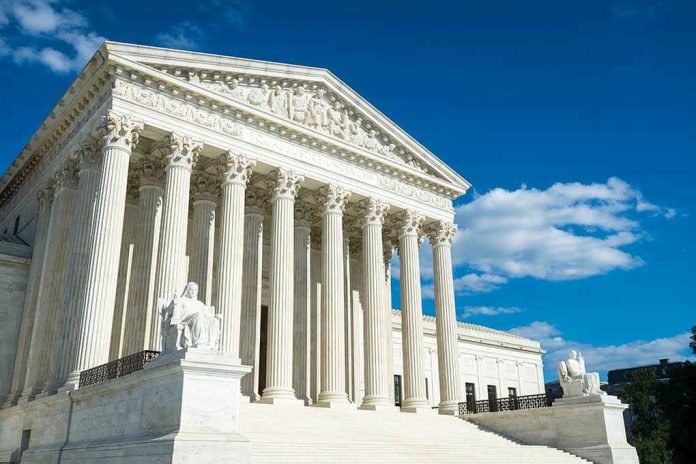
The Supreme Court’s recent ruling has reignited debates, revealing a selective concern for Asian Americans by some liberal factions.
Story Summary
- The Supreme Court struck down race-conscious admissions at Harvard and UNC.
- Asian American applicants were found to be disadvantaged under previous policies.
- The decision ends affirmative action in college admissions.
- Critics argue that liberal support for Asian Americans is conditional.
Supreme Court’s Landmark Decision
On June 29, 2023, the U.S. Supreme Court delivered a pivotal decision in Students for Fair Admissions v. Harvard and UNC, effectively dismantling race-conscious admissions policies. The 6–3 and 6–2 rulings found that these policies violated the Equal Protection Clause of the 14th Amendment, thus ending the use of race as a factor in college admissions decisions. This ruling marked a significant shift, highlighting the systemic biases Asian-American applicants faced under previous admissions frameworks.
The decisions underscore the Court’s commitment to a colorblind interpretation of the Constitution. By prohibiting race-based criteria, the Court emphasized individual merit over racial identity, a core conservative principle. The ruling has sparked a national dialogue on equity, meritocracy, and the role of race in educational opportunities.
Political and Media Reactions
The response from liberal institutions and media has been mixed, revealing a pattern of selective advocacy for Asian Americans. Critics argue that while Asian Americans are prominently featured in progressive narratives about representation and hate crimes, their grievances in the context of affirmative action were minimized. This selective support suggests a conditional concern that aligns with broader progressive agendas.
Conservative commentators and Asian-American plaintiffs have highlighted this inconsistency, arguing that it underscores a deeper bias within liberal policies. This perspective posits that such policies only support Asian Americans when it fits a victimhood narrative, rather than acknowledging their challenges in merit-based contexts.
Impact on Higher Education and Beyond
The Supreme Court’s decision has wide-ranging implications for higher education and beyond. Universities are now tasked with revising admission policies to comply with the new legal framework, possibly turning to race-neutral alternatives like socioeconomic status and geographic diversity. This shift aims to maintain diversity without contravening the Court’s directive.
Beyond academia, the ruling could influence corporate diversity, equity, and inclusion (DEI) initiatives, which may now face heightened scrutiny. Legal experts predict a trend towards diversity strategies that avoid explicit racial classifications, focusing instead on broader definitions of diversity that encompass viewpoint and socioeconomic factors.
Sources:
MIT Supreme Court Ruling Overview
Sidley Insights on Affirmative Action
Wikipedia: Students for Fair Admissions v. Harvard
SCOTUSblog: Affirmative Action Rulings