
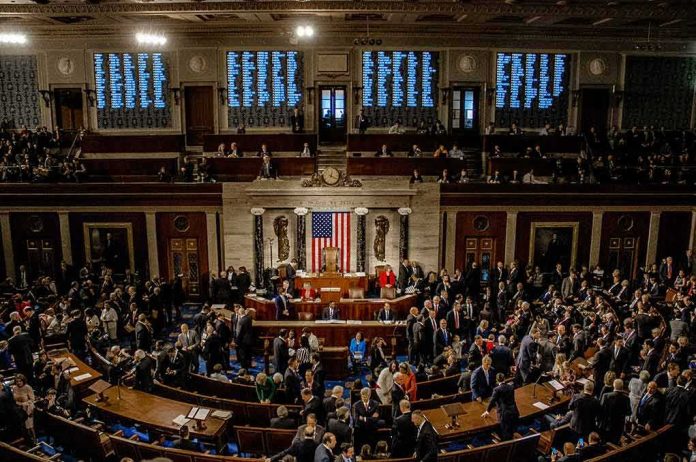
The United States has never resolved, by law or by court ruling, who actually controls the decision to keep American forces fighting once the shooting has started — and the Senate’s latest rejection of a resolution ordering withdrawal from hostilities with Iran is simply the newest chapter in a fight that is now older than most senators’ careers.
Key Points
- The Senate voted 48–51 against a resolution directing President Trump to remove U.S. forces from hostilities with Iran absent a declaration of war or specific authorization, with Republicans Susan Collins, Lisa Murkowski, and Rand Paul crossing party lines and Democrat John Fetterman voting no.
- The House had already passed its own version, 214–208, meaning the Senate measure arrived with a legislative counterpart rather than standing alone.
- This marked at least the fourth or fifth Senate attempt to curb the administration’s war-making authority over Iran, with prior tallies of 47–53, 47–52, and 47–49 showing the coalition shifting but never reaching a majority.
- Even supporters and reporting on the measure describe its practical effect as largely symbolic, since it would not have gone to the president’s desk or carried binding legal force.
- The underlying dispute traces directly to the 1973 War Powers Resolution and has resurfaced in nearly every extended U.S. military engagement since, from Reagan’s Persian Gulf tanker escorts to the current Iran operations.
What the Senate Actually Rejected
The resolution’s text was unambiguous: it would have directed the president to “remove the United States Armed Forces from hostilities with Iran, unless explicitly authorized by a declaration of war or a specific authorization for use of military force.” That is the core mechanism of every war powers resolution — not a request, but a statutory command tied to the 1973 framework requiring congressional sign-off for sustained hostilities. The Senate vote fell 48–51, with Collins, Murkowski, and Paul joining nearly every Democrat in support, while Fetterman alone broke from his party to oppose it. The House had passed its companion measure 214–208, giving the effort a two-chamber footprint rather than a single symbolic floor vote.
Fetterman’s rationale, laid out separately, centered on opposing a path to a nuclear-armed Iran rather than on the constitutional question of authorization — a reminder that these votes often blend war-powers principle with substantive judgments about the underlying conflict. Rand Paul’s reasoning ran in the opposite direction, rooted squarely in Article I: “The power to declare war is ours. If we give it up then we are turning our back on the Constitution and our responsibility to the American people.” Speaker Mike Johnson, defending the administration’s posture, told reporters “We’re not at war right now” even as he described active military operations — a semantic distinction that matters enormously under the 1973 statute, since its triggers depend on whether forces are in “hostilities,” not on whether Congress has formally declared war.
A Dispute Older Than the Current Conflict
Congress passed the War Powers Resolution in November 1973 over Richard Nixon’s veto, in the wake of Vietnam, requiring presidents to report the introduction of forces into hostilities and to withdraw within 60 to 90 days absent congressional authorization. The law was designed to settle exactly the question now before the Senate. It has never done so cleanly. President Carter reported the failed 1980 hostage-rescue mission into Iran after the fact, arguing he owed no advance consultation because it was a rescue operation rather than an act of force. Reagan’s escort of reflagged Kuwaiti tankers in the Persian Gulf during the 1980s prompted 110 House members to sue to compel a war-powers report; a federal court dismissed the case in Lowry v. Reagan, declining to referee what it treated as a political dispute between the branches. That pattern — presidents acting, Congress objecting, courts declining to intervene — has repeated almost every time U.S. forces have engaged abroad for more than a few weeks since.
Why the Coalition Keeps Shifting, and Why the Measure Keeps Failing
The vote totals across this year’s attempts — 47–53, 47–52, 47–49, and now 48–51 — show a chamber that is persistently uneasy but never quite at 50. That instability is itself instructive: it indicates genuine, recurring unease among a handful of Republicans rather than a single disciplined faction, and it indicates that Democratic unity, while largely intact, is not absolute either. Notably, the Senate did approve a war powers resolution on Iran once, in June, only for several Republican supporters to reverse their votes the very next day after President Trump confronted them directly at a closed-door party lunch. That reversal is one of the clearest documented instances of direct executive pressure altering a war-powers outcome in real time, and it explains why subsequent votes have settled back into familiar, narrow defeats.
Even a successful vote would not have forced an end to the conflict. Reporting on the measure has consistently characterized its effect as largely symbolic, since passage would not send the resolution to the president’s desk for signature and carries no enforcement mechanism of its own. One account of the broader pattern put it plainly: war powers resolutions are largely political statements without the full force of law, even as they remain among the sharpest tools short of cutting off funding that Congress has to register disapproval of a president’s military conduct. That symbolic quality has not stopped Republicans from treating the votes as consequential — one report on a recent attempt noted that several GOP senators who won’t be returning to the chamber after the new year still declined to hand Democrats what might be perceived as a political win, underscoring how much of the fight is institutional and partisan rather than purely legal.
Senate just rejected another Iran War Powers Resolution 48-51.
John Fetterman was the only Democrat who voted with Republicans to let President Trump keep operating as Commander-in-Chief.
Three Republicans (Collins, Murkowski, Paul) crossed the other way. Chris Murphy didn’t…
— QThestorm (@17QStorm) November 19, 2026
What the Recurring Defeats Signal Going Forward
The lesson of this long sequence of near-miss votes is not that the War Powers Resolution is dead letter, but that it functions as a pressure valve and a recorded objection rather than a binding check. Each failed resolution builds a paper trail — floor speeches, roll calls, named defectors — that future Congresses and future courts could draw on if a sharper constitutional test ever arrives. Until then, the authority to sustain hostilities abroad will keep resting, as it has since 1973, on the president’s operational latitude and Congress’s periodic, usually unsuccessful,