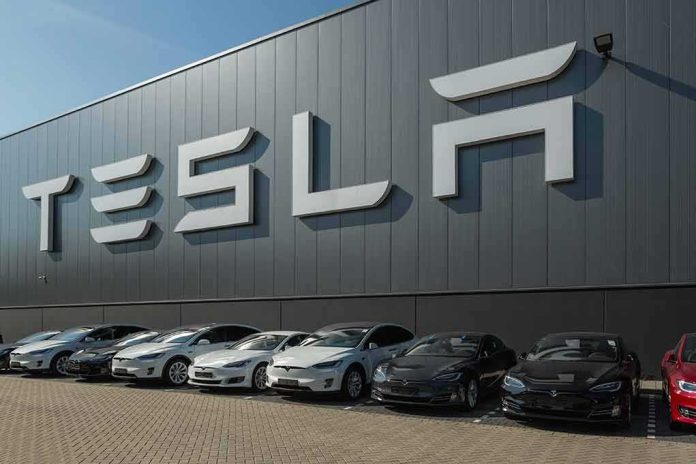
Tesla’s decision to wind down Cybertruck production at Gigafactory Texas to free capacity for its Cybercab program is not a mystery twist; it is a textbook capacity reallocation in response to realized demand that fell well short of early aspirations, paired with a strategic pivot toward a higher-priority platform.
At a Glance
- Elon Musk said Tesla will wind down Cybertruck production at Gigafactory Texas around mid-2027 to make room for Cybercab output.
- External sales data show a steep decline in U.S. Cybertruck sales from 2024 to 2025, reinforcing the weak-demand rationale.
- Cybercab production had already begun at the Texas plant, making the shift operationally credible.
- The announcement concerns the Texas factory; it does not confirm whether the Cybertruck model ends entirely or moves elsewhere.
What Tesla Actually Committed To
Elon Musk stated that Tesla will wind down Cybertruck production at Gigafactory Texas around the middle of 2027 to create capacity for the Cybercab—Tesla’s robotaxi-oriented vehicle line. The phrasing matters. This is a factory-level reallocation, not an explicit global discontinuation of the model. Reporting to date has not identified another plant prepared to take over Cybertruck production, and Texas is the only known facility currently tooled for the vehicle; that is why many outlets describe the move as likely marking the end of the road, even though Tesla has not formally said so. One reasonable caveat: Tesla has not released model-level financials or utilization data tying sales and margins directly to the decision.
The operational pivot would be unremarkable in the context of auto manufacturing if not for the Cybertruck’s outsized cultural footprint. Automakers routinely reassign space, tooling, and labor when a product’s sustained demand does not justify dedicated capacity. Musk’s statement squarely frames the decision as making room for Cybercab production—an autonomous mobility bet that has been part of Tesla’s narrative arc for years and, crucially, has entered production at the very factory absorbing the space.
Demand, Delivered: The Numbers Behind the Shift
The most convincing empirical backdrop is the trajectory of U.S. Cybertruck sales reported by external trackers and relayed by major outlets. Reuters, citing Kelley Blue Book data, reported 20,237 U.S. Cybertruck sales in 2025, down 48% from 38,965 in 2024; year-to-date comparisons through the first nine months of 2025 showed a similar 38% decline against 2024. These are not Tesla’s own model-by-model delivery disclosures—Tesla does not break those out—but they offer a consistent picture of a vehicle whose realized volume sagged materially after an initial burst.
The gap between early ambition and reality further sharpens the logic. Around the start of production, Musk spoke of potential annual volume on the order of 250,000 units; by contrast, the reported 2025 U.S. tally is roughly eight percent of that target. That mismatch does not by itself dictate a wind-down, but in a plant where every square foot and skilled worker can be pointed at another program, it makes an opportunity-cost case. Capacity is not sentimental. It flows toward the next best use.
Why Gigafactory Texas Is the Pivot Point
The Texas factory is the nexus of both vehicles. Tesla’s Q2 2026 update and investor filings indicated Cybercab production had begun at Gigafactory Texas, which makes the reallocation more than a press-release ambition; it is a scale-up of a program already born on that floor. Installed capacity figures in investor materials often overstate short-run output—industrialization is a slope, not a step function—but they still anchor the feasibility of moving headcount, line time, and tooling focus from Cybertruck to Cybercab. What the public record does not yet quantify is the precise transfer path: which final-assembly stations are reworked, how battery and drive-unit flows are rebalanced, or the capital schedule for line conversion. Those are execution details, not contradictions.
Critically, none of this requires the Cybertruck to be a categorical “failure.” It requires only that its steady-state demand, at its achieved price points and cost structure, does not compete with the expected return on Cybercab capacity inside the same four walls. Auto programs are portfolios; the internal rate of return, not the mythology, allocates bays and bodies.
The Broader Pattern: EV Ambition Meets Industrial Reality
Viewed in industry context, Tesla’s move sits squarely inside a wider EV recalibration. Across manufacturers, programs conceived for a steeper adoption curve have been delayed, downsized, or redirected as price sensitivity, charging friction, and interest rates changed the slope of demand. The sector has seen high-profile cancellations and deferrals of electric pickups and SUVs as companies right-size capacity to realized take rates and margin profiles. The operational motif is the same: preserve capital, align throughput to demand, and push capacity toward the next strategic differentiator.
One reason this particular pivot resonates is that it intersects two of Tesla’s identities: the provocateur of vehicle design and the evangelist for autonomy. The Cybertruck embodied the first, with its stainless exoskeleton and iconoclastic form; the Cybercab channels the second, concentrating the company’s autonomy thesis into a purpose-built platform. By migrating resources toward Cybercab, Tesla is wagering that the long-run value of a scaled robotaxi architecture exceeds the option value of sustaining a low-volume, high-variance pickup experiment at its flagship plant.
Tesla to cease production on cybertruck beginning in 2027.https://t.co/OGz0pVMvUb
— The Tornado News (@TheTornadoNews) November 7, 2026
What We Still Don’t Know—and What Matters Less Than It Seems
Two questions linger for investors and enthusiasts. First, whether Cybertruck production will continue anywhere after Texas winds down. Tesla has not said; absent a second prepared plant, the default assumption is a sunset until proven otherwise, which explains why some coverage interprets the Texas move as the effective end of the model. Second, the Cybercab’s capacity to absorb the freed resources at speed: regulatory readiness, fleet demand, quality ramp, and unit economics will determine whether the bet pays off. Production has started, but sustained commercial throughput is the real exam.
What matters less than the headlines imply is the need to cast the Cybertruck’s arc in absolutes. The evidence supports a straightforward reading: a vehicle that underdelivered on volume relative to early hopes, paired with a program Tesla now rates as strategically superior, led to a deliberate reallocation at the plant built to do both. That is how modern auto companies, especially those with platform ambitions beyond retail sales, survive their own hype cycles.
Sources:
msn.com, reuters.com, rmb.reuters.com, assets-ir.tesla.com, foxbusiness.com, finance.yahoo.com