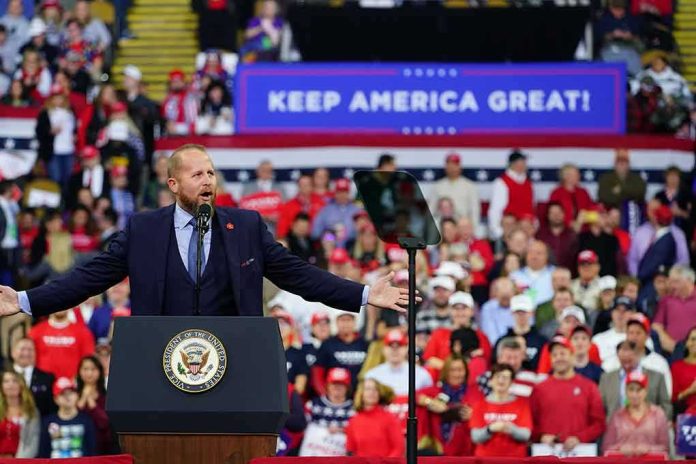
Presidential campaign rallies have long doubled as venues for announcing federal spending, but rarely does a candidate attach a dollar figure, a named company, and an explicit election trigger in the same sentence — which is exactly what happened in Highland Heights, Kentucky, on October 17, 2026.
Key Points
- At a midterm rally, President Trump said the Department of War would invest $100 million in Antheia, a pharmaceutical manufacturer, to revitalize a drug-production facility in Winchester, Kentucky — but only “if the Republicans win.”
- Five major outlets, plus local Northern Kentucky coverage, reported the same statement, quote, and conditional framing on the same day.
- The pledge is not without institutional grounding: Antheia already holds federal Title III funding under the Defense Production Act and has received prior U.S. government agreements worth a combined $23 million.
- No contract, award notice, or appropriation tied specifically to the $100 million figure had surfaced in reporting at the time of the rally, and the Department of Defense did not immediately confirm the pledge.
- The announcement lands in a Kentucky Senate race where Rep. Andy Barr, who represents Winchester, is the Republican nominee.
What Trump Said, and Where
Campaigning for Republican candidates in Highland Heights, President Trump told the crowd: “If the Republicans win, the Department of War will be investing $100 million in the pharmaceutical company Antheia to revitalize a gigantic drug manufacturing facility in Winchester, Kentucky.” The statement was specific in ways campaign-trail promises often aren’t — naming a recipient company, a dollar figure, a purpose, and a town, rather than gesturing vaguely at “bringing jobs back.” That specificity is part of what made the remark newsworthy; it reads less like a slogan and more like the outline of a term sheet.
The rally was covered live by the Courier-Journal, which reported the same quote in its running updates from the Highland Heights event, and corroborated independently by CNN, USA Today, NBC News, and the local outlet LINK nky. The convergence of five separate newsrooms on an identical quote, delivered in a public setting rather than relayed through an anonymous source, is the kind of corroboration that settles the factual question of what was said and where.
Why Antheia and Winchester Aren’t Random Choices
Antheia is not a company plucked out of nowhere for a rally applause line. The firm specializes in bioengineered production of pharmaceutical starting materials — notably oripavine and thebaine, the chemical precursors used to manufacture opioid-based medicines and, significantly, naloxone, the opioid-overdose reversal drug sold as Narcan. Antheia already sits inside the federal government’s Title III Essential Medicines Portfolio, a program under the Defense Production Act that funds domestic manufacturers to “modernize fermentation capacities” for key starting materials. In mid-2025, the company raised $56 million in a Series C financing round and disclosed it had already secured two U.S. government agreements worth a combined $23 million to support domestic production.
That existing relationship matters because it establishes mechanism: the legal authority to make an investment like the one Trump described already exists and has been used before, for Antheia specifically. Title III of the Defense Production Act lets federal agencies provide loans, purchase commitments, subsidies, and other financial assistance directly to private manufacturers to expand domestic production capacity. The government has used this exact authority at even larger scale elsewhere — a $765 million loan to Eastman Kodak for domestic pharmaceutical production and a $138 million award to support COVID-19 vaccine supply chains are both documented Title III actions. A $100 million pledge to a company that already has a Title III footprint is, in that sense, well within the range of what the authority has funded before — it is not a figure invented from nothing.
The Election Condition Is the Unusual Part
What distinguishes this pledge from a routine industrial-policy announcement is the explicit conditionality. Trump did not say the investment was happening; he said it would happen “if the Republicans win.” Reporting describes that trigger in slightly different terms — some framing it as Republicans winning the midterms generally, others as Republicans retaining control of Congress — and neither the rally remarks nor subsequent coverage specified whether that means holding the House, the Senate, both, or some other benchmark. That ambiguity doesn’t undercut the fact of the promise; it simply means the precise terms of fulfillment remain defined only by the president’s own words, not by a written policy document.
The political backdrop sharpens the stakes. Winchester sits in the congressional district represented by Rep. Andy Barr, who is also the Republican nominee in Kentucky’s Senate race this cycle. A federal investment pledge delivered at a rally where Barr was present, tied to his district, inevitably reads as a message to voters about what a Republican win would deliver locally — a tactic with deep roots in American retail politics, where presidents of both parties have long used the implicit promise of federal largesse to court votes in competitive districts. Legal scholars examining similarly transactional campaign-trail funding pledges have generally concluded they fall short of anything prosecutable, even when the sequencing — win first, funding second — sounds explicitly conditional.
Trump Promises Kentucky Drug Plant Investment if Republicans Win Midterms
President Donald Trump told a crowd at Truist Arena in Highland Heights, Kentucky, on Saturday that the Department of War will invest $100 million in the pharmaceutical company Antheia to revitalize a drug… pic.twitter.com/MhX4FySzBN— American Voice Rising (@amvoicerising) October 17, 2026
What Would Turn a Pledge Into a Program
A rally promise and a funded federal program are not the same instrument, even when the same dollar figure and company name attach to both. Converting this pledge into an actual investment would require a documented funding vehicle — a Title III award notice, a Department of Defense contract, a congressional notification, or a cooperative agreement naming Antheia and the Winchester facility specifically. At the time of the rally, the Department of Defense had not issued such confirmation, and representatives for the department and for Barr’s campaign did not immediately respond to reporters’ requests for comment. That is a standard reporting gap for a same-day announcement, not evidence that the pledge lacks a path to implementation; federal awards of this size typically take weeks or months to move from announcement to paperwork even when fully intended.
The more durable takeaway is structural: the authority to make this investment exists, the recipient company already has a federal funding relationship under that authority, and the president publicly tied its activation to an electoral outcome. Whether the $100 million materializes will be settled not by further rally remarks but by whatever budget justification, procurement notice, or Title III agreement the Department of Defense eventually publishes — the same paper trail that has documented every comparable award under this authority to date.
Sources:
youtube.com, courier-journal.com, edition.cnn.com, terrabrasilnoticias.com, usatoday.com, nbcnews.com, axios.com, antheia.bio, inkl.com, aspr.gov, war.gov