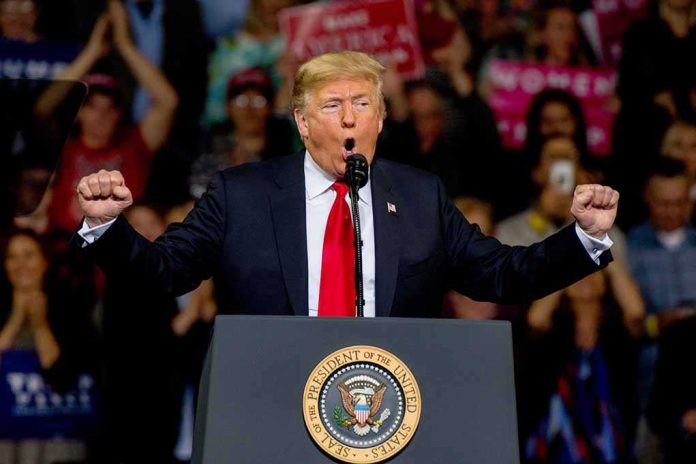
When a president names American cities as hypotheticals in the blast radius of a foreign adversary, the words do more than provoke outrage; they redraw the boundary between deterrence rhetoric and the nonnegotiable duty to protect citizens at home.
At a Glance
- Trump’s rally line explicitly named Los Angeles and San Diego as cities Iran could “take out,” triggering immediate condemnation from California leaders who read the remark as treating residents as expendable.
- The White House argued the comment was about stopping a nuclear-armed Iran from ever threatening U.S. cities, not inviting attacks—casting the backlash as a media misread.
- Multiple outlets independently quoted the same core phrasing, strengthening confidence the words were spoken even as dispute persists over intent.
- This clash fits a recurring pattern: punchy presidential phrasing meets clip-driven amplification, collapsing nuance and hardening political narratives long before context is resolved.
What Was Said, and Why It Landed Like a Shockwave
At a Nebraska rally, President Trump moved through a familiar argument about Iran and nuclear weapons, then used an illustrative line that detonated far beyond the venue: references to letting Iran “take out” Los Angeles or San Diego, in tandem with a framing about acceptable costs. California officials responded as if a red line had been crossed; Los Angeles Mayor Karen Bass called the rhetoric dangerous and potentially compromising to city safety, while San Diego Mayor Todd Gloria rejected the implication his city could be collateral damage. Those reactions were not isolated to one partisan lane—Republican voices also objected that no American is expendable. Independent reporting from multiple outlets captured the same essential phrasing, anchoring the controversy in what appears to have been said, not merely how it was paraphrased.
To defenders, however, the sentence belonged to a longstanding deterrence script: the White House said the point was that a nuclear Iran would be able to threaten U.S. cities if not checked, not that any attack should be allowed. They labeled the backlash a media overread and linked it to Trump’s consistent position that Iran must never acquire a nuclear weapon. Thus the dispute is less about whether the words were uttered than about whether the rhetorical construction served deterrence—or abdicated the protective posture expected of a commander in chief.
Mechanism: How Deterrence Rhetoric Collides With Domestic Security Norms
Strategic rhetoric often relies on stark hypotheticals: by naming the unacceptable, a leader signals resolve to prevent it. That is the grammar of deterrence—paint the worst case to galvanize allies and warn adversaries. The problem arises when the hypothetical names your own people in a way that sounds permissive rather than prophylactic. Syntax matters. A conditional (“we will never allow Iran to threaten our cities”) reads as protection; a permissive imperative (“let them take out”) reads as license. The White House insists the intended meaning was the former—U.S. policy to prevent Iran’s nuclear capability—yet the phrasing that spread across broadcasts and social feeds encoded the latter to many listeners.
Audiences hear what the sentence structure teaches them to hear. In a domestic political environment primed by years of acrimony between Trump and California leaders, city-specific permissive language reliably functions as an accelerant. That is not a matter of partisan fragility; it is the predictable outcome of crossing the rhetorical wire between deterrence theory and a president’s bedrock duty to shield Americans at home.
Evidence Weighing: What Holds Up, What Remains Contested
On the factual backbone, the case is strong that the president explicitly named Los Angeles and San Diego; ABC7, NBC, Reuters, KTLA, and others reported and quoted the line in near-identical form, creating redundancy across independent outlets. Where uncertainty persists is intent and surrounding context, because the most widely circulated material is excerpted rather than a full, authoritative transcript. That gap leaves room for the White House’s assertion that the remarks were about stopping a nuclear Iran—an interpretation echoed across multiple outlets carrying the administration’s response.
Two claims therefore coexist: the textual one (the naming of California cities in permissive phrasing) and the contextual one (the administration’s deterrence gloss). The first is well-supported by parallel reporting; the second is an official reading of meaning that cannot erase the original locution but can plausibly explain how the line was intended to function within a broader anti-nuclear argument.
Why California’s Reaction Was So Swift and So Broad
Local officials are operationally responsible for risk communication and threat posture. When a president appears to flirt with the idea that their cities are an “acceptable loss,” they must respond—quickly—to avoid normalizing vulnerability. Bass and Gloria’s statements reflect that operational logic as much as political opposition: signal to residents and would-be adversaries that the city is not expendable, and that all levels of government are aligned on protection. The speed of bipartisan pushback from some Republicans—emphasizing that no American is expendable—underscored that this is not solely about partisanship; it is about the civic compact that homeland safety is not a bargaining chip.
The White House defense sought to restore that compact by re-anchoring the words in deterrence. But in modern media, the first clip defines the battlefield. Once the permissive phrasing attached to the names of real American cities, city leaders had little choice but to repudiate the frame.
The Media Dynamics That Locked the Narrative
Short, emotionally charged excerpts outperform nuanced paragraphs; this is an iron law of digital distribution. When a line as combustible as “let them take out Los Angeles” is clipped and shared, it acquires a life of its own. Follow-on coverage often centers on the strongest reactions, which cements the frame of danger and outrage. Later official clarifications can dampen the fire but rarely reverse it—particularly when the clarification must argue that a permissive-sounding sentence was intended as preventive doctrine. The result is a familiar sequence: an inciting phrase, a cascade of condemnation, and dueling interpretations that harden into identity markers more than they converge on shared meaning.
President Donald Trump is facing bipartisan backlash after comments at a campaign rally in which he suggested that Iran could "take out" two cities in California. pic.twitter.com/UGU5hZJimT
— PBS News (@NewsHour) October 6, 2026
Lessons for Future Presidential Communication
Rhetoric about existential threats must honor two imperatives at once: convey the stakes vividly enough to sustain deterrence and alliance cohesion, and do so without implying that any Americans are negotiable. The discipline is not cosmetic; it is strategic. Precision about agency (what the U.S. will prevent) and modality (what will never be allowed) avoids the permissive constructions that invite domestic alarm. Consistency matters too: administrations build credibility when their language about protecting U.S. cities is as unambiguous as their vows to deny adversaries nuclear capability.
Bottom Line
The evidence is clear that Trump named Los Angeles and San Diego in a phrase many heard as permissive, prompting swift condemnation across California and some bipartisan lines. The White House’s counter—grounded in a long-articulated stance against a nuclear Iran—offers a plausible account of intended meaning but cannot fully neutralize how the words landed in public. In security politics, phrasing is policy’s first line of contact with the public. When the sentence structure suggests American cities are chips on the table, the reaction will be immediate, and it will be justified.
Sources:
feedpress.me, thehill.com, nbcsandiego.com, goodmorningamerica.com, nbcnews.com, kesq.com, reuters.com