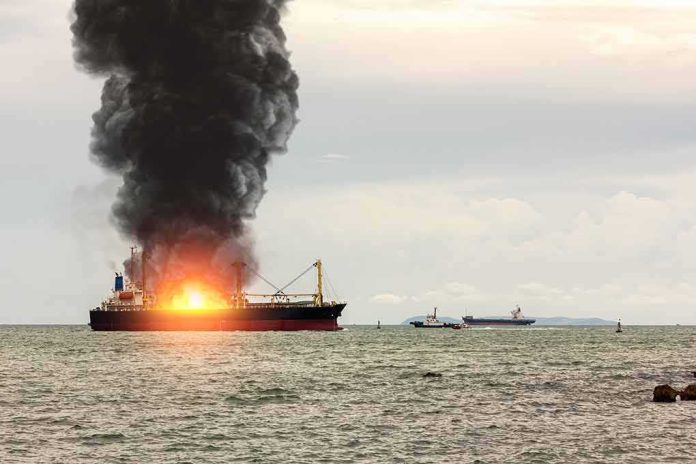
When missiles hit a working port, they ignite more than fuel and timber; they set fire to trade routes, insurance models, and the calculus of every shipowner deciding whether to risk a chokepoint or sail thousands of miles around it. The Houthi strikes on Yemen’s Mocha port fit that pattern exactly—kinetic blows whose real power lies in the economic shockwaves they send through the Red Sea and Bab al-Mandeb.
At a Glance
- Houthi strikes hit Mocha repeatedly; port officials suspended commercial and maritime operations after a barrage of more than 25 missiles over several days.
- Government and military accounts reported fatalities and dozens wounded in the Mocha attacks; smoke and burning vessels were documented by regional outlets and wire services.
- The incident aligns with a broader Houthi maritime campaign that has targeted hundreds of ships since late 2023, raising costs and rerouting traffic away from the Red Sea.
- The strategic stakes extend beyond Yemen: each successful port or ship strike reverberates through global supply chains and the politics of maritime security.
What happened in Mocha, and why it matters
Over several days, the Iran-aligned Houthi movement launched missiles at the government-held Red Sea port of Mocha, forcing a halt to commercial and maritime operations after a reported barrage exceeding two dozen strikes. The port’s director put the cumulative damage in the millions of dollars and confirmed the operational shutdown, while authorities reported multiple fatalities and injuries during the attacks. Video and stills carried by regional broadcasters and wire-service partners showed charred hulls and smoke columns—the visual signature of a strike that reached the waterfront and set vessels ablaze. In parallel, Yemen’s military and officials detailed the human toll from the Mocha assault, citing dead and wounded and describing damage that extended to civilian infrastructure as well as military targets.
Mocha is not a major container hub by global standards, but as a government-held port on the Taiz coast it matters for coastal trade, humanitarian throughput, and the movement of basic goods for southwestern Yemen. Closing it—whether for days or weeks—translates to longer hauls by road, congestion at alternate facilities, and higher prices in a market already squeezed by war. That is precisely the lever the Houthis have honed: localized strikes that ripple outward into regional and international cost curves.
Mechanics of the threat: from launcher to ledger
The Houthis’ maritime-attack toolkit mixes ballistic and cruise missiles, armed drones, and uncrewed explosive boats. Even where interception rates are high offshore, volleys stress defenses and create windows for leakage; when salvos are aimed at static infrastructure like a port, the probability of damage rises. In Mocha, the description of multiple missiles over several days, with images of burning vessels after impacts, aligns with a saturation approach that prioritizes disruption over precision. The effect is multiplicative: one strike can torch a pier or ship; repeated strikes force insurers to reassess risk, underwriters to adjust war premiums, and operators to pause sailings. Those second-order changes often cost more than the original damage.
Since late 2023, this has been the through-line of the Houthi maritime campaign. Independent assessments catalog well over a hundred attacks against commercial and naval vessels across the Red Sea and Gulf of Aden during the first phases of the operation, with multiple ships sunk and mariners killed as the tempo rose. Policy analyses and maritime advisories converged on the same operational truth: a relatively low-cost arsenal, combined with political will to use it, can reshape route economics for global carriers—pushing many to avoid the Suez-Bab al-Mandeb corridor entirely and divert around the Cape of Good Hope.
How Mocha fits the larger campaign
The Mocha port strikes are not an aberration; they are a coastal extension of a sustained pattern aimed at raising the price of transiting the southern Red Sea. Analysts tracking the campaign have documented the Houthis’ intent to impose their own de facto “rules” on shipping, targeting vessels they claim are linked—sometimes tenuously—to adversaries, and broadcasting attack footage to reinforce deterrence-by-example. The tactical emphasis has oscillated between ship strikes in the Bab al-Mandeb and shots at shore facilities like Mocha. In both cases, the strategic payoff is the same: uncertainty. Uncertainty is toxic to logistics contracts, charter rates, and schedules. In the Red Sea, it has already driven a measurable exodus of lines from their normal routings and introduced weeks of added transit for Asia–Europe services.
There is also a grim feedback loop. As ship operators adapt—sailing further offshore, forming convoys when possible, or tightening AIS and communications discipline—the Houthis have responded with different mixes of weapons and target sets, including ports within their reach. Reporting from the Mocha strikes underscores this dynamic: even when maritime patrols and naval defenses blunt offshore attacks, shore-based salvos can still achieve political and economic effect at acceptable cost to the attacker.
Human consequences: crews, port workers, and a war economy
The most compelling argument against normalizing this new maritime risk environment is human. Prior lethal strikes on commercial vessels south of Mocha killed mariners and set ships ablaze, with accounts of “double-tap” tactics that exacerbate casualties during rescue attempts. Port attacks carry the same hazard for stevedores, drivers, and emergency services. The fatalities and injuries reported in Mocha underline that every adjustment of insurance rates represents real people absorbing the shock at the waterline.
Yemen’s economy—fragmented, dollar-starved, and deeply dependent on imports—cannot easily absorb the closure of a coastal outlet. Each day of suspension forces re-routing of staples and aid, adding cost and delay. And while the Houthis frame maritime actions in political terms tied to broader regional conflicts, the immediate impact of a port attack lands on ordinary Yemenis who have no say in targeting decisions and little buffer against price spikes.
Why the Red Sea matters far beyond Yemen
Roughly one-tenth of global seaborne trade typically uses the Suez Canal, and the Bab al-Mandeb is the southern gate. When that gate is contested, costs ripple through energy markets, container supply chains, and bulk commodities. The recent campaign has already pushed many carriers to reroute, adding 10–14 days to Asia–Europe transits and tying up vessels and equipment that would otherwise circulate cargo; analysts have warned of knock-on inflationary effects if the instability persists. The Mocha strikes will not, by themselves, tip the global shipping system; but as part of a sustained pattern, they contribute to a higher baseline of risk and cost for everyone who depends on reliably moving goods between the Indian Ocean and the Mediterranean.
Security responses have similarly systemic tradeoffs. Naval patrols and missile defenses are expensive to maintain, interception is probabilistic, and rules of engagement evolve slowly compared to an adversary’s capacity to relocate a mobile launcher or switch to inexpensive drones. The cost-exchange ratio favors the attacker; the deterrence calculus, therefore, leans on broader political and economic levers as much as on hard-kill defenses.
Houthi Strikes on Yemen's Mocha Port Kill Workers, Halt Operations as Fragile Truce Collapses pic.twitter.com/g1ckgeJOO9
— Jessica Lee (@Global1Newz) August 15, 2026
What to watch next: thresholds, adaptations, and endurance
Three thresholds merit attention after Mocha. First, target selection: if the Houthis continue alternating between ships and shore facilities, port operators across Yemen’s west coast will need contingency plans that assume intermittent shutdowns. Second, weapon mixes: the balance of ballistic salvos, drones, and waterborne IEDs drives both defense design and insurer appetite. Third, the campaign’s endurance: the longer this pattern holds, the more it hardens into a “new normal” that bakes higher costs into contracts, freight rates, and ultimately consumer prices on another continent.
The lesson from Mocha is not mysterious. Ports are pressure points. Strike them repeatedly and even modest damage can have outsized effects—on the ledger sheets of shipping lines, on risk models at Lloyd’s, and on the dinner tables of families far from the Red Sea who feel the pass-through costs. That is the strategic logic the Houthis have pursued since 2023 and that Mocha, with its shut gates and burned hulls, makes plain.
Sources:
youtube.com, aol.com, english.news.cn, chinadailyasia.com, sabanew.net, washingtoninstitute.org, iiss.org, aei.org, onlinelibrary.wiley.com