
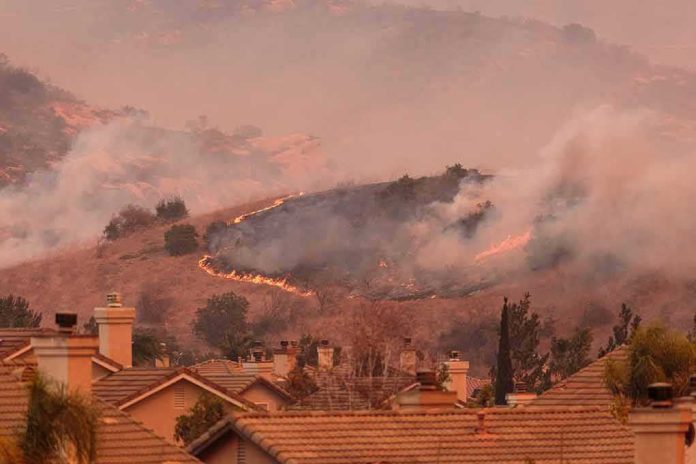
When a grassfire turns urban, minutes matter: the West Midlands wildfires showed how Britain’s patchwork of parched verges, golf-course rough, and garden fences can become a single fuel bed—and how fast a manageable field fire can become a street-by-street emergency.
At a Glance
- Stourbridge was the epicentre: a grassfire near a golf course jumped roads and rail, igniting at least six homes and forcing evacuations.
- West Midlands Fire Service deployed more than 100 firefighters at peak, calling conditions among the most challenging in decades.
- Tinder-dry grassland and wind-driven embers, not forest, made the fire urban—fences, sheds, and eaves carried flame into houses.
- Simultaneous incidents across the region strained control rooms and appliance availability, a recurring pattern in British heatwaves.
What made this wildfire different: a grassland ignition that became a neighborhood fire
Wildfire conjures images of moor or forest, but the Stourbridge fire began on grassland skirting a golf course and spread through what fire engineers call the wildland–urban interface—the zone where open land abuts homes, sheds, fences, and outbuildings. In this interface, the continuity of fuel is deceptive: knee-high desiccated grass, dry hedges, timber fences, decking, and shed contents stitch together a path for flame. As the blaze advanced, radiant heat, wind-borne embers, and direct flame contact ignited property perimeters first; once fence lines and eaves caught, structures followed. West Midlands Fire Service confirmed the grassfire near the course, rapid spread to homes, and casualties from heat and smoke, with live aerials showing multiple properties burning and heavy smoke columns marking spot fires ahead of the front.
Scale followed fast. The service escalated to more than 100 firefighters and roughly 20 appliances at the Stourbridge scene while managing other fires across the region—an operational picture their chief fire officer described as among the most significant and challenging of his career, driven by “tinder dry” conditions and extreme demand on call handlers and crews. Evacuations spanned several streets and estates; a reception center opened to receive displaced residents as utilities and transport were disrupted, including local rail and road closures because of smoke and heat effects.
How a UK grassfire escalates: mechanism, minute by minute
Mechanically, three forces turned a field ignition into house fires. First, fine fuels—and the West Midlands has them in abundance. Fine fuels are grasses and light vegetation that dry and cure quickly; they ignite with a match, a spark, or a shard of sunlit glass, and they carry flame faster than crews can overtake on foot. Second, wind alignment: even modest gusts bend flames forward, preheating the next meters of fuel and lofting embers. Residents and camera crews recorded the fire “jumping roads,” which in practice means convective lift sent embers across asphalt gaps to receptive beds—verges, mulch, and hedge bases—on the far side. Third, the built environment itself: timber fences behave like linear fuses, transmitting fire laterally to garden sheds and directly to the timber-rich underside of roof overhangs. Once eaves and soffits fail, a house can transition from exterior flame contact to an interior attic fire in minutes.
Suppression tactics in these conditions must pivot. Standard grassland attack relies on flanking with beaters and knapsacks, then laying hose where possible. In a wind-driven interface incident, commanders prioritize life safety and structure triage: position appliances to protect exposures, create wet lines along likely ember landing zones, and move residents out before conditions close egress. That’s what unfolded in Stourbridge—simultaneous structure protection and evacuation as the grass front advanced into streets, with incident command scaling to multiple sectors and mutual aid from neighboring brigades to maintain coverage for new starts elsewhere.
How we got here: heat, fuel, and simultaneous-incident strain
The fires coincided with the hottest day of the year so far, after a prolonged run of dry weather. Cured grass behaves like kindling; add wind and low humidity and the fire danger index spikes. That backdrop explains two otherwise puzzling facts: why a golf-course edge could outpace crews, and why so many separate ignitions surfaced across the West Midlands within hours. The region’s fire service and major newsrooms documented multiple, concurrent wildfires and grassfires from Birmingham to Barr Beacon to Clayhanger, with evacuations undertaken so crews could contain lines and prevent spread into built-up areas. These clusters are a known pattern: during British heatwaves, control rooms face surges of 999 calls, crews cycle rapidly between jobs, and a single large incident can pull a disproportionate number of appliances, stretching cover for the next call.
The service’s top officer labeled the Stourbridge event “extensive” in its devastation and “one of the most significant” the brigade has confronted, not because of size in hectares but because of the interface impact: homes destroyed, multiple injuries from heat and smoke, and the need to coordinate evacuations and welfare alongside fireground operations. Reporting from the scene tallied at least six properties on fire at peak and documented hospitalizations, including a child and firefighters treated for smoke inhalation—typical casualties in fast-moving interface events where heat stress and toxic products of combustion are as dangerous as burns.
What is contested—and what is not
In the early hours of any major fire, cause is an open question; formal origin-and-cause investigations require scene cooling, debris removal, and lab analysis when needed. In the West Midlands cluster, some separate commercial fires in Stourbridge were later found accidental, while police probed other wildfires for deliberate ignition; those determinations are incident-specific and arrive days later. What is not contested here is the impact profile: a grassfire near a golf course, extreme dryness, rapid expansion into residential streets, multiple homes burning, evacuations, and heavy commitment of regional fire resources—these facts are consistent across fire service statements, wire reporting, and live aerial coverage. That is the load-bearing truth of the day.
This distinction matters for policy. Preparedness decisions—crew surge capacity, interface preplans, public alerting, seasonal restrictions on ignition sources—track the predictable impact patterns under certain weather regimes. Whether a single spark came from machinery, glass, or malice changes the criminal file; it does not change the operational requirement that, given tinder-dry fine fuels and wind, grassland at the city’s edge will carry flame into streets unless fuels are managed and response is rapid.
Lessons for communities at the wildland–urban edge
Britain’s interface is not a Californian chaparral, but it has its own signature hazards. The most combustible material outside many UK homes is the perimeter fence; when dry, close-board panels light easily and propagate fire along property lines. Replace or break up wooden runs with noncombustible sections near structures; clear leaf litter from fence bases; and treat the first meter around a house as a noncombustible zone, free of bark mulch and stacked timber. Eaves and soffits benefit from ember-resistant vents and intact mesh; sheds and stored fuels should be set back, not tucked under eaves. These are modest retrofits, but in a grassfire they can be the difference between external scorching and an attic fire.
On the public side, councils and land managers can reduce continuous fine fuels where urban fabric meets open space—mow firebreaks ahead of forecast heat spikes, manage gorse and bramble thickets at interface pinch points, and coordinate with golf clubs, rail operators, and utilities to time vegetation work before peak risk periods. During declared high fire danger, targeted restrictions on barbecues and machinery in grassland are a rational trade to avoid multi-appliance incidents that degrade region-wide resilience. Incident commanders will still need surge capacity; Stourbridge showed that twenty appliances on one fire leave a thin line elsewhere. Preplanned cross-border aid agreements and dynamic cover moves are the backbone of maintaining service when a cluster of ignitions arrives within an hour.
Why this will recur—and how to be ready
Longer, hotter dry spells are now a standing feature of British summers. Fine fuels cure earlier, stay receptive longer, and regenerate quickly after rain, resetting the hazard. The operational story in the West Midlands—a grass ignition, wind-driven spread, homes alight, evacuations, hospitals treating smoke inhalation, and a control room handling thousands of calls—is therefore not an anomaly; it is a template for the next heat spike. Preparedness means treating grassland urban interface fire as a first-order risk: seasonal public campaigns keyed to weather, neighborhood-scale fuel management, appliance and crew surge rostering, and inter-agency rehearsal for evacuations and reception centers. Residents should know two things in advance: their fastest egress and the simple exterior mitigations that lower ignition probability when embers fall.
The Stourbridge fire compressed these truths into an afternoon. Crews fought hard and long; many residents lost homes; many more returned to streets blackened but standing. The mechanism that decided which outcome each address saw was not mysterious—continuous fuels, wind, and ember pathways. Neither is the remedy. If we interrupt those pathways before the next hot, dry day, the next fire will still run across grassland. It does not have to run through our homes.
🚨 BREAKING: A wildfire in Stourbridge, West Midlands, damaged multiple homes! A child and three firefighters were taken to hospital. Further details can be found at the incident's page.https://t.co/tlZPwoJQnT
— UK Flash Point (@UKFlashAlerts) August 13, 2026
Sources:
independent.co.uk, youtube.com, bbc.com, itv.com, facebook.com