When religious symbols are placed at the center of provocative LGBT-themed art inside a former church, the conflict that follows is less about whether art or faith should exist in public life than about how far artistic freedom can go before it becomes, in the eyes of believers, a direct act of sacrilege.
At a Glance
- A Sydney arts venue, Divine Playhouse, staged LGBT-themed performances using explicitly Catholic imagery inside a deconsecrated former church.
- Archbishop Anthony Fisher condemned the programming as a deliberate denigration of sacred symbols, not as a broad attack on LGBT people or art itself.
- The landlord terminated the venue’s lease under “offensive trade” provisions, suggesting concern extended beyond church authorities.
- The dispute crystallizes a recurring global tension: religious communities defending the sanctity of their rituals versus artists invoking those rituals in satire, critique, or identity expression.
How a Deconsecrated Church Became a Flashpoint
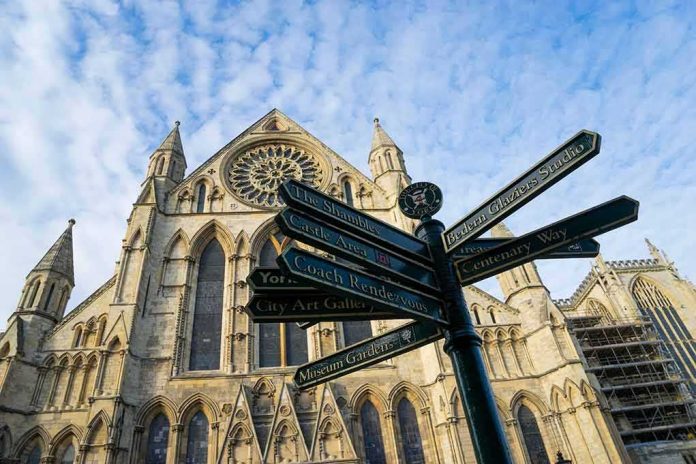
The controversy centers on Divine Playhouse, a temporary arts venue established in a deconsecrated former Catholic church in Sydney’s central business district. The building itself is a powerful symbol: legally and liturgically it is no longer consecrated, yet its architecture, history, and name continue to mark it as a site once reserved for Catholic worship. When such a space is repurposed for experimental performance—especially performance that plays with religious imagery—it almost inevitably becomes a litmus test for how a community understands the boundary between sacred and secular realms.
Divine Playhouse reportedly received a substantial public arts grant and hosted programming that incorporated overtly Catholic-coded language and visual motifs. Among the advertised events were “Sunday Mess” and “Unholy Confessions,” titles that invert or parody standard Catholic phrases, and promotional imagery that depicted McDonald’s fries as the Eucharist. From a purely curatorial standpoint, these choices are legible as commentary: they signal that the work will treat religion as a cultural system, subject to critique, irony, and perhaps camp sensibility. From a Catholic theological standpoint, however, they step directly onto the central sacrament of the faith—the Eucharist—and into a liturgical lexicon that Catholics do not regard as available for casual repurposing.
Archbishop Fisher’s Argument: Artistic Freedom Has Limits
Archbishop Anthony Fisher’s response to Divine Playhouse did not take the form of a generalized denunciation of LGBT people or of art as such; rather, he framed the dispute as a question of the proper limits of artistic freedom when it intersects with religious belief. In his published statement, Fisher acknowledged the value of free expression and the long public tradition of satire and criticism. Yet he insisted that freedom of speech includes not only the right to create and perform, but also “the right, and at times the responsibility, to say plainly when something is inappropriate, offensive, wrong.” That dual emphasis is characteristic of many contemporary religious leaders who engage culture: they concede the civil liberty to offend, while defending a parallel liberty to object.
More specifically, Fisher drew a line between satire and what he described as “the deliberate appropriation, sexualisation, and denigration of symbols and rituals specific and sacred to the Catholic faith.” For Catholics, he wrote, the Eucharist is not a cultural motif to be parodied; it is “the sacrament at the heart of our worship.” When an image as central as the consecrated host is replaced in publicity by fast-food fries, the Archbishop reads this not as playful metaphor but as an act that trivializes what Catholics believe to be the real presence of Christ. His condemnation of the Divine Playhouse material therefore turns on sacramentality—on the conviction that liturgical signs participate in divine realities, and that mocking those signs is spiritually serious in a way secular parody is not.
Blasphemy Claim Versus Anti-LGBT Accusation
One of the notable features of Fisher’s intervention is the care he takes to separate his critique of the performances from a blanket rejection of LGBT people. He explicitly rejected claims that Christian objections to Divine Playhouse were directed at the LGBT community or at artistic expression itself. His stated objection was narrower: he argued that these particular performances ridiculed beliefs and practices Catholics hold sacred, using religious symbolism as a target rather than as a vehicle for pastoral dialogue.
This distinction matters because it places the dispute within a broader and more complex landscape of Christian engagement with LGBT questions. In various contexts, bishops and archbishops have both opposed certain legal recognitions of same-sex relationships and simultaneously condemned violence, bullying, or exclusion directed at LGBT people. Others, like Cardinal McElroy in the United States or Archbishop Heiner Koch in Berlin, have publicly apologized for the church’s mistreatment of LGBT individuals and called homophobia an “unholy line of tradition,” even as they navigate doctrinal boundaries. Fisher himself has a long record of opposing same-sex civil marriage and certain LGBT protections in education and health care, yet this episode is framed by him primarily as a defense of sacred symbols rather than of a specific policy stance.
A Pattern: Sacred Spaces, Queer Art, and Symbolic Transgression
The Divine Playhouse dispute is not an isolated anomaly; it fits a recurrent pattern in which LGBT-themed art or events collide with Christian sensibilities when they occupy or reference spaces marked as sacred. In 2021, Fisher protested the use of St Mary’s Cathedral’s forecourt in promotion for an LGBT “Live N’ Queer” concert, calling the imagery “frustrating and upsetting” and objecting to “little sensitivity shown to people of faith.” City authorities ultimately ordered the cathedral image removed from the advertising, a secular counterpart to the later lease termination at Divine Playhouse.
Similar conflicts have emerged elsewhere. In New York, a human-rights arts festival withdrew from a Catholic church hall after senior church officials raised objections to gay- and transgender-themed performances they deemed incompatible with church doctrine. In Vienna, Archbishop Carlo Vigano denounced a pro-LGBT concert held inside St Stephen’s Cathedral as a “homoerotic and blasphemous provocation,” arguing that performers like Conchita Wurst should receive proclamation of the Gospel rather than a liturgical-stage platform. These episodes share structural features: LGBT identity or activism is linked with ecclesial space; religious leaders interpret that linkage as transgressive, sometimes explicitly as sacrilege; and civil authorities or landlords intervene through permits, leases, or advertising rules.
The Role of the Landlord and “Offensive Trade”
One of the more concrete external facts in the Divine Playhouse case is the landlord’s decision to terminate the venue’s lease, citing provisions related to “offensive trade.” While the details of that clause and the correspondence behind the decision are not publicly available in the material we have, the mere presence of such terminology in a commercial lease signals a risk calculus: landlords anticipate that some uses of a space—sexual, political, religious, or artistic—may attract public controversy severe enough to affect the property’s reputation or value. When that threshold is judged to be crossed, termination or non-renewal follows.
The lease termination provides modest corroboration of Fisher’s claim that objection to Divine Playhouse extended beyond strictly ecclesial circles. At minimum, it indicates that someone in the property chain believed the programming had become sufficiently controversial to trigger a contractual safeguard; it also suggests that, in this instance, claims of offense did not remain purely symbolic but carried real institutional consequences. It does not, by itself, prove that the performances were blasphemous in the theological sense Fisher uses; but it does demonstrate that the intersection of religion, sexuality, and art can have tangible economic and infrastructural effects.
Evidence Gaps: Intent, Content, and Fair Characterization
Where the available record is strong is in documenting Fisher’s language, the venue’s use of Catholic imagery in promotion, and the fact of the landlord’s intervention. Where it is weak is in reproducing the performance itself. We do not have a full script, a recording, or a scene-by-scene description that would allow independent observers to assess precisely how Catholic symbols were deployed on stage and how audience members experienced them. Without such material, we cannot make a definitive judgment about the performers’ intent: whether they aimed at ridicule, at critique of ecclesial power, at exploration of queer spirituality, or at some combination of these.
This evidentiary gap matters for anyone trying to distinguish between blasphemy and legitimate artistic commentary. What we can say, based on the titles and promotional imagery, is that the programming engaged Catholic motifs in a way likely to be perceived as provocative by believers and as affirming or playful by some LGBT participants. We can also say that Fisher has a consistent interpretive stance: he has repeatedly treated perceived mockery of Christian symbolism—whether on television comedy panels or in cathedral-adjacent advertising—as “highly inappropriate” and has encouraged Catholics to speak out when their beliefs are attacked. That consistency lends coherence to his reaction in this case, even if it does not resolve the question of artistic intent.
Freedom, Pluralism, and the Question of Mutual Limits
At the heart of Fisher’s argument is an appeal to pluralism. He contends that a genuinely pluralist society must protect three freedoms at once: freedom of artistic creation, freedom of religious practice, and freedom to protest peacefully when one’s convictions are mocked. In this view, objection to a performance is not censorship; it is participation in the same public sphere that art occupies. There are practical limits—no one has a legal right to be free from offense—but there is, in his account, a moral right to defend what one holds sacred against what feels like gratuitous denigration.
On the other side of such disputes, artists and LGBT advocates often argue that religious institutions wield substantial cultural power and that using their symbols in critique is precisely how marginalized voices push back. They see ecclesial calls to respect sacred imagery as attempts to reassert control over narratives that art seeks to pluralize. Globally, Catholic and Anglican debates over LGBT inclusion—from marriage liturgies to youth ministry—have made these symbolic questions sharper, because they are not merely about aesthetics but about who is welcome, under what conditions, and on whose terms.
Why This Conflict Will Keep Returning
The Divine Playhouse episode, and Fisher’s condemnation of what he labeled blasphemous LGBT performance, will not be the last iteration of this kind of controversy. As more churches are deconsecrated and repurposed as cultural venues, their residual sacred character remains a live element in how events are perceived—especially when programming touches on sexuality, gender, or religion. As LGBT artists and communities continue to claim space, they will sometimes choose to stage work in former churches precisely because those buildings embody histories of exclusion and doctrinal control they wish to interrogate or subvert.
In that environment, the question is not whether to choose art or faith, but how a pluralist society negotiates shared space. Fisher’s insistence that artistic freedom does not justify mockery of faith represents one end of that negotiation; the Divine Playhouse’s programming, with its Eucharist-as-fries imagery and inverted liturgical titles, represents another. The lease termination shows that landlords and funders are third parties in the negotiation, making decisions that can either facilitate or shut down contested expression. For readers trying to make sense of these dynamics, the key is to see beyond culture-war shorthand: to recognize that what is at stake is a persistent struggle over whose symbols, whose wounds, and whose stories are allowed to appear without apology in public space.
Sydney Archbishop Anthony Fisher OP has defended Catholics’ right to publicly oppose performances that mock their faith, arguing that artistic freedom does not justify the denigration of beliefs held sacred by millions.
Source: @catholic_weekly.https://t.co/HI392KYqAQ
— CathNews (@CathNews) July 29, 2026
Archbishop Fisher in Broader Perspective
Finally, situating this dispute within Fisher’s wider public ministry helps explain why it drew such strong reaction. He has consistently opposed the legal recognition of same-sex marriage, warned that expanded LGBT protections could pressure Catholic schools and hospitals, and testified in parliamentary contexts about religious freedom. At the same time, he has positioned himself as a defender of Catholics’ right to resist being “bullied” into endorsing changes they believe conflict with their faith. For supporters, his stance at Divine Playhouse is a coherent extension of his role as guardian of doctrine and worship. For critics, it is another example of an archbishop reading LGBT expression through a lens of threat and insult.
Understanding that tension does not require choosing sides; it requires acknowledging that when sacred symbols are drawn into contested cultural struggles, they carry more than aesthetic meaning. For Catholics, the Eucharist is the heart of worship. For many LGBT artists, the church is both a source of cultural language and an institution that has wounded them. The Divine Playhouse controversy is what happens when those two truths meet on a small stage, under high ceilings, in a former church that has not yet ceased to be a battleground over what counts as holy.
Sources:
lifesitenews.com, catholicweekly.com.au, abc.net.au, reuters.com, anglicannews.org, theguardian.com, smh.com.au, newwaysministry.org, episcopalnewsservice.org, tylerclementi.org, bbc.com