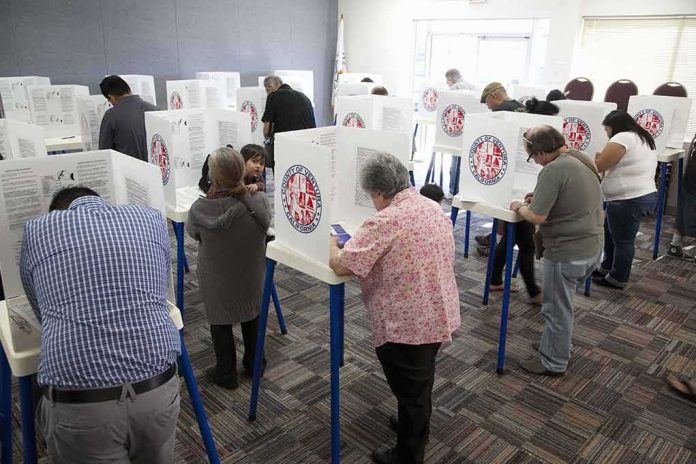
When you strip away the rhetoric, New Jersey’s noncitizen voter registration episode is a textbook case of how small but serious administrative failures in modern registration systems get weaponized into sweeping claims of “massive fraud” that the evidence simply does not support.
At a Glance
- About 6,600 noncitizens were wrongly added to New Jersey’s voter rolls over a year due to a Motor Vehicle Commission software error; fewer than 400 are believed to have voted.
- The glitch traces to automatic voter registration at DMV-style offices and a vendor system (IDEMIA) that registered some applicants even when they answered “no” to being citizens.
- Governor Mikie Sherrill ordered all erroneous registrations removed, fired the vendor, and opened an investigation, while stressing there is no evidence any election outcome was changed.
- National actors, including DHS leadership and former President Trump, have seized on the case to argue for strict federal voter roll “scrubbing” and proof-of-citizenship laws, despite broader research showing noncitizen voting is exceedingly rare.
- The episode illustrates both genuine vulnerabilities in how states implement automatic registration and the danger of converting isolated technical failures into narratives of systemic election corruption.
What Actually Happened in New Jersey’s Motor Vehicle System
According to Governor Mikie Sherrill and corroborating press coverage, the core facts of the New Jersey case are straightforward and largely uncontested. Beginning in June 2023, a “serious software error” in the state Motor Vehicle Commission’s (MVC) system caused certain noncitizens to be registered to vote when they obtained a driver’s license or state ID. These were individuals who, by design, were asked about voter registration during the transaction and answered that they were not U.S. citizens and therefore ineligible—yet the software nonetheless pushed a voter registration record into the election database.
Sherrill’s public statements, backed by Associated Press and CNN reporting, put the total at roughly 6,600 affected individuals between June 2023 and June 2024, when the glitch was finally fixed. Initial analysis by the Division of Elections indicates that fewer than 400 of those erroneously registered actually cast ballots, in elections ranging from local contests to statewide races. Those voters were distributed across the state and across party lines: Democrats, Republicans, and a substantial unaffiliated share.
The vendor responsible for the MVC software, IDEMIA, is identified by state officials as the source of the malfunction. The system was supposed to prevent noncitizens from being registered—but in a subset of cases, it did the opposite, overriding the applicants’ “no” responses and transmitting registrations anyway. That kind of bug is precisely the sort of subtle failure that can slip through testing in complex integrated systems; it rarely leaves a clear political fingerprint, but it can have real consequences for the affected individuals.
Governor Sherrill’s Response and Remedial Measures
Sherrill took office after the error window opened; her account is that she learned of the problem only recently and immediately directed her chief counsel to open an investigation. She ordered election officials to remove every erroneously added registrant from the voter rolls and to notify affected individuals by letter. She also moved to replace IDEMIA with another vendor, describing the year-long lag between the bug’s introduction and its fix as “unacceptable” on both the vendor’s and MVC’s part.
There are, at this stage, limits to what we know. No public technical report detailing the root cause, code path, or specific transaction flows has been released. There is no independent forensic audit on the public record that verifies the precise counts—6,600 registrations and under 400 votes—against federal citizenship databases or county election histories. The New York Times explicitly noted that its own independent verification of those statistics is pending. So while there is no substantive reason to doubt the state’s figures, they remain government-provided numbers awaiting third‑party validation.
Sherrill has emphasized repeatedly that there is “no evidence at this time that any elections were swayed.” That claim is plausible on its face: when you set several hundred questionable ballots against statewide margins in the hundreds of thousands, the mathematical reality is that the overall outcomes are unlikely to change. But “unlikely to change outcomes” is not the same as “insignificant”; for those who care about election administration, the error is serious precisely because even a small number of ineligible registrations should not slip through a system designed to prevent them.
How Automatic Voter Registration Creates These Failure Modes
To understand the New Jersey glitch, you have to understand the design of modern automatic voter registration (AVR). Under AVR, eligible residents are registered to vote by default when they interact with agencies like the DMV, unless they opt out. The mechanism typically depends on data fields like citizenship status, date of birth, and residence being correctly captured and correctly mapped into the election system.
In practice, this is fragile. DMV clerks may mis-key data, applicants may misunderstand questions, and software integrations may have bugs in how they parse “yes/no” answers or interface with downstream databases. States that have studied their own systems have repeatedly found that noncitizens who end up registered almost always arrived there through these kinds of inadvertent channels—misconfiguration, human error, or systemic glitches—not because they intentionally lied to gain voting rights they knew they did not have.
National research bears this out. The Brennan Center for Justice, the Election Innovation Lab, and other experts have synthesized state audits and found that actual noncitizen voting is “vanishingly rare,” and when it does occur, it typically represents a tiny fraction—0.0001% or less—of all votes cast. Pennsylvania, for example, identified 544 suspected noncitizen votes over seventeen years and roughly 93 million ballots, a rate so small that officials described it as “minuscule.” Oregon’s audit of automatic registration found a small number of mistaken noncitizen registrations and only a handful of ballots cast.
New Jersey’s numbers fit squarely within that pattern: the problem is real from an administrative perspective, but its scale is not evidence of coordinated or systemic fraud. It is evidence that complex, high‑volume registration systems will occasionally fail in ways that must be detected, corrected, and prevented from recurring.
The Counter-Evidence: Genuine Illegal Voting Exists, but Not at the Claimed Scale
Critics of Sherrill’s framing are correct on one important point: noncitizen registration and illegal voting are not purely hypothetical. Federal prosecutors in New Jersey have charged resident aliens with illegally voting in federal elections and making false statements during citizenship applications. Those cases demonstrate that, at least in isolated instances, individuals have both registered and voted despite ineligibility, and have done so knowingly enough to warrant criminal charges.
The New Jersey Republican Party and RNC have also conducted public records requests and say they found “hundreds” of noncitizens on voter rolls statewide, some of whom reportedly asked to be removed after discovering their registrations. However, their public statements have not, to date, included the kind of individual-level documentation—names, registration dates, matched immigration records—that would allow outside observers to assess the methodology and reconcile their numbers with the state’s 6,600‑case software error narrative.
On the national stage, Department of Homeland Security Secretary Markwayne Mullin has asserted that DHS has identified roughly 250,000 noncitizens registered to vote across California, New Jersey, Nevada, and Pennsylvania, plus tens of thousands more through the SAVE program. Yet in correspondence with Pennsylvania officials, DHS has not released the underlying list of alleged noncitizens or the methodology used. Experts who have examined similar data-matching efforts have consistently found high false-positive rates, particularly when federal immigration databases are matched against state voter files without careful context.
That is the key evidentiary divide. There is solid, specific proof of small numbers of illegal votes and mistaken registrations; there is, so far, only broad, undocumented assertion behind the six‑figure registration claims. Sherrill’s figures, by contrast, are narrow and linked to a defined technical failure window. Until DHS or party critics release granular data and allow independent review, their larger numbers remain unsubstantiated estimates rather than competing facts.
Data, Narratives, and the “Weaponization” of Elections
Governor Sherrill has framed the New Jersey episode not just as an administrative failure but as fodder for what she calls the “weaponization” of elections by former President Trump and his allies. That is not a claim about the bug itself; it is a claim about how that bug is being used in national discourse. The Trump administration, DHS leadership, and conservative media outlets have seized on New Jersey’s admission as evidence that “the thing Democrats said never happens just happened 6,600 times,” and as rhetorical ammunition for the Save America Act—a proposed federal law requiring proof of citizenship for voter registration and mandating aggressive voter roll purges.
The pattern here tracks other states’ experiences. California’s automatic registration glitches in 2019 were immediately cited by AVR opponents as proof of systemic fraud, despite investigations concluding that the mistakes affected a tiny number of records and did not change outcomes. Texas’s use of the federal SAVE database to identify supposed noncitizens on its voter rolls produced thousands of false matches, triggering federal lawsuits and eventual walk-backs when many flagged voters turned out to be citizens.
Sherrill’s argument is essentially that New Jersey is now being folded into this broader narrative: a localized, definable error is being generalized into a sweeping indictment of the electoral system, outpacing the evidence. Whether one shares her political perspective or not, the empirical record supports skepticism toward large-scale noncitizen voting claims. Across dozens of jurisdictions and millions of ballots, independent reviews have repeatedly found that improper noncitizen votes occur, but at levels several orders of magnitude below what would be required to support allegations of “massive fraud.”
What Integrity Looks Like Going Forward
If you view the New Jersey case through the lens of election administration rather than partisan combat, the lessons are relatively clear.
First, automatic voter registration systems need more rigorous engineering and oversight. That means formal vendor accountability, detailed technical audits when integrations change, and rapid detection mechanisms when data patterns suggest a systemic anomaly—like a sudden spike in registrants coded as noncitizens in upstream records. AVR remains a powerful tool for broadening lawful participation, but its design must minimize the risk that ineligible individuals are swept in inadvertently.
Second, states and federal agencies need to be more transparent with their data and methods. When DHS claims tens of thousands of noncitizens are registered in a given state, it should share its matching criteria, allow state election officials to validate or refute individual records, and publish error rates. Likewise, when a governor announces a software error of the scale seen in New Jersey, the eventual investigative report should be public, with only necessary privacy redactions, so that both critics and defenders can assess the evidence rather than the spin.
Third, the public conversation would benefit from better statistical literacy. The fact that noncitizen voting is exceedingly rare does not mean that specific cases are unimportant; nor does a serious glitch involving 6,600 registrations mean the overall system is broadly corrupted. Those two truths can coexist. Policymakers and commentators who genuinely care about election integrity should be able to distinguish between fixing discrete, evidence‑backed vulnerabilities and invoking them to justify sweeping changes whose own empirical foundations are thin.
Finally, for the individuals caught in the middle—lawful immigrants wrongly registered, or noncitizens who voted based on misunderstanding rather than deceit—the system must provide remedies that recognize both the seriousness of the error and the complexity of their legal status. As naturalization lawyers regularly point out, an inadvertent voter registration can jeopardize an immigrant’s path to citizenship. Resolving those cases fairly is part of election integrity too.
Democrat New Jersey governor says thousands of noncitizens discovered on voter rolls, purged https://t.co/RDU246Tqdm #FoxNews
— SANDALIO CARMONA (@SANDALIOCARMONA) July 21, 2026
Where the Real Debate Should Be
The New Jersey motor vehicle glitch does not vindicate claims of widespread noncitizen voting; the best available evidence places it in the same category as other states’ administrative misfires—serious, specific, and numerically small. What it does highlight is a genuine design challenge in modern election systems: how to combine convenience, broad automatic registration, and robust eligibility safeguards without creating new failure modes.
The debate worth having is not whether one software bug proves or disproves a grand theory of fraud. It is how we build systems and public institutions that respond to such failures with technical competence, measured transparency, and proportionate policy changes, rather than with opportunistic escalation. On that front, New Jersey’s case is still unfolding. The eventual investigation report, and any independent audits that follow, will tell us far more about the health of its election infrastructure than any headline about “6,600 noncitizens” ever could.
Sources:
redstate.com, wsj.com, northjersey.com, electionlawblog.org, brennancenter.org, noticias.foxnews.com, foxnews.com, whitehouse.gov, justice.gov, pa.gov, electioninnovation.org, publicinterestlegal.org, npr.org, papers.ssrn.com, fairelectionscenter.org, votingrightslab.org, kpbs.org