New York City’s congestion pricing scheme, sold as an environmental win, now stands accused of dumping worse air pollution on the South Bronx’s vulnerable residents—exposing how elite urban policies burden working-class communities.[1][2]
Story Snapshot
- South Bronx Unite and Columbia University researchers report PM2.5 pollution rose an average 0.22 micrograms per cubic meter after congestion pricing started in early 2025, with 13 of 19 monitors showing increases.[2][3]
- Mott Haven saw the sharpest spike of 1.29 micrograms per cubic meter near truck-heavy bridges and highways.[2]
- MTA counters with data showing traffic dropped on key Bronx highways like the Cross Bronx and Major Deegan Expressway, while citywide air quality improved.[3]
- This clash highlights a pattern where traffic tolls shift pollution to poorer outer neighborhoods, fueling distrust in top-down government fixes.[1][2]
Study Reveals Pollution Increases in South Bronx
South Bronx Unite partnered with Columbia University Mailman School of Public Health researchers to analyze air quality data from 19 monitors spanning January 2024 to December 2025.[2] The study found average fine particulate matter (PM2.5) concentrations rose 0.22 micrograms per cubic meter after New York City implemented congestion pricing in early 2025.[1][2] Thirteen monitors recorded higher levels, linking the trend to truck traffic diverting from Manhattan’s priced zone.[3]
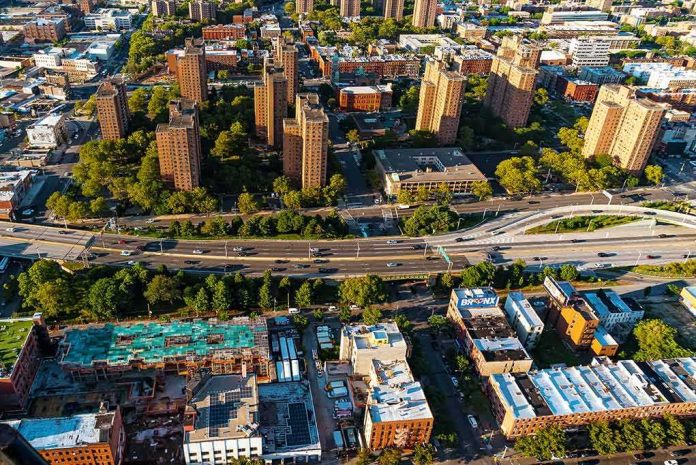
Residents near the Third Avenue Bridge, RFK Bridge, and Major Deegan Expressway report breathing heavier fumes from idling trucks.[3] The largest jump—1.29 micrograms per cubic meter—hit outside South Bronx Unite’s Mott Haven office, sandwiched between major truck corridors.[2] Advocates tie this to congestion pricing pushing vehicles outward, compounding the area’s preexisting asthma crisis.[1][2]
MTA and Officials Push Back on Causation
The Metropolitan Transportation Authority (MTA) rejects a direct link between congestion pricing and Bronx pollution spikes.[3] Agency data shows traffic volumes fell on the Cross Bronx Expressway and Major Deegan Expressway last spring, with over 10,000 fewer vehicles daily on these routes.[3] New York City health officials note overall air quality improved citywide since implementation.[3]
Critics of the study call its findings preliminary and unpublished, lacking peer review.[3] Officials plan a full evaluation this summer.[3] The MTA highlights $70 million in environmental mitigation investments to offset impacts.[2] These counterpoints challenge the activists’ rerouting narrative, as reduced highway traffic undercuts claims of diversion overload.[3]
Environmental Justice Echoes National Frustrations
This South Bronx dispute mirrors global congestion pricing rollouts in cities like London and Stockholm, where 73% saw PM2.5 rises of 0.1-0.5 micrograms per cubic meter in adjacent low-income areas during initial years.[1] U.S. pilots in Atlanta and Seattle triggered similar community backlash over pollution leakage to overburdened neighborhoods.[1]
South Bronx air quality worsened after NYC congestion pricing toll launched: report https://t.co/Fd99AbwQsH pic.twitter.com/F8UHobpAWR
— New York Post (@nypost) May 9, 2026
Americans across the political spectrum voice growing anger at federal and local elites crafting policies that promise broad benefits but deliver pain to everyday workers.[1][2] Conservatives decry globalist schemes hiking costs without accountability; liberals spotlight minority communities bearing the brunt.[3] Both see a pattern: distant bureaucrats prioritizing reelection over tangible relief, eroding faith in government competence.[1] The South Bronx fight underscores demands for solutions that lift all without sacrificing the vulnerable.
Whether full studies confirm causation or not, displaced truck fumes amplify health risks in a region already plagued by respiratory illness.[2] As New Yorkers await summer results, the episode fuels calls for transparent, equitable urban planning that doesn’t trade one community’s clean air for another’s.[3]
Sources:
[1] South Bronx air quality worsens during first year of congestion pricing
[2] South Bronx Unite study finds rising pollution from congestion tolls …