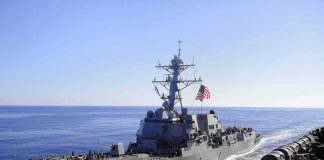
CENTCOM’s newly released strike footage is a blunt reminder that, when America is led to act decisively, Iran’s missile-and-drone terror toolkit can be smashed fast.
Quick Take
- Operation Epic Fury began March 1, 2026, and continued at least through March 5, with CENTCOM publishing combat video of precision hits.
- Pentagon briefers reported Iranian ballistic missile launches down 86% and one-way attack drone launches down 73% from the opening days.
- U.S. forces struck more than 2,000 regime targets and reported destroying more than 20 Iranian naval vessels, including a submarine torpedo sinking in the Indian Ocean.
- U.S. and Israeli officials said gains in air superiority enabled a shift from standoff weapons to closer “stand-in” precision strikes using JDAMs and Hellfires.
CENTCOM footage puts proof behind the Pentagon’s numbers
U.S. Central Command released additional combat footage showing precision strikes on Iranian military infrastructure, including mobile missile sites and aircraft inside hangars, under what officials have called “Operation Epic Fury.” The timeline in public reporting places the operation’s start on Saturday, March 1, 2026, with strikes continuing at least through March 5. The videos matter because they provide visual confirmation of target types and strike accuracy that press releases alone cannot.
Pentagon briefings on Wednesday, March 5, described measurable effects on Iran’s ability to keep launching. Gen. Dan Caine reported ballistic missile launches down 86% since the conflict began, including a 23% drop in the prior 24 hours, and one-way attack drone launches down 73% compared with the opening days. Officials also cited more than 2,000 targets struck. Those figures, while still high-level, are the clearest public accounting of operational momentum so far.
What triggered the campaign: mass missile and drone attacks across the region
Reporting describes Iran as initiating the latest escalation by launching more than 500 ballistic missiles and 2,000 drones at targets across the Middle East, including Gulf States, Israel, and U.S. bases. Several outlets characterized those attacks as indiscriminate and imprecise, with impacts beyond purely military sites. The human cost is not abstract: at least six American service members were reported killed in Kuwait, with additional personnel wounded, after some strikes penetrated defenses.
The scope of targeted countries and defenses underscores why the operation quickly became multinational in effect, even when U.S. and Israeli aircraft executed the main strikes. Regional partners referenced in coverage include Jordan, Bahrain, Saudi Arabia, the UAE, Qatar, Iraq, Kuwait, and Oman—nations that have had to defend their own populations and infrastructure while also hosting U.S. forces. The U.S. military response reportedly involved all branches, highlighting the scale of coordination and the pressure of sustained air defense.
Air superiority claims and a shift to closer, more precise strikes
As the operation continued, U.S. officials described a tactical shift from standoff munitions to “stand-in” precision strikes, including Joint Direct Attack Munitions and AGM-114 Hellfire missiles. The logic presented publicly is straightforward: improved freedom of action in contested airspace allows aircraft to operate closer to targets and apply precision effects more reliably. U.S. and Israeli statements also pointed to air superiority above Iran as a key enabler of that shift and sustained tempo.
That shift matters for conservatives focused on accountable use of force and clear objectives. Stand-in precision is generally discussed by the Pentagon as a way to reduce missed targets and limit wasted sorties when operating conditions allow it. At the same time, the public still lacks a full breakdown of what the “2,000 targets” represent, because target categories and battle damage assessments are often partly classified. Viewers should treat the released footage as illustrative, not exhaustive, evidence.
Sea power and deterrence: naval losses and America’s “global reach” message
The March 5 briefings also highlighted maritime results: officials said more than 20 Iranian naval vessels were destroyed. One incident drew special attention—a U.S. Navy fast-attack submarine reportedly sank an Iranian vessel in the Indian Ocean with a torpedo, described as the first such sinking since World War II. Gen. Caine framed it as a demonstration of America’s ability to find and strike an “out-of-area deployer,” reinforcing deterrence beyond the immediate theater.
WATCH: US CENTCOM Releases More Footage of Strikes on Iranian Missile and Drone Sites (VIDEOS) https://t.co/iwmbMyrUXL #gatewaypundit via @gatewaypundit
— Fearless45 (@Fearless45Trump) March 5, 2026
Think-tank analysis cited in reporting argued the strategy aims to crush missile launch capacity before defensive interceptor stockpiles become strained, shifting the burden from “catching” incoming threats to preventing launches in the first place. That is a practical approach when adversaries rely on saturation tactics with drones and missiles. What remains unclear from public reporting is how much capability Iran retains, how quickly it can reconstitute launchers, and what political end state leaders seek.
Sources:
https://www.jpost.com/middle-east/iran-news/article-888847
https://www.stripes.com/theaters/middle_east/2026-03-01/weapons-iran-20922986.html