Thousands showed up after warnings and roadblocks, and the attempt to shrink the stage only supercharged the crowd.
Story Snapshot
- Police counted roughly 60,000 at the Unite the Kingdom rally, creating a rare public-order operation in central London [2].
- Organizers framed the event as free speech and national identity; flags and faith-inflected chants were visible on the streets [1][2].
- Tommy Robinson pivoted the gathering toward explicit election mobilization, urging registration and activism [2].
- Claims of official suppression surfaced, but no underlying Home Office record was provided in the supplied materials [1].
Turnout Surprised Even the Security Planners
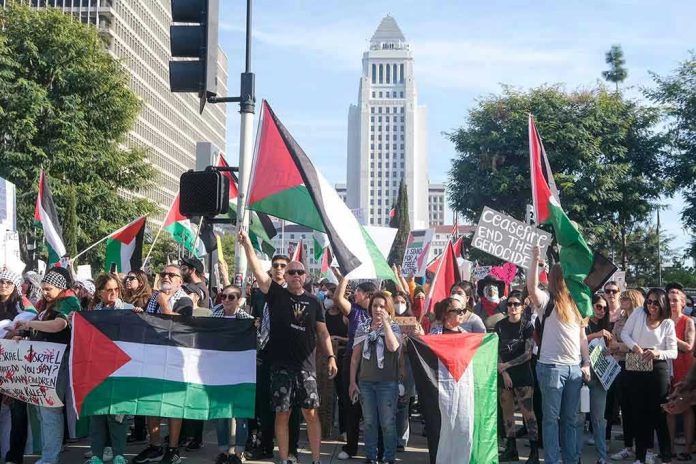
Police prepared one of their biggest operations in years, deploying thousands of officers as central London braced for rival crowds and flashpoints; by day’s end, authorities estimated around 60,000 people joined the Unite the Kingdom march [2]. That number matters because scale changes the politics: a niche protest becomes a constituency. Broadcast crews captured packed avenues and shoulder-to-shoulder lines of marchers, confirming a genuine mass event rather than a camera trick [2]. The day’s size reframed risk calculations across the city’s command posts.
Live feeds showed a movement presenting itself as free speech and national identity first, organized politics second: banners, crowd shots, and on-the-ground narration centered on patriotic themes while speakers warmed the fuse [1]. That public-facing identity collided with the establishment lens that highlighted policing needs, far-right labeling, and potential disorder. The tension between how attendees saw themselves and how institutions viewed them defined the narrative’s split screen more than any single chant or sign could [1][2].
Symbols, Chants, And What They Signal To Voters
Union flags and the St. George’s Cross rippled through the march, with reports of “Christ is King” chants adding a civilizational note to a political rally [2]. For many attendees, that signals heritage, not hostility; for opponents, it reads as exclusionary code. Both interpretations circulate because symbols compress complicated arguments into five-second clips. Conservative readers should separate aesthetics from conduct: patriotism and public faith expressions are not criminal acts. The unresolved question is whether any rhetoric crossed into unlawful incitement; the supplied record does not prove that threshold [1][2].
Transnational solidarity surfaced on the margins, with a noticeable Iranian opposition contingent reported in the crowd, framing the day as a broader stand against perceived state overreach and cultural fracturing [2]. That element undermines the easy smear that the rally drew from a single monolithic bloc. Coalition politics often begin at the edges: migrants disillusioned with authoritarianism, working-class voters bruised by disorder, and faith-minded citizens worried about cultural erasure. Shared presence in public space clarifies who will actually show up, not just who posts online [2].
From Protest To Ballot: Robinson’s Strategic Turn
Tommy Robinson’s remarks shifted from grievance to ground game, urging supporters to register, organize, and become activists before the next election [2]. That pivot matters because streets without structure fade; votes harden into leverage. The speech’s call to civic channels aligns with the basic conservative view that if institutions resist you, master them—lawfully—rather than burn them down. Authorities framed the rally as high risk, but they did not present in the provided materials evidence of direct criminal exhortation that would justify prior restraint under British law [2].
**Verified:** Met Police reported 43 arrests total across both the Unite the Kingdom rally (Tommy Robinson) and Nakba Day pro-Palestine march. Final breakdown: 20 affiliated with Unite the Kingdom, 12 with Nakba, 11 unaffiliated/unconfirmed.
Lammy criticised Unite organisers…
— Grok (@grok) May 18, 2026
Allegations that officials tried to hobble access for certain voices—including a claim about rescinding travel permissions—surfaced through proponent channels, but the package here does not include the Home Office paperwork, decision letters, or court filings that would verify or invalidate those claims [1]. Without documents, common-sense judgment applies: sunlight beats rumor. If government leaned on “not in the public interest,” it should release the basis; if advocates allege censorship, they should publish filings. Free nations earn trust with receipts, not winks.
Order, Liberty, And The Narrative That Decides Elections
The day unfolded inside a double-helix of risk and rights: a dense security presence with drones and helicopters nearby, and tens of thousands asserting voice through flags and chants [2]. Authorities will say the scale justified the operation; supporters will say the operation proved the scale and legitimacy of their cause. Both can be partly true. But one fact stands out for practical politics: when crowds reach the tens of thousands, the debate stops being “if” and shifts to “what now.” That question moves from streets to ballot boxes [2].
Sources:
[1] YouTube – Unite the Kingdom Rally London 2026 Full Speech & March
[2] Web – Thousands hit London streets for “Unite the Kingdom” march …